Indiana Social Studies GHW.2.2
The Standard
Analyze and assess the rise of fundamentalist movements in the world’s major religions during contemporary times (1980–present), and describe the relationships between religious fundamentalism, extremism, secularism, and modernism associated with the Western tradition.
2026 Indiana Academic Standards: K-12 Social Studies
Teacher's field guide
What This Standard Means
What Students Need to Do
- Students use dated events to explain how religious movements gained political influence after 1980. They compare calls for strict religious authority with secular government and modernist views. They distinguish those calls from threats and violence.
What Mastery Looks Like
- A student can explain how political conditions helped two movements gain support. They can point to evidence of strict religious beliefs, then identify separately any evidence of coercion or violence. They do not apply one movement’s actions to an entire religion.
Common Misconceptions
- Students may treat all devout people as fundamentalists and all fundamentalists as violent. They may think secular government bans worship. They may use modernism to mean anything new, rather than a response to modern ideas.
How to Assess It
- Exit ticket: "In 1980, the Moral Majority rallied voters who opposed abortion and limits on school prayer." Give one reason it gained support, then explain why organizing voters alone does not prove violent extremism.
Lesson moves
Ways to Teach It
Give groups cards on the 1980 Moral Majority, 1992 Babri Masjid demolition, and 1996 Taliban takeover; have them order the cards and note political context.
Ask, "Can a movement seek religious rules in government without endorsing violence?" Have partners cite a sentence from a case card.
Read four short claims aloud; teams sort them as secular law, modernist interpretation, strict religious authority, or coercion, then justify two choices.
Show a local school calendar marking religious holidays; students draft an attendance rule that respects worship without requiring it.
Free download
Printable GHW.2.2 Worksheet
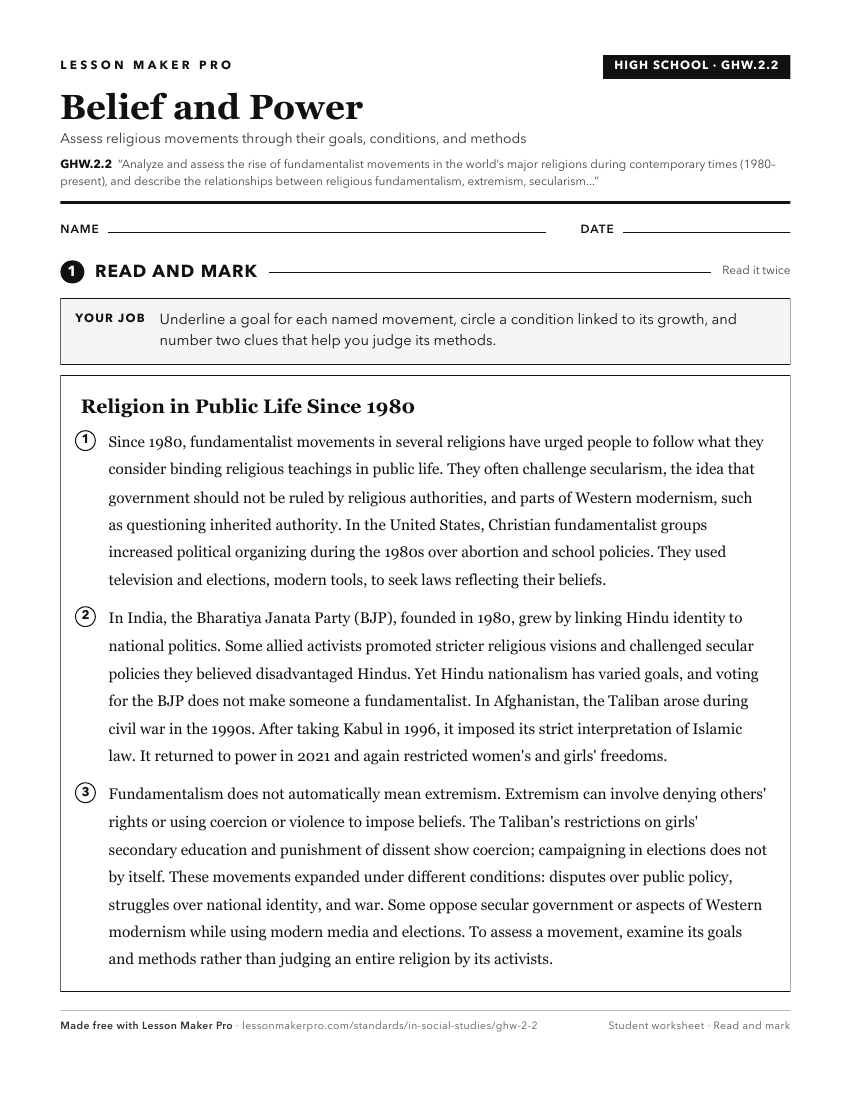
A ready-to-print activity worksheet aligned to GHW.2.2, with an answer key for the teacher on its own page. No account needed.
PDF, US Letter, prints cleanly in black and white.
Download the worksheetKeep exploring
Related Standards
- WH.4.2
Analyze the factors that led to the origin and spread of the Protestant Reformation, the Catholic Counter-Reformation, as well as reforming movements in other r...
- GHW.2.1
Map the development over time of world religions from their points of origin, and identify those that exhibit a high degree of local and/or international concen...
- WH.2.1
Review the development and fundamental beliefs and features of major world religions and philosophies, including Hinduism, Buddhism, Sikhism, Judaism, Christian...
- 7.H.2
Describe, compare, and contrast the historical origins, central beliefs and features, and spread of major religions, including Hinduism, Buddhism, Judaism, Chri...
Turn this exact standard into a lesson
Grade, subject, topic, and the complete standard are prefilled. Create one free, no account needed.
Also for this standard:Make a WorksheetMake a QuizMake a Sub Lesson