Indiana Social Studies WG.5.3
The Standard
Describe how and why the ability of people to use Earth’s resources to feed themselves has changed over time.
2026 Indiana Academic Standards: K-12 Social Studies
Teacher's field guide
What This Standard Means
What Students Need to Do
- Students compare how people grew and obtained food from 1500 to 1900. They explain how new crops, farming methods, transport, and control of land changed who could feed themselves.
What Mastery Looks Like
- Students use dates and evidence to connect new crops or tools to bigger harvests and railroads to wider food markets. They can explain why people without land or money might still go hungry.
Common Misconceptions
- Students may think new crops reached every region at once or that bigger harvests ended hunger. They may overlook how land ownership and the cost of food shaped who could eat.
How to Assess It
- Exit ticket: “Potatoes reached Europe from the Americas after 1500. By the 1800s, railroads carried food farther.” Explain one change in food access and one reason people could still go hungry.
Lesson moves
Ways to Teach It
Give pairs a world map and potato, maize, and wheat cards; have them draw crop routes and label one change in local diets.
Ask students to write two reasons a family might go hungry even when nearby farms produce more food.
Hand out cards showing irrigation, new crops, and railroads; have teams match each one to a change in growing or moving food.
Show a supermarket produce label with its country of origin; have students map the trip and compare it with food transport in 1700.
Free download
Printable WG.5.3 Worksheet
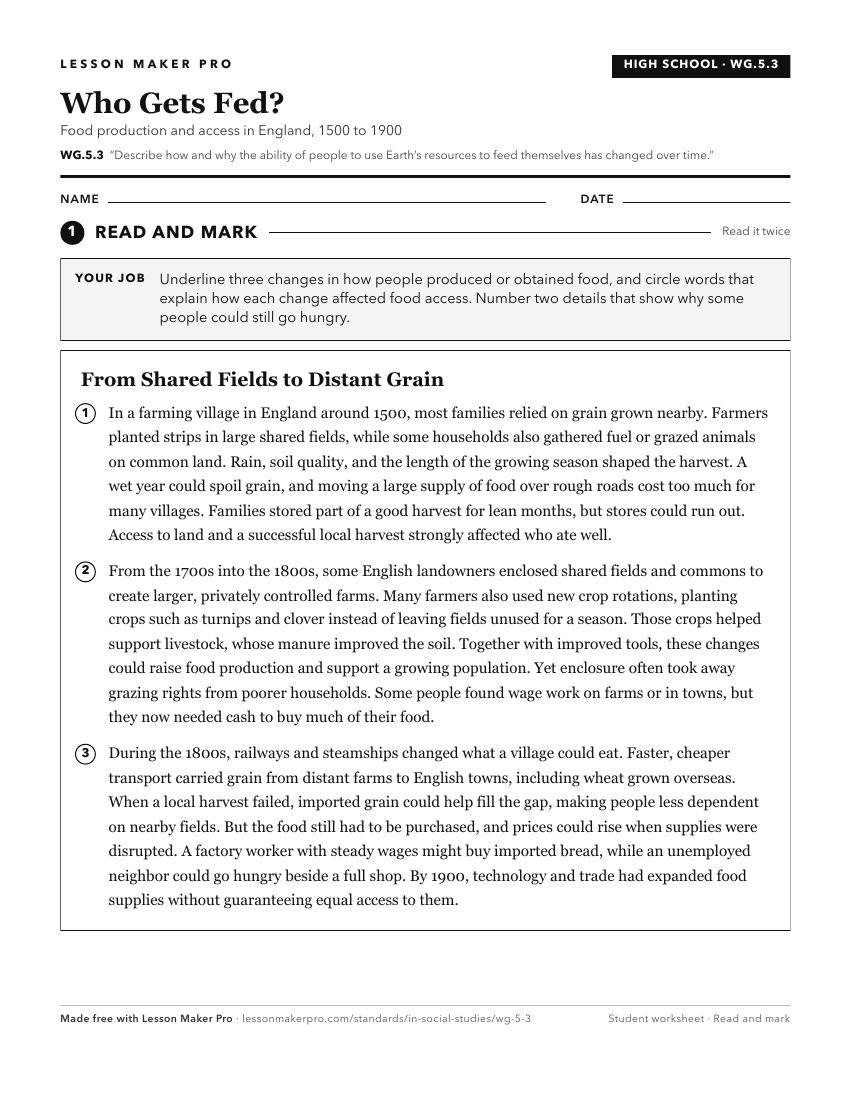
A ready-to-print activity worksheet aligned to WG.5.3, with an answer key for the teacher on its own page. No account needed.
PDF, US Letter, prints cleanly in black and white.
Download the worksheetKeep exploring
Related Standards
- WG.5.4
Identify patterns of world resource distribution and utilization, and explain the impacts of using renewable and nonrenewable resources.
- GHW.8.1
Use maps to show the location and distribution of Earth’s resources, and analyze how this distribution changes over time and affects trade among countries, regi...
- GHW.3.4
Give examples of and evaluate how the physical and human environments in different regions have changed over time due to significant population growth or declin...
- S.8.1
Describe how and why societies change over time.
Turn this exact standard into a lesson
Grade, subject, topic, and the complete standard are prefilled. Create one free, no account needed.
Also for this standard:Make a WorksheetMake a QuizMake a Sub Lesson