Indiana Social Studies WG.4.10
The Standard
Describe and locate on maps the worldwide occurrence of the three major economic systems (traditional, command, and market) and describe the characteristics of each.
2026 Indiana Academic Standards: K-12 Social Studies · Economic Interdependence (Globalization)
Teacher's field guide
What This Standard Means
What Students Need to Do
- Students find places where custom, state plans, and prices guide work and trade. They explain who decides what gets produced in each place. They recognize that most economies combine these approaches.
What Mastery Looks Like
- A student maps Yanomami communities in the Amazon and Maasai herders in East Africa as examples of customary practices. They locate North Korea for state planning and the United States and Japan for markets. They can explain the main production decisions in each case without treating any place as a pure example.
Common Misconceptions
- Students often label an entire country as purely traditional, command, or market. They may assume traditional economies never use money or that any government rule makes an economy a command economy.
How to Assess It
- On a blank map, mark the Yanomami region in northern Brazil, North Korea, and the United States. Beside each, name who mainly decides what to produce, then explain why the United States is not a pure market economy.
Lesson moves
Ways to Teach It
Give pairs a blank map and case cards about Yanomami gardening, Maasai herding, North Korean factories, and U.S. stores; have them pin each.
Ask, 'Who decides how many shoes a North Korean factory makes versus a U.S. shoe company, and where do laws still matter?'
Have pairs sort six slips describing herd sharing, state crop quotas, and store restocking by the kind of decision each shows.
Use a local grocery flyer to trace how shoppers' choices and prices shape what the store orders next week.
Free download
Printable WG.4.10 Worksheet
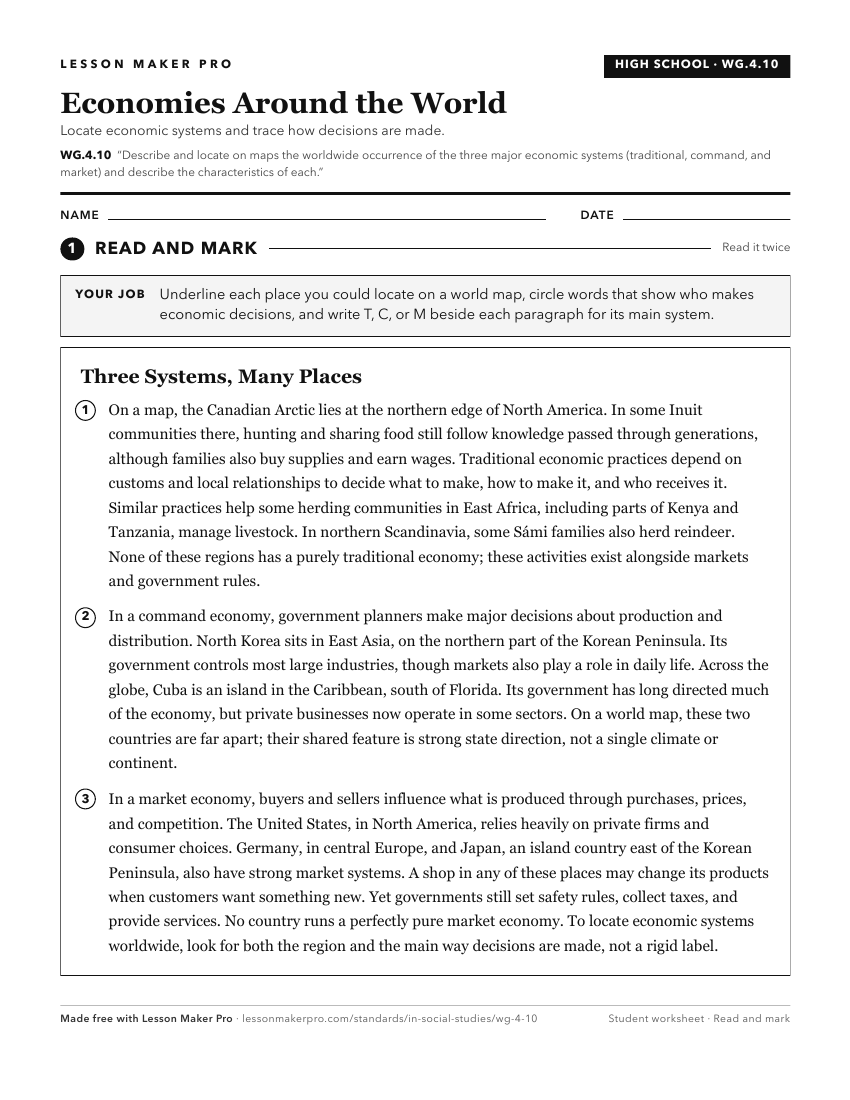
A ready-to-print activity worksheet aligned to WG.4.10, with an answer key for the teacher on its own page. No account needed.
PDF, US Letter, prints cleanly in black and white.
Download the worksheetKeep exploring
Related Standards
- E.1.6
Describe and compare the various economic systems (i.e., traditional, market, command, mixed, feudal, mercantile) and explain their strengths and weaknesses.
- GE.2.3
Evaluate the strengths and weaknesses of various economic systems.
- 6.E.4
Describe how different economic systems (traditional, command, market, and mixed) in Europe and the Americas answer the basic economic questions on what to prod...
- GE.2.1
Describe the various economic systems such as a free market, a command economy, or a mixed economy.
Turn this exact standard into a lesson
Grade, subject, topic, and the complete standard are prefilled. Create one free, no account needed.
Also for this standard:Make a WorksheetMake a QuizMake a Sub Lesson