Indiana Social Studies 6.E.4
The Standard
Describe how different economic systems (traditional, command, market, and mixed) in Europe and the Americas answer the basic economic questions on what to produce, how to produce, and for whom to produce.
2026 Indiana Academic Standards: K-12 Social Studies
Teacher's field guide
What This Standard Means
What Students Need to Do
- Students explain who decides what goods to make, how to make them, and who receives them. They compare decisions based on custom, government plans, prices, or a mix of these in Europe and the Americas.
What Mastery Looks Like
- Given a short case, students can name the best-fitting system and explain all three decisions. They can compare a Soviet-era state farm with a present-day U.S. grocery store and point out where government rules and market choices overlap.
Common Misconceptions
- Students may think a market system has no government rules or that a mixed system is an equal split. They may assume people in traditional systems never trade, or that a command system gives everyone the same goods.
How to Assess It
- Exit ticket: A Soviet-era state farm follows government crop quotas. A U.S. grocery store sets prices but follows food rules. Name the best-fitting system for each, then explain who decides what to produce, how to produce it, and who gets it.
Lesson moves
Ways to Teach It
Give groups seed, worker, and customer cards; have them allocate food using family custom, state orders, prices, then prices plus safety rules.
Ask, 'Who decides what to grow on a Soviet-era state farm versus a present-day U.S. farm, and how do harvests reach people?'
Have students move to four labeled corners as you read: ancestral planting calendar, Soviet quota, price-led sales, and regulated store sales.
Give students a grocery receipt and a SNAP flyer; ask how prices and public benefits affect who can buy food.
Free download
Printable 6.E.4 Worksheet
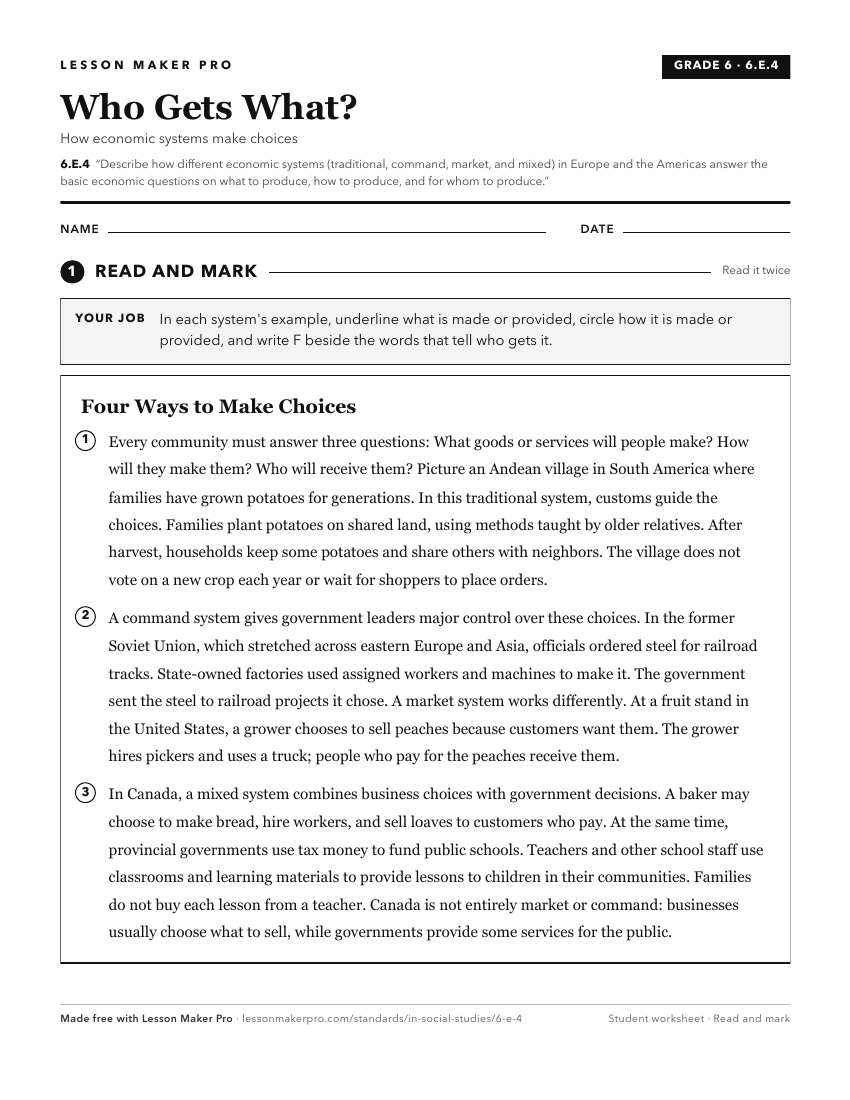
A ready-to-print activity worksheet aligned to 6.E.4, with an answer key for the teacher on its own page. No account needed.
PDF, US Letter, prints cleanly in black and white.
Download the worksheetKeep exploring
Related Standards
- E.1.6
Describe and compare the various economic systems (i.e., traditional, market, command, mixed, feudal, mercantile) and explain their strengths and weaknesses.
- GE.2.2
Identify questions that must be answered by any economic system and how they are categorized by how they answer the basic economic questions.
- WG.4.10
Describe and locate on maps the worldwide occurrence of the three major economic systems (traditional, command, and market) and describe the characteristics of ...
- GE.2.1
Describe the various economic systems such as a free market, a command economy, or a mixed economy.
Turn this exact standard into a lesson
Grade, subject, topic, and the complete standard are prefilled. Create one free, no account needed.
Also for this standard:Make a WorksheetMake a QuizMake a Sub Lesson