Indiana Social Studies WG.3.3
The Standard
Describe the world patterns of natural vegetation and biodiversity and their relations to world climate patterns.
2026 Indiana Academic Standards: K-12 Social Studies
Teacher's field guide
What This Standard Means
What Students Need to Do
- Students use maps to find where rainforests, grasslands, deserts, and tundra occur. They explain how temperature and rainfall affect plant cover and the variety of living things.
What Mastery Looks Like
- Given climate data for two places, a student predicts the likely vegetation and which place has greater biodiversity. They support both predictions with rainfall, temperature, and map evidence.
Common Misconceptions
- Students may think every hot place has a rainforest, even where rain is scarce. They may also mistake biodiversity for the number of plants, rather than the variety of living things.
How to Assess It
- Give students two locations: A averages 27°C and 220 cm of rain yearly; B averages 27°C and 15 cm. Ask them to name likely vegetation, identify which has greater biodiversity, and explain why.
Lesson moves
Ways to Teach It
Stack clear climate, vegetation, and biodiversity maps; trace the Amazon, Sahara, and Siberia, then note where patterns match.
Ask: Why does the Amazon have more kinds of living things than the Sahara, even though both are hot? Use map evidence.
Give pairs climate cards with rainfall and temperature data; have them match each card to a vegetation photo and defend their choice.
Find a cocoa-growing region on a world map; use rainfall and vegetation maps to explain its location and nearby forest biodiversity.
Free download
Printable WG.3.3 Worksheet
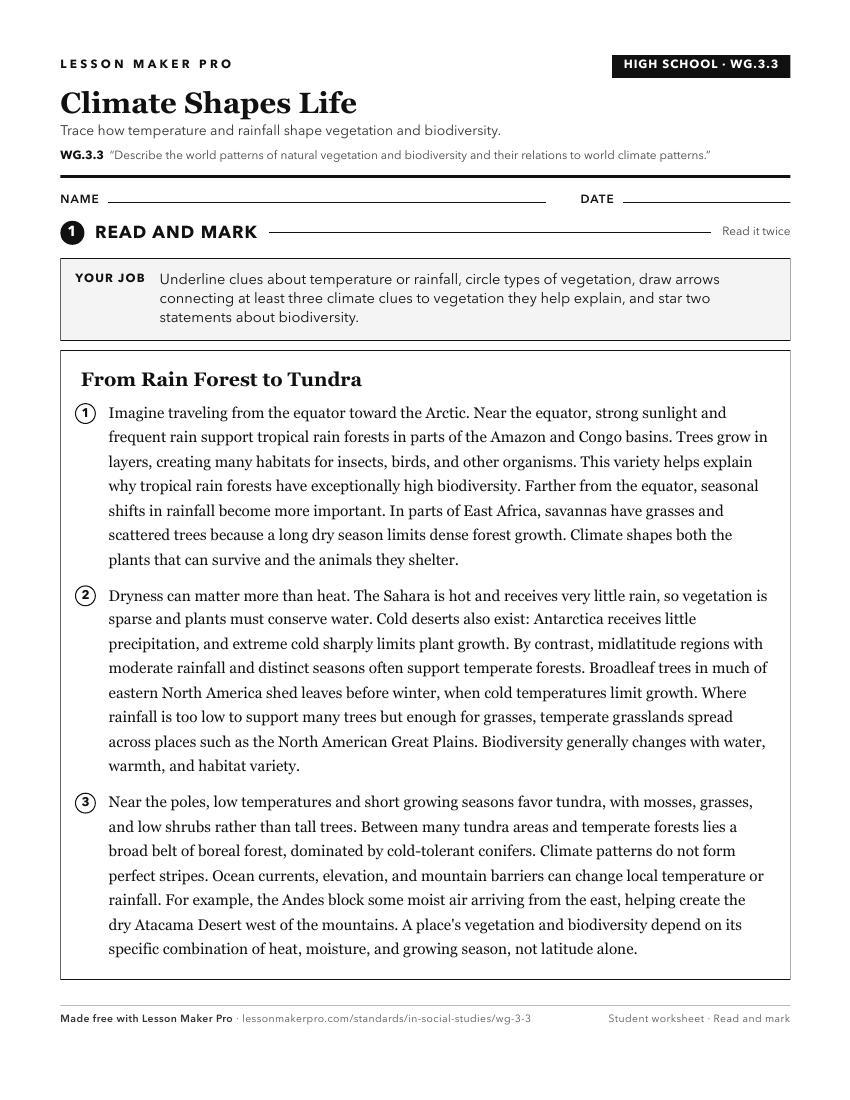
A ready-to-print activity worksheet aligned to WG.3.3, with an answer key for the teacher on its own page. No account needed.
PDF, US Letter, prints cleanly in black and white.
Download the worksheetKeep exploring
Related Standards
- WG.5.4
Identify patterns of world resource distribution and utilization, and explain the impacts of using renewable and nonrenewable resources.
- GHW.12.1
Analyze global climate change forecasts for different parts of Earth and the implications of these changes for humans.
- 3.G.8
Identify and describe how human activities and natural systems affect the local environment.
- WG.3.2
Identify and account for the distribution pattern of the world’s climates, taking into account the Earth/Sun relationship, ocean currents, prevailing winds, and...
Turn this exact standard into a lesson
Grade, subject, topic, and the complete standard are prefilled. Create one free, no account needed.
Also for this standard:Make a WorksheetMake a QuizMake a Sub Lesson