Indiana Social Studies USG.4.1
The Standard
Analyze powers the United States Constitution gives to the executive, legislative, and judicial branches of government in the area of foreign affairs and how they have changed over time.
2026 Indiana Academic Standards: K-12 Social Studies · Students understand the nature of citizenship, politics, and governments, understanding the rights and responsibilities of citizens and how these are part of local, state, and national government. Students examine how the United States Constitution protects rights and provides the structure and functions of various levels of government. Students examine how the United States interacts with other nations as well as the government's role in world affairs will be examined.
Teacher's field guide
What This Standard Means
What Students Need to Do
- Students identify what the president, Congress, and courts can do in foreign affairs. They compare those powers with how the branches have used them over time.
What Mastery Looks Like
- Students can explain why the Senate votes on treaties the president negotiates and how courts can limit a president's wartime actions. They can distinguish Congress's 1941 war declaration from its 2001 authorization for force.
Common Misconceptions
- Students often think the president can declare war or approve a treaty alone. They may mistake an authorization for force for a formal war declaration, or assume courts cannot review wartime actions.
How to Assess It
- Exit ticket: Compare Congress's 1941 war declaration with its 2001 authorization for force. Name the president's role in each, then give one example of a court checking a wartime action.
Lesson moves
Ways to Teach It
Give groups cards for treaty negotiations, Senate approval, a war declaration, and the Youngstown ruling; have them sort the cards by branch.
Ask: Why did Congress declare war in 1941 but authorize force in 2001 without a formal declaration?
Read four foreign affairs scenarios aloud; teams raise president, Congress, or courts signs and name the power behind each choice.
Put a recent White House ambassador nomination beside its Senate confirmation vote; ask students to mark each branch's action.
Free download
Printable USG.4.1 Worksheet
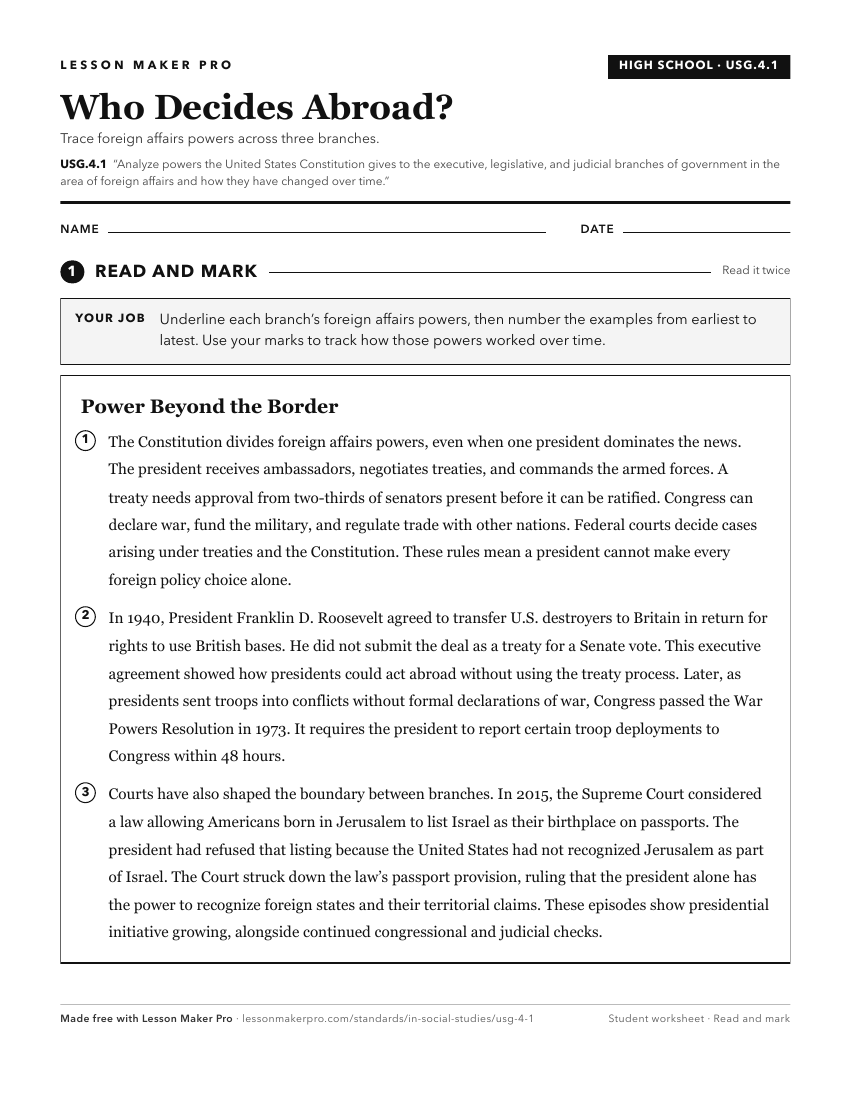
A ready-to-print activity worksheet aligned to USG.4.1, with an answer key for the teacher on its own page. No account needed.
PDF, US Letter, prints cleanly in black and white.
Download the worksheetKeep exploring
Related Standards
- USG.1.3
Interpret and analyze the constitutional purposes and functions of government found in the Preamble of the United States Constitution.
- USG.3.1
Analyze the United States Constitution, and explain characteristics of government in the United States, which define it as a federal, presidential, constitution...
- USG.2.3
Analyze and interpret central ideas on government, individual rights, and the common good in founding documents of the United States.
- 8.C.2
Compare and contrast the delegated, reserved, and concurrent powers (division of power or federal system) contained in the United States Constitution.
Turn this exact standard into a lesson
Grade, subject, topic, and the complete standard are prefilled. Create one free, no account needed.
Also for this standard:Make a WorksheetMake a QuizMake a Sub Lesson