Indiana Social Studies USG.3.9
The Standard
Explain presidential elections and executive power by examining the presidency, including, but not limited to, election, exercise of presidential powers, and the President's relationship with Congress and influence over implementation of their laws through the Cabinet and executive agencies.
2026 Indiana Academic Standards: K-12 Social Studies · Students understand the nature of citizenship, politics, and governments, understanding the rights and responsibilities of citizens and how these are part of local, state, and national government. Students examine how the United States Constitution protects rights and provides the structure and functions of various levels of government. Students examine how the United States interacts with other nations as well as the government's role in world affairs will be examined.
Teacher's field guide
What This Standard Means
What Students Need to Do
- Use state election results and electoral votes to explain how a president is chosen. Explain how presidents use powers such as vetoes and appointments, how Congress checks those powers, and how agencies carry out laws.
What Mastery Looks Like
- Given an electoral map, students can total the votes and identify the winner, even when that person loses the national popular vote. They can explain how Congress can override a veto and how a president can direct an agency within the limits of a law.
Common Misconceptions
- Students may think the national popular vote directly decides the election or that every state has the same number of electoral votes. They may think an executive order creates a new law or that agencies can ignore laws passed by Congress.
How to Assess It
- Exit ticket: Candidate A wins the popular vote, but Candidate B earns 270 electoral votes. Who becomes president, and what is one way that president and Congress could each shape how the EPA carries out a clean air law?
Lesson moves
Ways to Teach It
Give pairs a printed electoral map with state winners and vote totals; have them add each candidate's electoral votes and mark the winner.
Ask, 'Can a president make a law alone?' Students write three sentences using Congress, a veto, and an agency.
Play a card match: students pair veto, veto override, Senate confirmation, and agency rule with the person or group responsible.
Compare a Clean Air Act excerpt with an EPA rule fact sheet; students underline Congress's requirement and circle the agency's implementation choice.
Free download
Printable USG.3.9 Worksheet
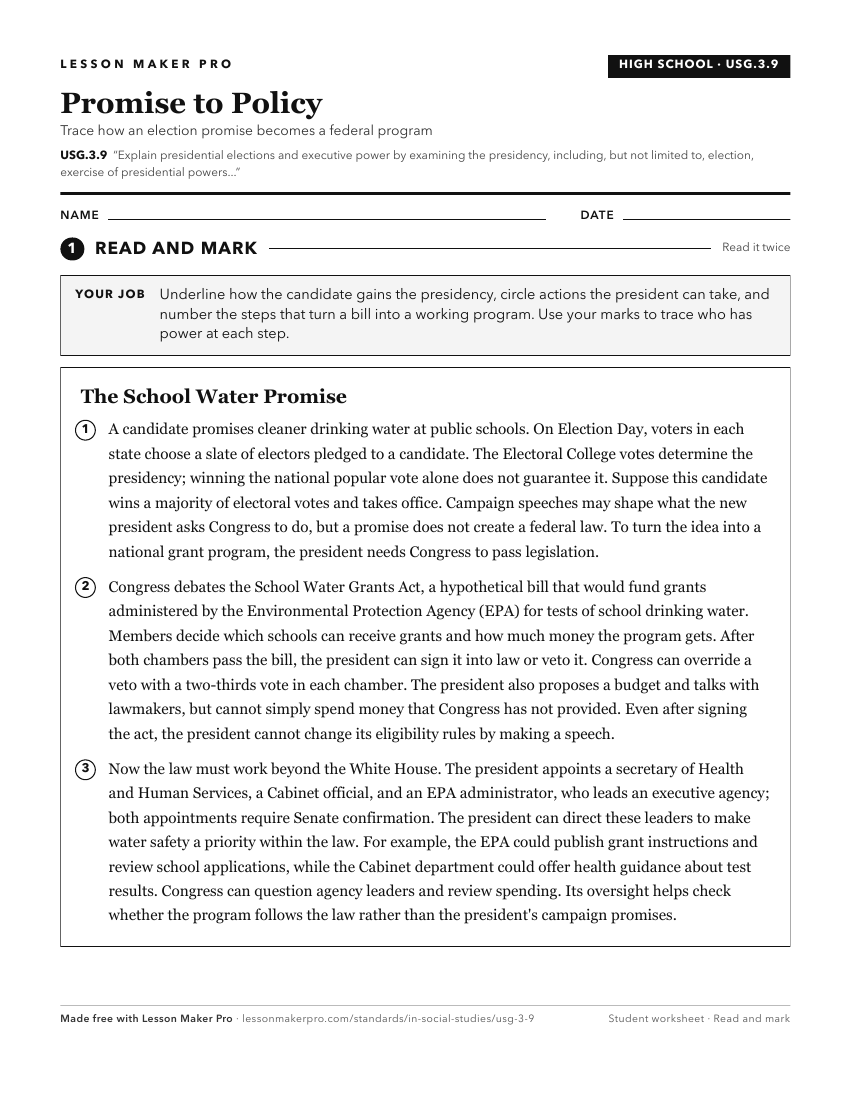
A ready-to-print activity worksheet aligned to USG.3.9, with an answer key for the teacher on its own page. No account needed.
PDF, US Letter, prints cleanly in black and white.
Download the worksheetKeep exploring
Related Standards
- USH.7.3
Evaluate the presidential administrations from Reagan to the present, including domestic and foreign policy, programs, and legal rulings.
- USH.6.7
Evaluate the presidential administrations from Truman to Carter, including domestic and foreign policy, programs, and legal rulings.
- 5.C.4
Describe the primary and general election processes for local, state, and federal offices, including those used to select congressional and presidential office ...
- USG.4.1
Analyze powers the United States Constitution gives to the executive, legislative, and judicial branches of government in the area of foreign affairs and how th...
Turn this exact standard into a lesson
Grade, subject, topic, and the complete standard are prefilled. Create one free, no account needed.
Also for this standard:Make a WorksheetMake a QuizMake a Sub Lesson