Indiana Social Studies USG.3.12
The Standard
Explain and evaluate the original purpose and role of the Electoral College and its relevance today.
2026 Indiana Academic Standards: K-12 Social Studies · Students understand the nature of citizenship, politics, and governments, understanding the rights and responsibilities of citizens and how these are part of local, state, and national government. Students examine how the United States Constitution protects rights and provides the structure and functions of various levels of government. Students examine how the United States interacts with other nations as well as the government's role in world affairs will be examined.
Teacher's field guide
What This Standard Means
What Students Need to Do
- Students explain why the founders chose state-appointed electors as a compromise between having Congress choose the president and holding a national popular vote. They compare that plan with how presidential elections work now and judge whether the system still works well.
What Mastery Looks Like
- A student can explain how a state gets its number of electors and tally an election using winner-take-all rules. They can use the results to support a claim about whether the system represents voters fairly today.
Common Misconceptions
- Students may think voters directly elect the president or that every state divides its electors in proportion to its vote. They may assume the national popular-vote winner always wins. Some think electors were originally meant to follow party pledges, as they generally do now.
How to Assess It
- Exit ticket: Under winner-take-all rules, A wins 51 to 49 in a state with 6 electors, while B wins 90 to 10 in a state with 4. Name the popular-vote and electoral-vote winners, then give one original reason for the system and one argument about using it today.
Lesson moves
Ways to Teach It
Give pairs three state cards: 6 electors, A51 B49; 4 electors, A10 B90; 3 electors, A51 B49. Count electoral and popular votes.
Ask: Should a candidate win the presidency after losing the national popular vote? Defend your answer using the original compromise and a concern today.
Reuse the three state cards; change one state's winner by two votes, and have teams race to recalculate both totals.
Show Pennsylvania and California on a 2024 election map; have students explain why a close state can draw more campaign visits.
Free download
Printable USG.3.12 Worksheet
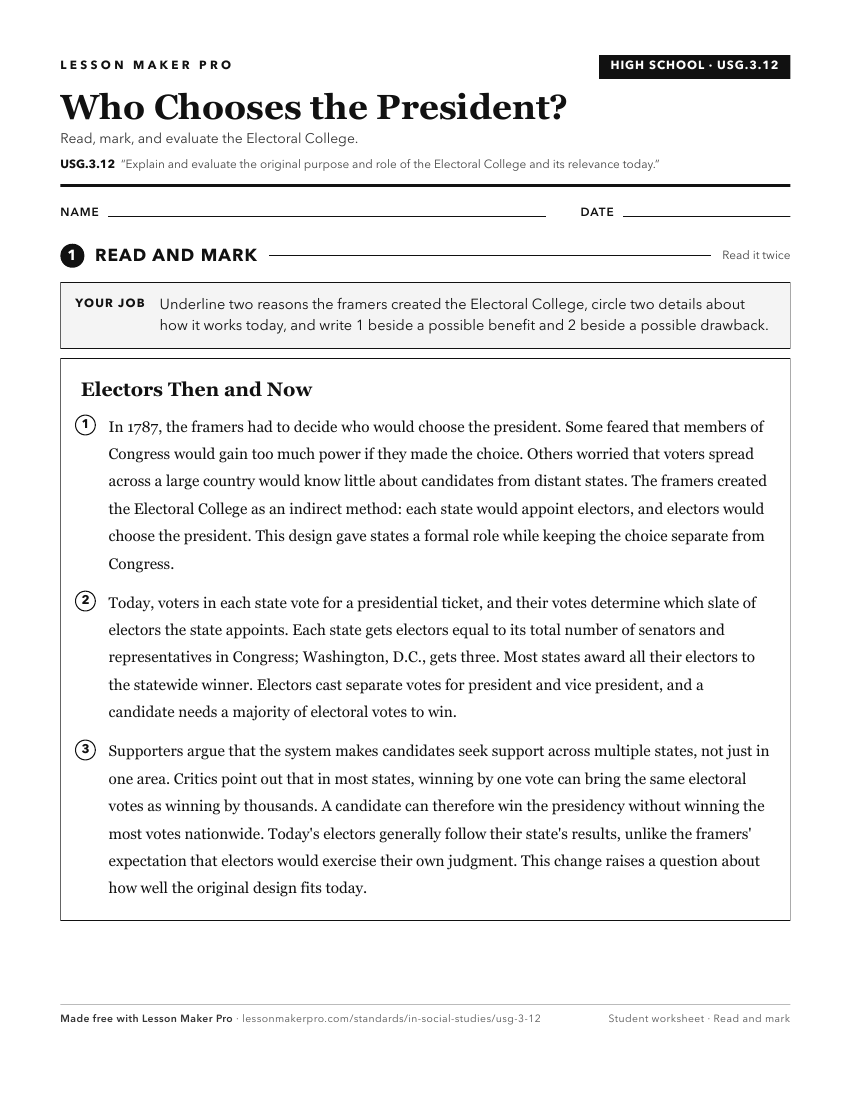
A ready-to-print activity worksheet aligned to USG.3.12, with an answer key for the teacher on its own page. No account needed.
PDF, US Letter, prints cleanly in black and white.
Download the worksheetKeep exploring
Related Standards
- USG.1.3
Interpret and analyze the constitutional purposes and functions of government found in the Preamble of the United States Constitution.
- 5.H.16
Explain why the first American political parties developed, and analyze the impact political parties had on early presidential elections.
- 5.H.14
Explain why the United States Constitution was created in 1787 and how it established a stronger union among the original 13 states by making it the supreme law...
- USG.3.8
Explain the electoral process in terms of election laws and election systems on the national, state, and local level.
Turn this exact standard into a lesson
Grade, subject, topic, and the complete standard are prefilled. Create one free, no account needed.
Also for this standard:Make a WorksheetMake a QuizMake a Sub Lesson