Indiana Social Studies USG.3.10
The Standard
Examine the progression of political parties and their ideologies and the broad political spectrum in the American governmental system, and analyze their functions in elections and government at federal, state, and local levels.
2026 Indiana Academic Standards: K-12 Social Studies · Students understand the nature of citizenship, politics, and governments, understanding the rights and responsibilities of citizens and how these are part of local, state, and national government. Students examine how the United States Constitution protects rights and provides the structure and functions of various levels of government. Students examine how the United States interacts with other nations as well as the government's role in world affairs will be examined.
Teacher's field guide
What This Standard Means
What Students Need to Do
- Trace how U.S. political parties and their positions have changed over time. Place policy views on a broad political spectrum. Explain how parties help candidates win elections and work together in federal, state, and local government.
What Mastery Looks Like
- Students can use two dated platform excerpts to show how a party's position changed. They can place a policy claim on a spectrum without assuming every party member agrees. They can name a party's role in an election and a role it plays after the election.
Common Misconceptions
- Students may assume today's party positions have always been the same. They may think everyone in a party agrees on every issue, or that parties matter only in presidential elections.
How to Assess It
- Exit ticket: In 1932, Democrats called for federal spending cuts; recent Democrats have supported more spending on health programs. Place those views on a spending spectrum, explain what changed, and name one party role in a state election and one in Congress.
Lesson moves
Ways to Teach It
Give pairs 1932 and 2024 Democratic platform excerpt cards; have them highlight spending claims and place the cards on a timeline and spectrum.
Ask students to write two sentences answering: Why might a voter agree with one party on taxes but disagree with it on immigration?
Play a card sort: match mayoral endorsements, governor recruitment, and House committee chairs to government levels and election or governing roles.
Open the latest county sample ballot; circle party labels in federal, state, and local races, then note any races without labels.
Free download
Printable USG.3.10 Worksheet
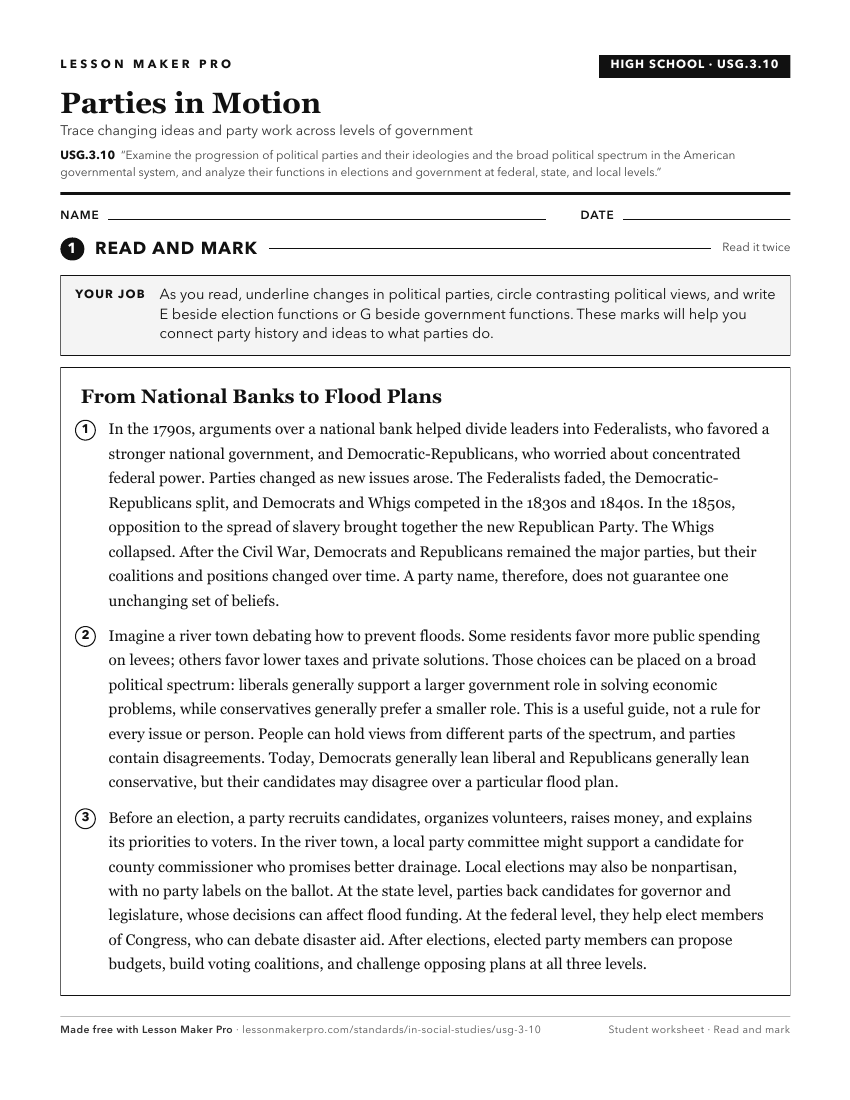
A ready-to-print activity worksheet aligned to USG.3.10, with an answer key for the teacher on its own page. No account needed.
PDF, US Letter, prints cleanly in black and white.
Download the worksheetKeep exploring
Related Standards
- 5.C.7
Examine ways by which citizens may effectively voice opinions, monitor government, and bring about change in government, including voting and participation in t...
- 8.C.6
Explain ways that citizens can participate in the election process (e.g., political parties, campaigns, and elections) at the federal, state, and local levels.
- USG.3.11
Analyze the functions of political parties in elections and government at national, state, and local levels of the federal system.
- 5.H.16
Explain why the first American political parties developed, and analyze the impact political parties had on early presidential elections.
Turn this exact standard into a lesson
Grade, subject, topic, and the complete standard are prefilled. Create one free, no account needed.
Also for this standard:Make a WorksheetMake a QuizMake a Sub Lesson