Indiana Social Studies USG.2.1
The Standard
Analyze how colonial, revolutionary, and Founding Era events helped to inform the Framers on the design, ratification, and implementation of the United States Constitution (1787) and the Bill of Rights (1791).
2026 Indiana Academic Standards: K-12 Social Studies · Students understand the nature of citizenship, politics, and governments, understanding the rights and responsibilities of citizens and how these are part of local, state, and national government. Students examine how the United States Constitution protects rights and provides the structure and functions of various levels of government. Students examine how the United States interacts with other nations as well as the government's role in world affairs will be examined.
Teacher's field guide
What This Standard Means
What Students Need to Do
- Students connect colonial protests, the Revolution, and problems under the Articles of Confederation to choices made at the Constitutional Convention. They explain how ratification debates led to the Bill of Rights. They trace how Congress and the states added those protections to the Constitution.
What Mastery Looks Like
- A student can explain how Shays' Rebellion exposed weaknesses in the Articles and why delegates gave Congress more power to raise money. They can connect Anti-Federalist objections to Congress proposing rights amendments after ratification. They know states had to approve those amendments.
Common Misconceptions
- Students may think the Bill of Rights was part of the Constitution approved in 1787. They may mistake Shays' Rebellion for a protest against the Constitution, rather than an event that exposed problems under the Articles.
How to Assess It
- On an exit ticket, ask: How did Shays' Rebellion affect the design of the Constitution, and how did Anti-Federalist objections affect what happened after ratification?
Lesson moves
Ways to Teach It
Have pairs match cards labeled Stamp Act, Shays' Rebellion, and Anti-Federalist objections to cards showing representation, federal powers, and rights amendments.
Ask, “Would you ratify the Constitution in 1788 without a bill of rights?” Have students cite one Federalist and one Anti-Federalist argument.
Run a timeline relay: teams order the Stamp Act, independence, Shays' Rebellion, ratification, and Bill of Rights, then explain two links.
Give students the Twenty-Sixth Amendment and ask how today's 18-year-old voters gained a right through the amendment process used in 1791.
Free download
Printable USG.2.1 Worksheet
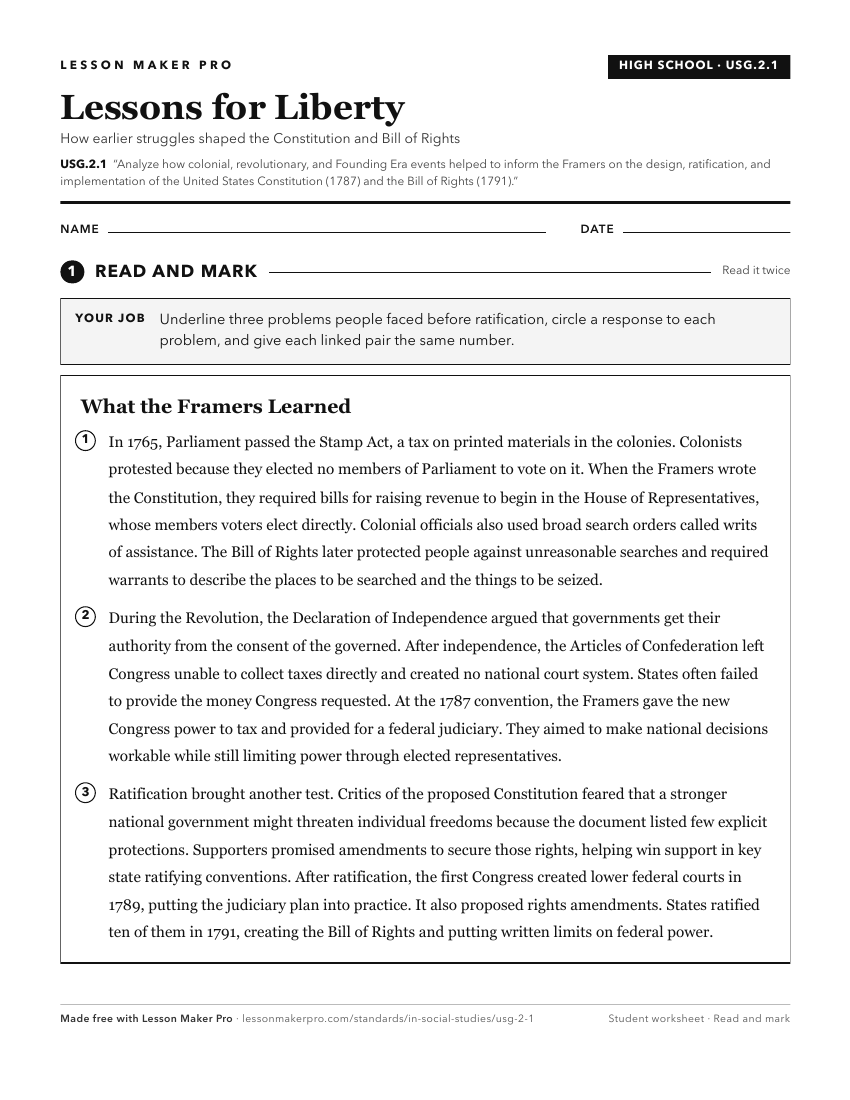
A ready-to-print activity worksheet aligned to USG.2.1, with an answer key for the teacher on its own page. No account needed.
PDF, US Letter, prints cleanly in black and white.
Download the worksheetKeep exploring
Related Standards
- USH.1.1
Analyze key documents from the Founding Era and major ideas about government, individual rights, and the general welfare embedded in these documents.
- USG.2.3
Analyze and interpret central ideas on government, individual rights, and the common good in founding documents of the United States.
- USG.2.4
Explain and analyze historical and contemporary examples of Founding Era principles of American government including natural rights, federalism, social contract...
- 8.H.6
Identify and provide the significance of major events in the creation of the U.S. Constitution, such as the enactment of state constitutions, the weaknesses of ...
Turn this exact standard into a lesson
Grade, subject, topic, and the complete standard are prefilled. Create one free, no account needed.
Also for this standard:Make a WorksheetMake a QuizMake a Sub Lesson