Indiana Social Studies S.6.1
The Standard
Define social groups as understood in sociology and distinguish groups from crowds and aggregates.
2026 Indiana Academic Standards: K-12 Social Studies
Teacher's field guide
What This Standard Means
What Students Need to Do
- Students identify a social group by its ongoing interaction and sense of belonging. They tell it apart from a crowd gathered around an event and an aggregate of people who happen to share a place.
What Mastery Looks Like
- A student can label a weekly chess club, people watching a street performer, and strangers waiting at a bus stop. They can explain which people have ongoing ties, shared attention, or only a shared location.
Common Misconceptions
- Students may call strangers at a bus stop a group because they stand together. They may call people watching a performer a group because everyone is focused on the same event.
How to Assess It
- Exit ticket: Label a weekly chess club, strangers watching a street performer, and strangers waiting silently at a bus stop as group, crowd, or aggregate. Give one reason for each.
Lesson moves
Ways to Teach It
Give pairs cards labeled 'weekly chess club,' 'parade watchers,' and 'silent bus stop'; have them sort the cards into group, crowd, or aggregate.
Ask: If the same people meet at a bus stop every morning and begin planning rides together, when do they become a group?
Call out 'choir rehearsal,' 'concert audience,' and 'strangers in an elevator'; students hold up G, C, or A cards.
Show a school club roster, a game-night crowd photo, and a bus-stop photo; have students explain who has ongoing ties.
Free download
Printable S.6.1 Worksheet
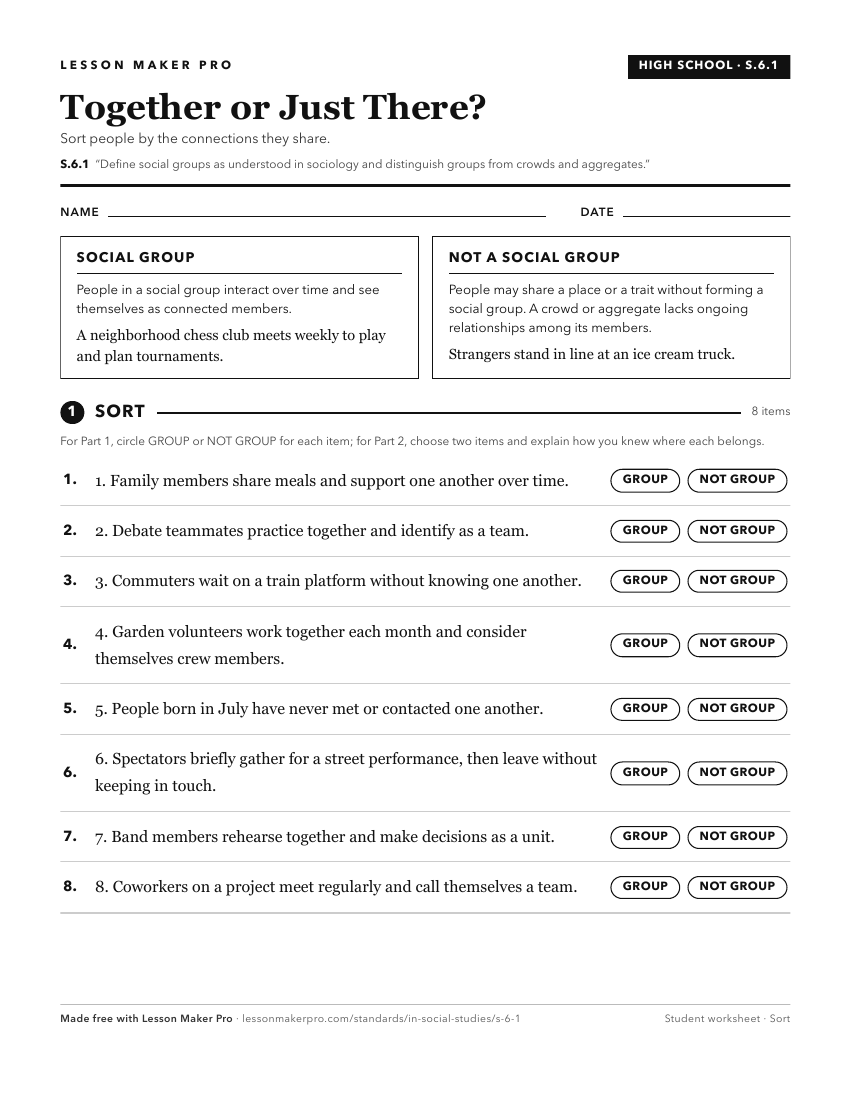
A ready-to-print activity worksheet aligned to S.6.1, with an answer key for the teacher on its own page. No account needed.
PDF, US Letter, prints cleanly in black and white.
Download the worksheetKeep exploring
Related Standards
- S.1.1
Define sociology and trace its development as a distinct discipline.
- S.6.4
Explain the functions of groups both for individual group members and for society.
- S.6.8
Define different types of groups (involuntary, voluntary, coercive, reference).
- S.7.1
Define social institutions as being made up of norms and values, and explain their importance to society.
Turn this exact standard into a lesson
Grade, subject, topic, and the complete standard are prefilled. Create one free, no account needed.
Also for this standard:Make a WorksheetMake a QuizMake a Sub Lesson