Indiana Social Studies S.4.5
The Standard
Explain how roles and role expectations can lead to role conflict and role strain.
2026 Indiana Academic Standards: K-12 Social Studies
Teacher's field guide
What This Standard Means
What Students Need to Do
- Students name the roles a person holds and what others expect from each role. They tell when demands from two roles clash and when demands within one role are hard to meet together.
What Mastery Looks Like
- A student identifies a work shift that overlaps with a school concert as a clash between employee and student roles. They explain why a group leader who must hear every idea and finish by Friday faces strain within one role.
Common Misconceptions
- Students may call any argument with another person role conflict, even when no roles clash. They may call feeling busy role strain without naming competing demands within one role.
How to Assess It
- Exit ticket: A student misses a work shift to play in a school concert; a group leader must hear every idea and finish by Friday. Label each case role conflict or role strain, and name the clashing expectations.
Lesson moves
Ways to Teach It
Give pairs role cards labeled student, employee, and group leader; match demand cards for homework, shifts, listening, and deadlines, then find clashes.
Ask students to write: How is missing rehearsal for a work shift different from a club president pleasing members while enforcing rules?
Run a two-column card race with babysitting versus soccer practice and a team captain encouraging teammates versus enforcing rules; students explain each placement.
Show a school club schedule and a part-time job schedule; ask students to mark an overlap and name the roles involved.
Free download
Printable S.4.5 Worksheet
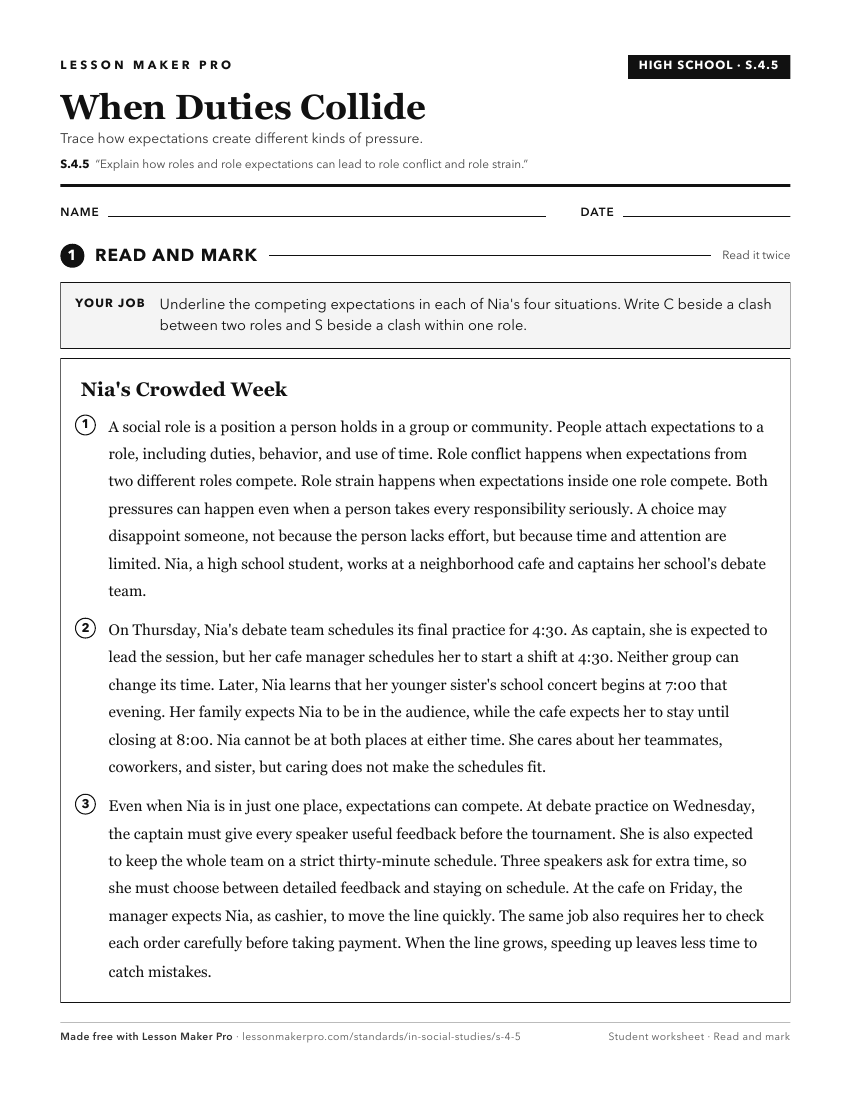
A ready-to-print activity worksheet aligned to S.4.5, with an answer key for the teacher on its own page. No account needed.
PDF, US Letter, prints cleanly in black and white.
Download the worksheetKeep exploring
Related Standards
- S.4.3
Explore stratification from both functionalist and conflict perspectives.
- P.7.5
Discuss the various types of conflict, including ingroup and outgroup bias, and the processes involved in conflict resolution (realistic conflict theory).
- S.10.3
Explore explanations of deviance such as the Strain Theory, the Differential Association Theory, and the Control Theory.
- S.4.4
Distinguish between the terms role, status, and esteem.
Turn this exact standard into a lesson
Grade, subject, topic, and the complete standard are prefilled. Create one free, no account needed.
Also for this standard:Make a WorksheetMake a QuizMake a Sub Lesson