Indiana Social Studies S.2.8
The Standard
Explain how functionalists, interactionists, and conflict theorists differ in their view of culture.
2026 Indiana Academic Standards: K-12 Social Studies
Teacher's field guide
What This Standard Means
What Students Need to Do
- Students explain three ways to study culture. They look at how shared customs hold groups together, how people give symbols meaning, and how powerful groups shape cultural rules.
What Mastery Looks Like
- Given a school dress code, a student can explain why a functionalist might see it as creating shared expectations. They can also explain how students interpret clothing and ask who sets the rules and who faces penalties.
Common Misconceptions
- Students may think the three views disagree about whether culture exists, rather than asking different questions about it. They may also assume a custom helps everyone equally just because it creates order.
How to Assess It
- Exit ticket: A school bans hats. In three labeled sentences, explain how each viewpoint would interpret the rule.
Lesson moves
Ways to Teach It
Give pairs nine printed statements about a school dress code and have them sort the statements by viewpoint.
Ask students to write three answers to: Why does our school have a mascot, one from each viewpoint?
Play lens bingo: read statements about graduation robes, then have students cover a viewpoint and defend their choice.
Hand out your school dress code and ask students to mark a rule that may affect one group more than another.
Free download
Printable S.2.8 Worksheet
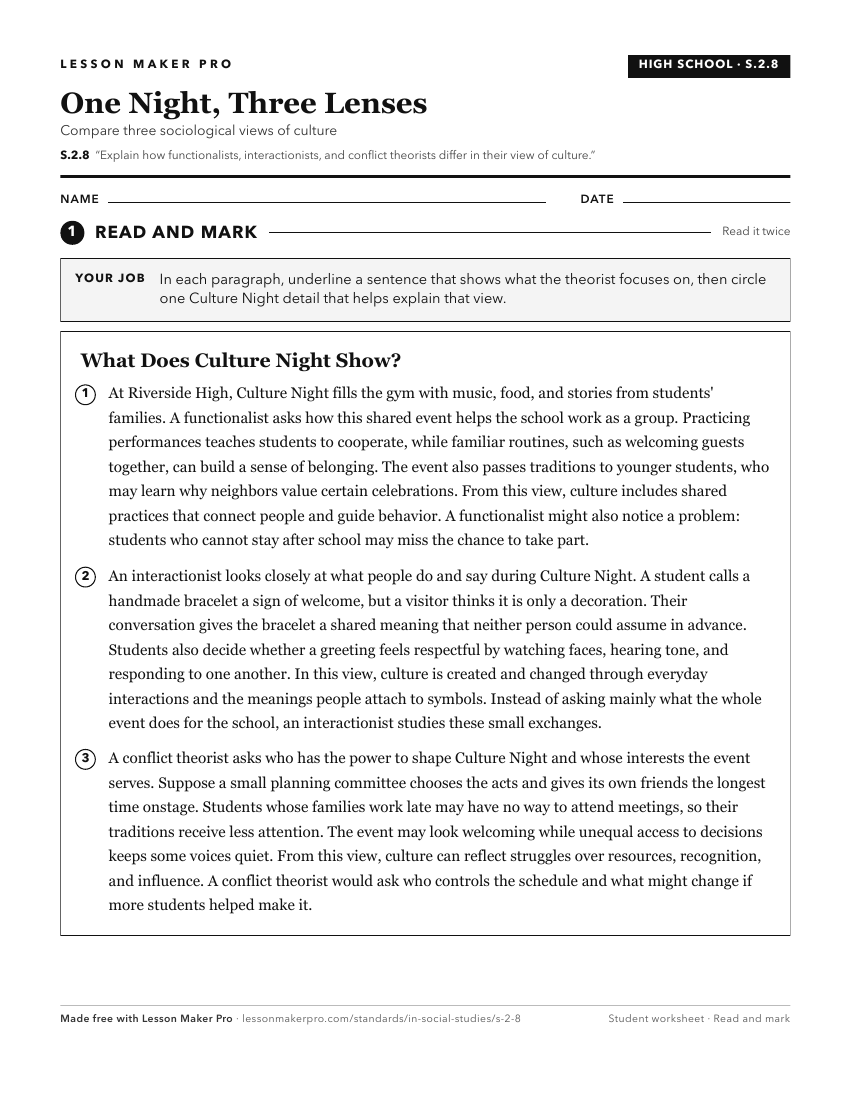
A ready-to-print activity worksheet aligned to S.2.8, with an answer key for the teacher on its own page. No account needed.
PDF, US Letter, prints cleanly in black and white.
Download the worksheetKeep exploring
Related Standards
- S.4.3
Explore stratification from both functionalist and conflict perspectives.
- S.2.2
Explain the differences between the concepts: culture and society.
- S.5.5
Compare and contrast various sociological perspectives of gender role socialization.
- S.1.4
Explain the major theoretical perspectives (paradigms) common to sociology including structural functional, symbolic interaction, and conflict theory. Demonstra...
Turn this exact standard into a lesson
Grade, subject, topic, and the complete standard are prefilled. Create one free, no account needed.
Also for this standard:Make a WorksheetMake a QuizMake a Sub Lesson