Indiana Social Studies S.2.3
The Standard
Identify and apply elements of nature vs. nurture in explaining human social behavior.
2026 Indiana Academic Standards: K-12 Social Studies
Teacher's field guide
What This Standard Means
What Students Need to Do
- Students tell biological influences from learned influences on how people act with others. They explain how both can shape the same behavior.
What Mastery Looks Like
- Given a greeting example, students identify a possible inborn tendency to notice faces and a learned custom, such as bowing. They explain how both could affect the greeting without claiming either one determines it.
Common Misconceptions
- Students may assume a polite person was born polite, or that every behavior is learned at home. They may treat biology and experience as competing explanations when both can play a part.
How to Assess It
- Exit ticket: A toddler pays attention to faces and learns to wave after watching family members. Name one possible biological influence and one learned influence on the toddler's greeting.
Lesson moves
Ways to Teach It
Give pairs cards labeled noticing faces, waving hello, and sharing toys; have them sort each as biological, learned, or both and explain their choices.
Ask, “Why might two siblings greet visitors differently even if they grow up in the same house?” Have students write two possible influences.
Read four short scenarios about greetings and turn taking; students hold up B, L, or Both cards and explain one answer.
Show photos of a handshake and a bow; ask what people learn locally and what human abilities help them learn greetings.
Free download
Printable S.2.3 Worksheet
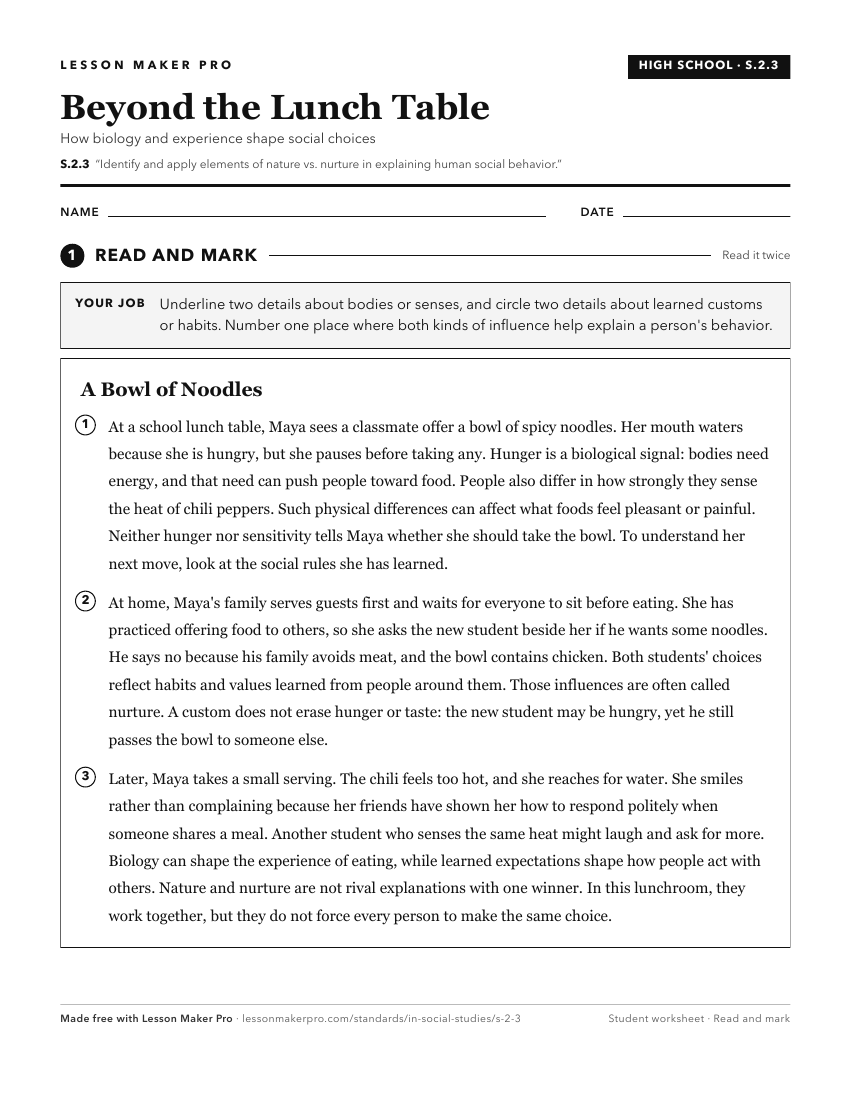
A ready-to-print activity worksheet aligned to S.2.3, with an answer key for the teacher on its own page. No account needed.
PDF, US Letter, prints cleanly in black and white.
Download the worksheetKeep exploring
Related Standards
- S.8.7
Discuss theories that attempt to explain collective behavior.
- P.5.6
Evaluate the influences of variables, such as culture (belonging to an individualist or collectivist culture), family, and genetics, on personality development ...
- P.3.1
Explain the roles, effects, and outcomes of prenatal and postnatal development on human behavior.
- P.1.8
Explain how nature and nurture influence human development.
Turn this exact standard into a lesson
Grade, subject, topic, and the complete standard are prefilled. Create one free, no account needed.
Also for this standard:Make a WorksheetMake a QuizMake a Sub Lesson