Indiana Social Studies P.6.4
The Standard
Discuss major categories of maladaptive behavior and distinguish which disorders (mood, anxiety, obsessive compulsive, schizophrenia, depressive, sleep) classify with these categories in the most up to date edition of the Diagnostic and Statistical Manual of Mental Disorders.
2026 Indiana Academic Standards: K-12 Social Studies
Teacher's field guide
What This Standard Means
What Students Need to Do
- Students match examples of harmful patterns of thought, feeling, or behavior to the right disorder groups in the DSM-5-TR. They learn that depression and bipolar disorder are in separate chapters, rather than one chapter called mood disorders.
What Mastery Looks Like
- A student can place OCD, schizophrenia, insomnia disorder, and generalized anxiety disorder in their correct chapters. They can point to a clue in a fictional case and explain why one symptom alone is not a diagnosis.
Common Misconceptions
- Students may place OCD under anxiety disorders because both can involve fear. They may put bipolar disorder under depressive disorders or mistake schizophrenia for multiple personalities. One bad night of sleep does not mean someone has a sleep disorder.
How to Assess It
- Exit ticket: Match major depressive disorder, bipolar I disorder, OCD, and insomnia disorder to their DSM-5-TR chapters. Ask students to explain one match using a clue from a short fictional case.
Lesson moves
Ways to Teach It
Give pairs six fictional case cards and six DSM-5-TR chapter strips to cut out, sort, and label with supporting clues.
Ask students to write two sentences explaining why repeated unwanted thoughts and rituals fit a different chapter from generalized anxiety disorder.
Play a matching round with disorder-name cards and chapter cards; require students to explain each match before keeping the pair.
Make a mock clinic intake form with questions about sleep, mood, and worry; have students name possible chapters without diagnosing anyone.
Free download
Printable P.6.4 Worksheet
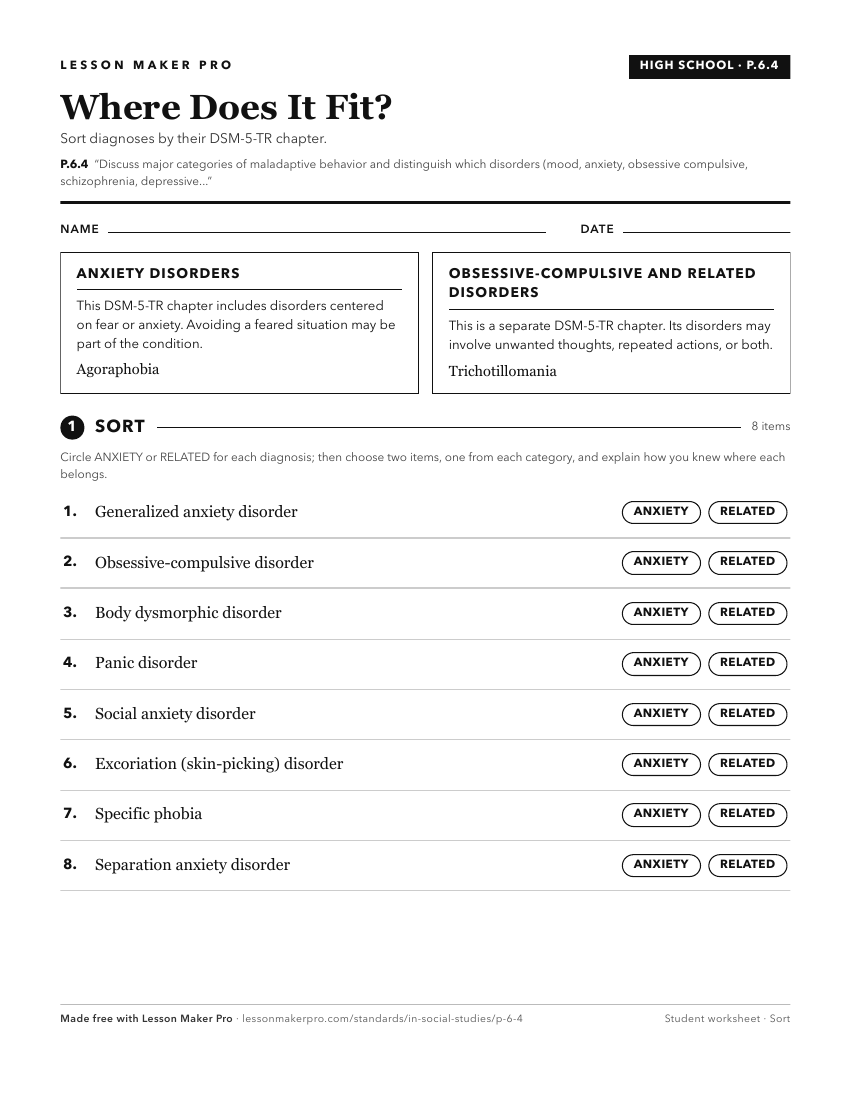
A ready-to-print activity worksheet aligned to P.6.4, with an answer key for the teacher on its own page. No account needed.
PDF, US Letter, prints cleanly in black and white.
Download the worksheetKeep exploring
Related Standards
- P.6.1
Describe the characteristics defining maladaptive behavior and its diagnostic criteria (deviant, distressful, dysfunctional).
- P.2.5
Identify the major divisions and subdivisions of the nervous system and describe how they function, and their effect on human behavior.
- P.6.3
Identify and describe the theories of maladaptive behaviors.
- P.6.2
Explain how both cultural and historical influences have affected the definition of maladaptive behavior, including the harmful effects of diagnostic labeling a...
Turn this exact standard into a lesson
Grade, subject, topic, and the complete standard are prefilled. Create one free, no account needed.
Also for this standard:Make a WorksheetMake a QuizMake a Sub Lesson