Indiana Social Studies P.3.3
The Standard
Describe the physical, motor, cognitive, and language development of children, including the importance of critical periods of development.
2026 Indiana Academic Standards: K-12 Social Studies
Teacher's field guide
What This Standard Means
What Students Need to Do
- Students describe how children grow, move, think, and learn language. They explain why some experiences, such as clear visual input, matter most during certain periods of childhood.
What Mastery Looks Like
- A student can identify height gain as physical growth, walking as a motor skill, object permanence as cognitive development, and two-word phrases as language development. They can explain why treating a baby's cataract early may protect later vision.
Common Misconceptions
- Students may call walking physical growth rather than a motor skill. They may think a critical period means no learning is possible afterward, or that every child reaches milestones at the same age.
How to Assess It
- On an exit ticket, have students classify height gain, walking, object permanence, and two-word phrases by development area. Ask why treating a baby's cataract early can matter for later vision.
Lesson moves
Ways to Teach It
Give pairs milestone cards for height gain, walking, object permanence, and two-word phrases to sort into four labeled columns.
Ask students to write two sentences answering: Why might treating a baby's cataract early protect vision better than waiting until age ten?
Play milestone match: read 'buttoning a coat' or 'using two-word phrases,' then have teams show the matching development card.
Give students a pediatric milestone checklist and have them write two questions a caregiver could ask about movement and speech at a checkup.
Free download
Printable P.3.3 Worksheet
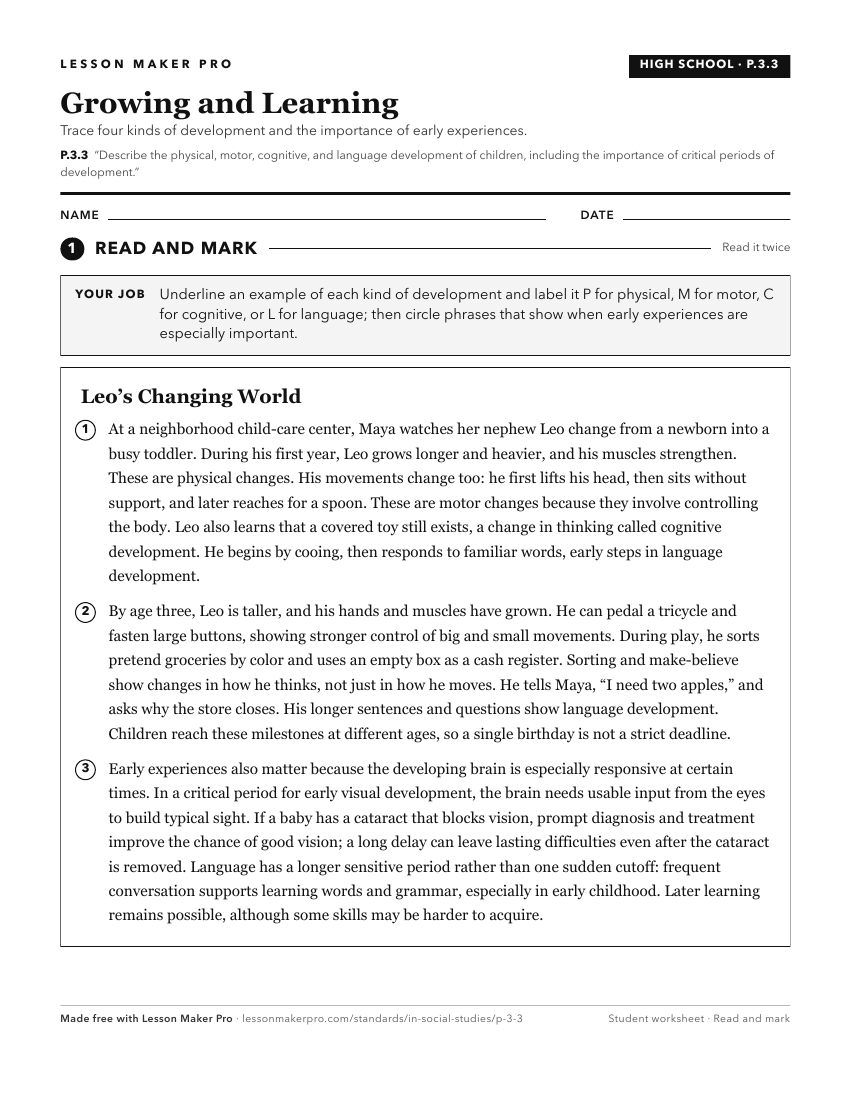
A ready-to-print activity worksheet aligned to P.3.3, with an answer key for the teacher on its own page. No account needed.
PDF, US Letter, prints cleanly in black and white.
Download the worksheetKeep exploring
Related Standards
- P.3.2
Explain the physical, motor, and perceptual development of infants.
- P.3.1
Explain the roles, effects, and outcomes of prenatal and postnatal development on human behavior.
- P.3.6
Describe the theories of various developmental psychologists such as Piaget, Vygotsky, Freud, and Erikson.
- P.1.8
Explain how nature and nurture influence human development.
Turn this exact standard into a lesson
Grade, subject, topic, and the complete standard are prefilled. Create one free, no account needed.
Also for this standard:Make a WorksheetMake a QuizMake a Sub Lesson