Indiana Social Studies GHW.9.3
The Standard
Distinguish and assess the human and physical factors associated with the spread of selected epidemics and/or pandemics over time, and propose strategies for limiting the spread of diseases.
2026 Indiana Academic Standards: K-12 Social Studies
Teacher's field guide
What This Standard Means
What Students Need to Do
- Students compare how a disease spread in two places or time periods. They separate human factors, such as sanitation, from physical factors, such as rainfall and river flow. They then suggest a way to slow its spread.
What Mastery Looks Like
- A student can use a map or case report to explain how cholera reached drinking water in 1854 London and 2010 Haiti. They can judge which factors had the greatest effect in each case and suggest a practical step, such as chlorinating water.
Common Misconceptions
- Students may think cholera spreads mainly through casual contact or that rain itself causes the disease. They may also assume closing one contaminated pump would work when many water sources are unsafe.
How to Assess It
- Exit ticket: Compare cholera in 1854 London and 2010 Haiti. Name one human and one physical factor that shaped its spread, explain which mattered more in one case, and propose one water safety step.
Lesson moves
Ways to Teach It
Give pairs printed maps of London's Broad Street pump and Haiti's Artibonite River; have them trace likely paths from contaminated water to households.
Ask: Why might closing one pump help in 1854 London but not solve a riverwide outbreak in 2010 Haiti?
Play a factor sort with cards labeled heavy rain, river flow, damaged latrines, and crowded camps; teams defend human versus physical placements.
Print a past city boil-water advisory; students underline the contamination risk and list two steps a household should take.
Free download
Printable GHW.9.3 Worksheet
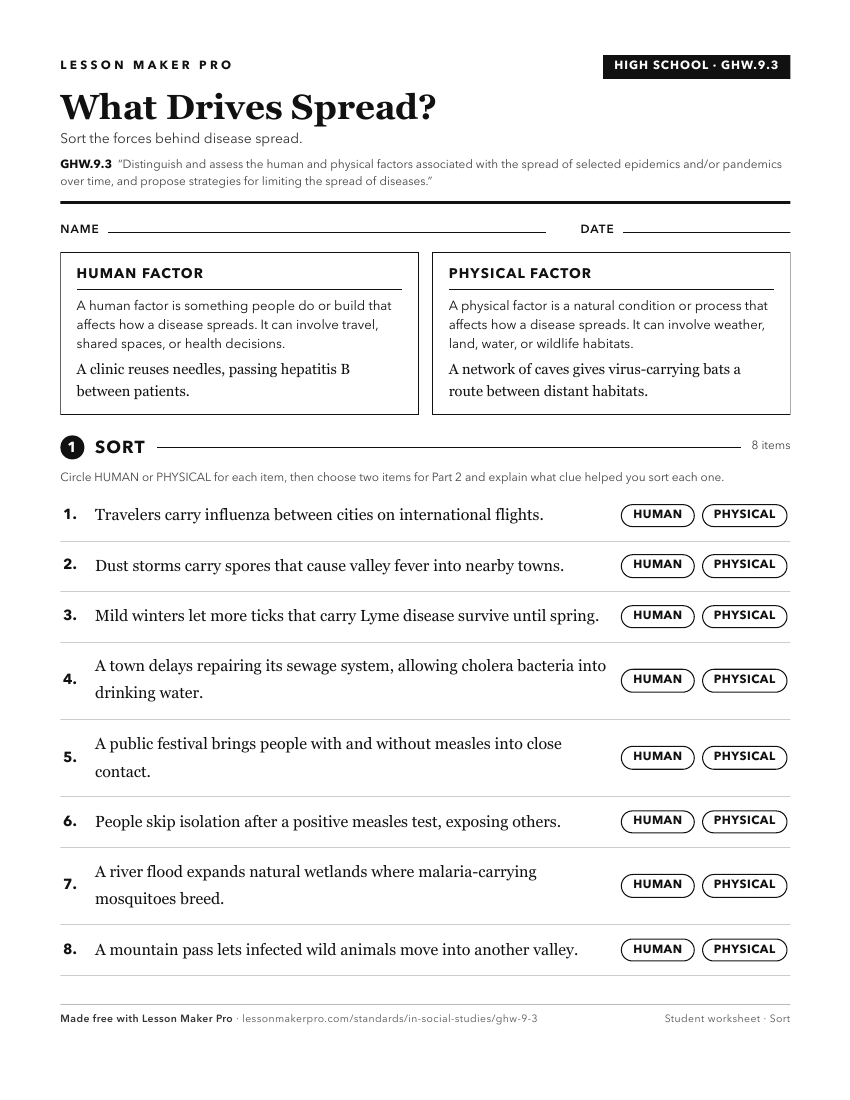
A ready-to-print activity worksheet aligned to GHW.9.3, with an answer key for the teacher on its own page. No account needed.
PDF, US Letter, prints cleanly in black and white.
Download the worksheetKeep exploring
Related Standards
- GHW.3.2
Identify and describe the push-pull factors that resulted in the migration of human population over time, and detect changes in these factors.
- WG.4.4
Evaluate the impact of human migration on physical and human systems (economic, government, environment, individuals, society, and culture).
- GHW.9.1
Use maps to identify regions in the world where particular natural disasters occur frequently, and analyze how the physical and human environments have been mod...
- GHW.7.2
Analyze the physical and human factors involved in conflicts and violence related to nationalist, racial, ethnic, religious, economic, political, and/or resourc...
Turn this exact standard into a lesson
Grade, subject, topic, and the complete standard are prefilled. Create one free, no account needed.
Also for this standard:Make a WorksheetMake a QuizMake a Sub Lesson