Indiana Social Studies GHW.6.4
The Standard
Compare and contrast the impact of the Industrial Revolution on developed countries with the economic processes acting upon less developed and developing countries in the contemporary world.
2026 Indiana Academic Standards: K-12 Social Studies
Teacher's field guide
What This Standard Means
What Students Need to Do
- Students compare how factories changed jobs, cities, and wealth in countries that industrialized early with changes in lower-income countries today. They explain how global trade and investment shape those changes now.
What Mastery Looks Like
- A student can name a shared effect, such as workers moving to cities, and support it with examples from both periods. They can explain a difference, such as why a factory making goods for foreign brands may keep less profit locally.
Common Misconceptions
- Students may assume every country follows Britain's path from the 1800s. They may also assume that more factories always mean higher wages for workers, or that lower-income countries have no industry.
How to Assess It
- Give students a short account of a British textile mill in 1850 and a garment factory in Bangladesh today. Ask them to write one shared effect and one difference, using a detail from each account.
Lesson moves
Ways to Teach It
Give pairs source cards about British mills and Bangladeshi garment factories; have them place each card on a shared or different effects chart.
Ask students to write: Who earned money from British textiles in 1850, and who earns money from a shirt made in Bangladesh today?
Run a card sort with effects such as city growth, pollution, and export sales; students match each to one or both periods.
Have students check a shirt label, locate its manufacturing country on a map, and trace its likely route to a local store.
Free download
Printable GHW.6.4 Worksheet
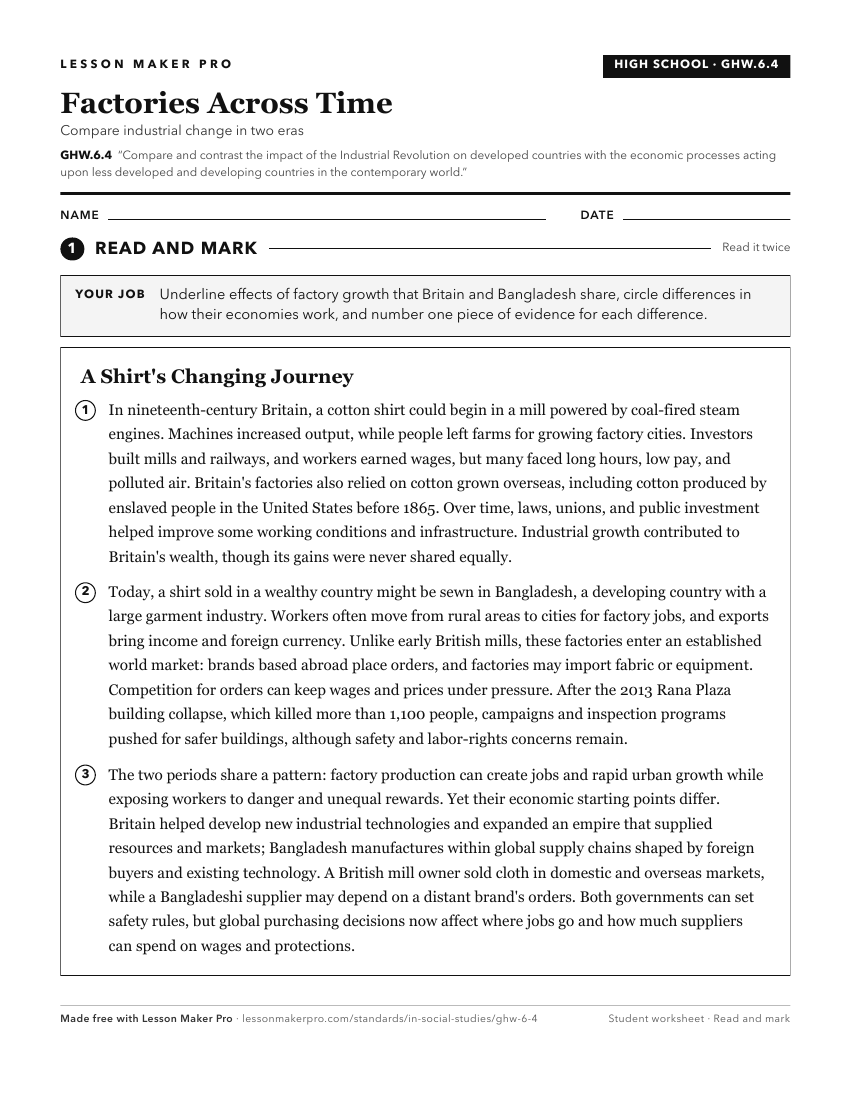
A ready-to-print activity worksheet aligned to GHW.6.4, with an answer key for the teacher on its own page. No account needed.
PDF, US Letter, prints cleanly in black and white.
Download the worksheetKeep exploring
Related Standards
- S.4.2
Compare the stratification of different societies along with its causes and effects.
- 6.H.10
Describe the origins, developments, and innovations of the Industrial Revolution throughout Europe and the United States, and explain how the impact of these ch...
- USH.2.1
Explain the causes of the Industrial Revolution and its social, political, and economic outcomes.
- WH.5.4
Examine the economic, social, and political changes caused by the Industrial Revolution and their impact on the development of political and economic theories.
Turn this exact standard into a lesson
Grade, subject, topic, and the complete standard are prefilled. Create one free, no account needed.
Also for this standard:Make a WorksheetMake a QuizMake a Sub Lesson