Indiana Social Studies 6.H.10
The Standard
Describe the origins, developments, and innovations of the Industrial Revolution throughout Europe and the United States, and explain how the impact of these changes brought about urbanization and the changing role of women and children labor.
2026 Indiana Academic Standards: K-12 Social Studies
Teacher's field guide
What This Standard Means
What Students Need to Do
- Students explain why factory production began in Britain and spread across Europe and to the United States. They connect new machines and steam power to faster production and growing cities. They describe how factory work changed the lives of women and children.
What Mastery Looks Like
- A student can trace a chain from coal and textile machines to factories, jobs, and migration to cities. They can explain how mill work changed the hours, pay, or safety of women and children.
Common Misconceptions
- Students may think factories appeared everywhere at once, rather than spreading from Britain. They may think women and children first began working during industrialization, though both had long worked on farms and at home. Some overlook migration for jobs when explaining city growth.
How to Assess It
- Exit ticket: Draw a three-box chain linking coal or a textile machine to factories and city growth. Write one sentence about how factory work changed life for women or children.
Lesson moves
Ways to Teach It
Give pairs cards labeled coal, textile machine, factory, and city; have them arrange the cards and explain each link.
Read brief accounts of farm work and child mill work; ask, "What changed for children, and what stayed the same?"
Play a match game with invention cards and result cards, such as steam engine and faster transport; have students defend each match.
Show Chicago population figures from 1850 and 1900; ask how factory jobs might help explain the city's growth.
Free download
Printable 6.H.10 Worksheet
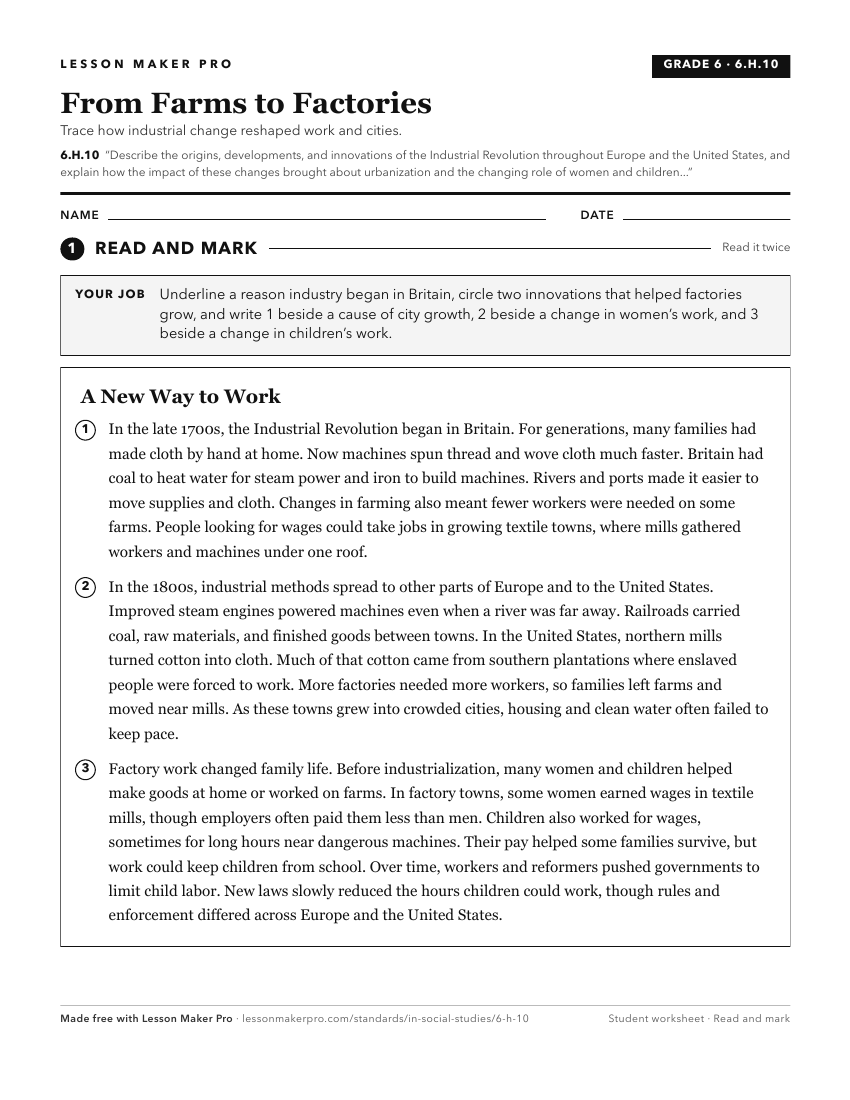
A ready-to-print activity worksheet aligned to 6.H.10, with an answer key for the teacher on its own page. No account needed.
PDF, US Letter, prints cleanly in black and white.
Download the worksheetKeep exploring
Related Standards
- 6.H.11
Identify an impact of industrialization on trade and cultural exchange between Europe and the Americas.
- GHW.6.4
Compare and contrast the impact of the Industrial Revolution on developed countries with the economic processes acting upon less developed and developing countr...
- USH.2.1
Explain the causes of the Industrial Revolution and its social, political, and economic outcomes.
- WH.5.4
Examine the economic, social, and political changes caused by the Industrial Revolution and their impact on the development of political and economic theories.
Turn this exact standard into a lesson
Grade, subject, topic, and the complete standard are prefilled. Create one free, no account needed.
Also for this standard:Make a WorksheetMake a QuizMake a Sub Lesson