Indiana Social Studies GHW.12.2
The Standard
Explain the concepts of depopulation, steady, accelerating and exponential growth and apply these concepts to geographical/spatial themes while analyzing the consequences of various human responses.
2026 Indiana Academic Standards: K-12 Social Studies
Teacher's field guide
What This Standard Means
What Students Need to Do
- Students use population tables, graphs, and maps to spot places losing people or growing at different rates. They explain how changes to housing, schools, or transport might affect those places.
What Mastery Looks Like
- A student can tell steady growth from accelerating growth by checking how much is added each period. They can identify exponential growth by a repeated percentage increase, then explain a trade-off in serving a growing or shrinking town.
Common Misconceptions
- Students may call any rising line exponential, even when the same number is added each decade. They may think a falling birth rate means the population is already shrinking. They may miss how moving a service to one town affects another.
How to Assess It
- Exit ticket: Four neighboring towns report populations of A: 100, 110, 120, 130; B: 100, 110, 130, 160; C: 100, 200, 400, 800; D: 100, 90, 80, 70. Label each pattern, then choose C or D and explain one service change and a possible cost to another town.
Lesson moves
Ways to Teach It
Give pairs four town population tables and graph paper; have them plot each trend and mark likely housing or school changes on a map.
Ask: If one town doubles each decade while its neighbor loses residents, where should the county build a school, and why?
Run a card sort matching population sequences to depopulation, steady, accelerating, or exponential growth; students defend each match using differences or percentages.
Show 2010 and 2020 census totals for two nearby towns; students choose where to add a bus route and name a cost elsewhere.
Free download
Printable GHW.12.2 Worksheet
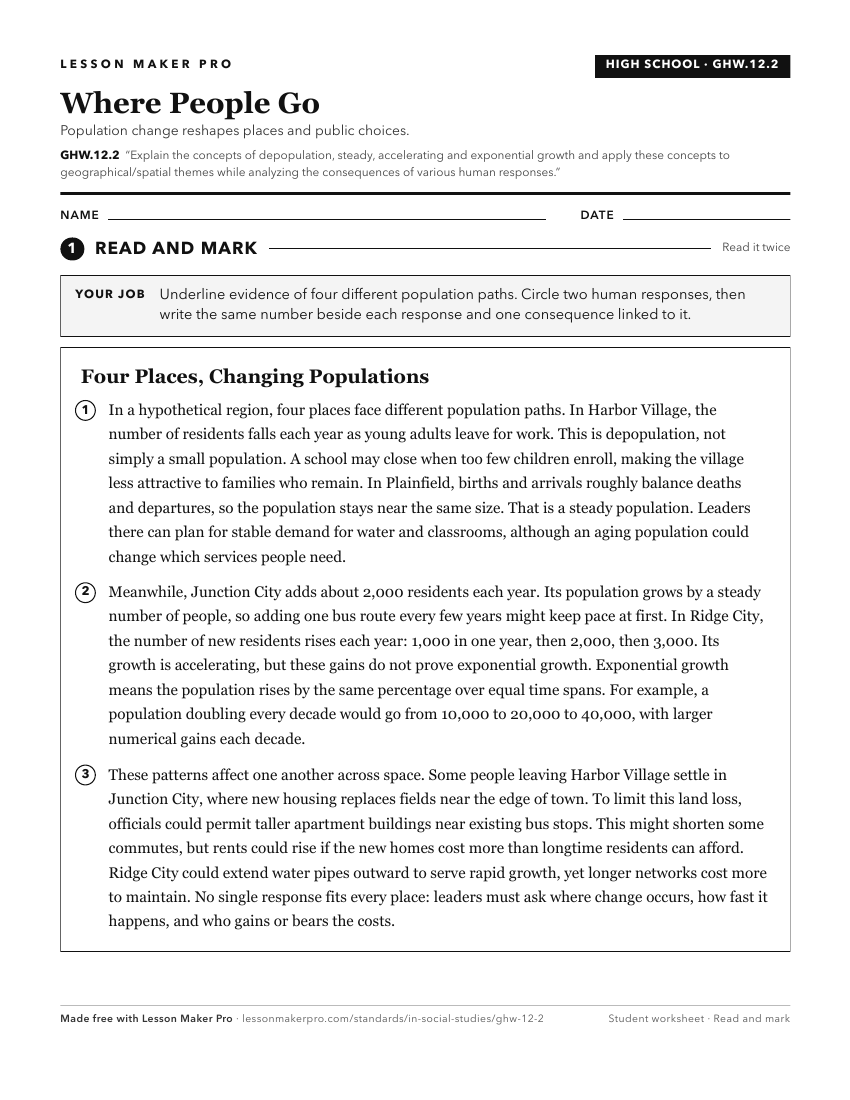
A ready-to-print activity worksheet aligned to GHW.12.2, with an answer key for the teacher on its own page. No account needed.
PDF, US Letter, prints cleanly in black and white.
Download the worksheetKeep exploring
Related Standards
- GHW.3.3
Analyze the changes in population characteristics and physical and human environments that resulted from the migration of peoples within, between, and among wor...
- WG.4.5
Assess the changes and consequences of population growth or decline in various parts of the United States based on global migration patterns and determine wheth...
- GHW.3.4
Give examples of and evaluate how the physical and human environments in different regions have changed over time due to significant population growth or declin...
- WG.4.1
Using maps, establish world patterns of population distribution, density, and growth. Relate population growth rates to health statistics, food supply, or measu...
Turn this exact standard into a lesson
Grade, subject, topic, and the complete standard are prefilled. Create one free, no account needed.
Also for this standard:Make a WorksheetMake a QuizMake a Sub Lesson