Indiana Social Studies GE.4.2
The Standard
Explain how specialization promotes international trade and how international trade increases total world output.
2026 Indiana Academic Standards: K-12 Social Studies
Teacher's field guide
What This Standard Means
What Students Need to Do
- Students compare what two countries give up to make each product. They explain how focusing on the product with the lower opportunity cost, then trading, can increase combined output.
What Mastery Looks Like
- Given a production table, a student finds what each country gives up to make one more unit. They choose what each country should make, show a possible gain in combined output, and explain what they could trade.
Common Misconceptions
- Students may think a country that can make more of both products has no reason to trade. They may also think trading creates more goods by itself, without any change in what countries produce.
How to Assess It
- Exit ticket: A makes 4 bags of rice or 2 shirts per hour. B makes 1 bag of rice or 1 shirt. Which product should each focus on for trade, and why could their combined output rise?
Lesson moves
Ways to Teach It
Give pairs hourly rate cards: A, 4 rice or 2 shirts; B, 1 rice or 1 shirt; shift hour tokens and tally output.
Ask: If A makes more rice and shirts per hour than B, why might A still buy shirts from B?
Put four rice and shirt rate tables on desks; teams race to circle each country's lower opportunity cost good and propose a trade.
Read the country label on a shirt; name something local workers could make instead and explain why importing shirts might raise total output.
Free download
Printable GE.4.2 Worksheet
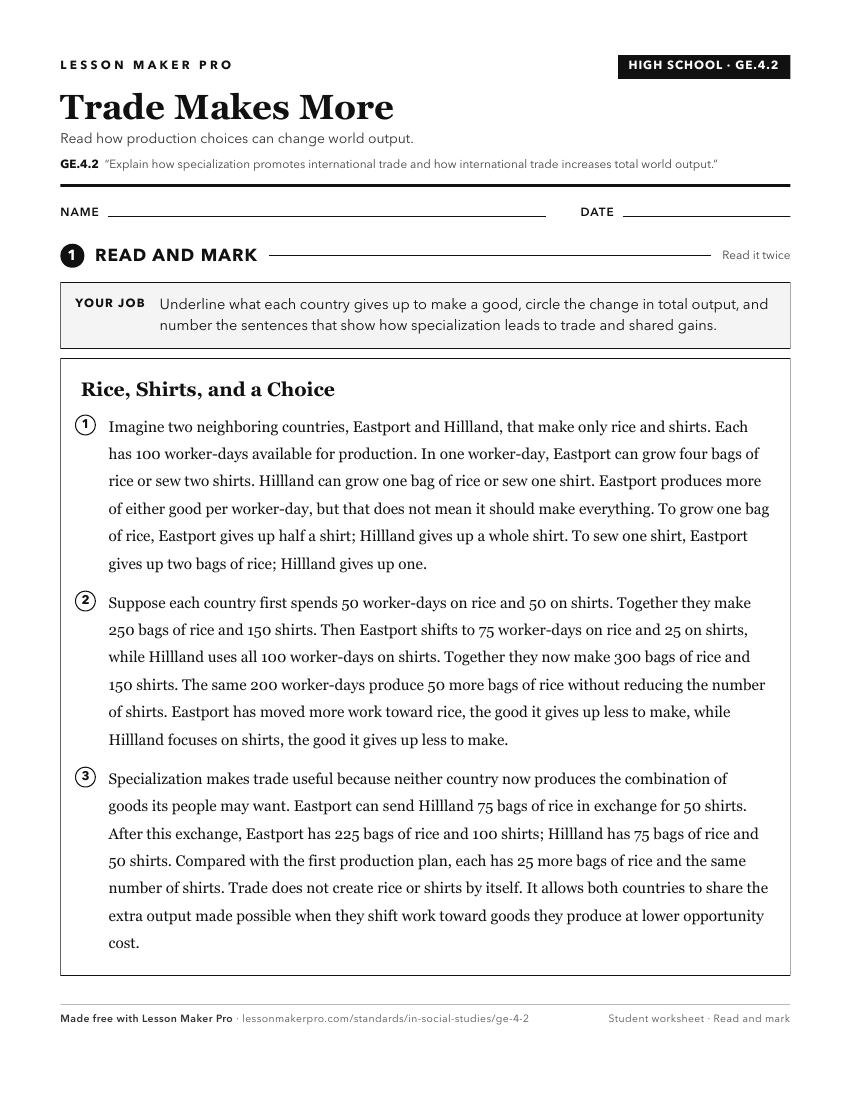
A ready-to-print activity worksheet aligned to GE.4.2, with an answer key for the teacher on its own page. No account needed.
PDF, US Letter, prints cleanly in black and white.
Download the worksheetKeep exploring
Related Standards
- 7.E.1
Evaluate the benefits and opportunity costs of voluntary trade and specialization on the standards of living in Africa, Asia, and the Southwest Pacific.
- 2.E.4
Explain why people trade for goods and services, and explain how money makes trade easier.
- 5.E.3
Explain the benefits of education and training, specialization, and investment in capital resources.
- 6.E.3
Explain why international trade requires a system for exchanging currency between various countries.
Turn this exact standard into a lesson
Grade, subject, topic, and the complete standard are prefilled. Create one free, no account needed.
Also for this standard:Make a WorksheetMake a QuizMake a Sub Lesson