Indiana Social Studies E.4.4
The Standard
Determine whether different types of taxes (e.g., income tax, sales tax, and Federal Income Contributions Act [FICA] tax including Social Security and Medicare) are progressive, proportional, or regressive.
2026 Indiana Academic Standards: K-12 Social Studies · Students explain that because resources are limited, people must make choices, understanding the role that supply, demand, prices, and profits play in a market economy. Key elements of the course include study of scarcity and economic reasoning, supply and demand, market structures, the role of government, national economic performance, the role of financial institutions, economic stabilization, and trade.
Teacher's field guide
What This Standard Means
What Students Need to Do
- Students compare taxes paid as a share of income at different income levels. They classify federal income tax, sales tax, Social Security tax, and Medicare tax. They account for the Social Security wage cap and the extra Medicare tax on high earnings.
What Mastery Looks Like
- Given two incomes and tax bills, students calculate the tax paid as a percent of each income. They explain why a sales tax can be regressive even when both shoppers pay the same rate. They distinguish the capped Social Security tax from the basic Medicare tax.
Common Misconceptions
- Students often call sales tax proportional because the rate at checkout is the same for everyone. Some assume all payroll taxes stay proportional at every income. Others think a higher income tax bracket applies to every dollar earned.
How to Assess It
- Exit ticket: Two people earn $20,000 and $200,000. Each pays $800 in sales tax, while Social Security tax is 6.2% on wages up to a $100,000 cap. Classify both taxes and show the tax paid as a share of each income.
Lesson moves
Ways to Teach It
Hand out mock $20,000 and $100,000 pay stubs and receipts; partners calculate each tax as a percent of income.
Ask students to write two sentences explaining why the same sales tax rate can take a larger share of one family's income.
Run a card sort with paired incomes and tax bills; teams label each tax and defend one choice with calculations.
Bring a store receipt and sample pay stub; students circle sales tax, federal withholding, Social Security, and Medicare deductions.
Free download
Printable E.4.4 Worksheet
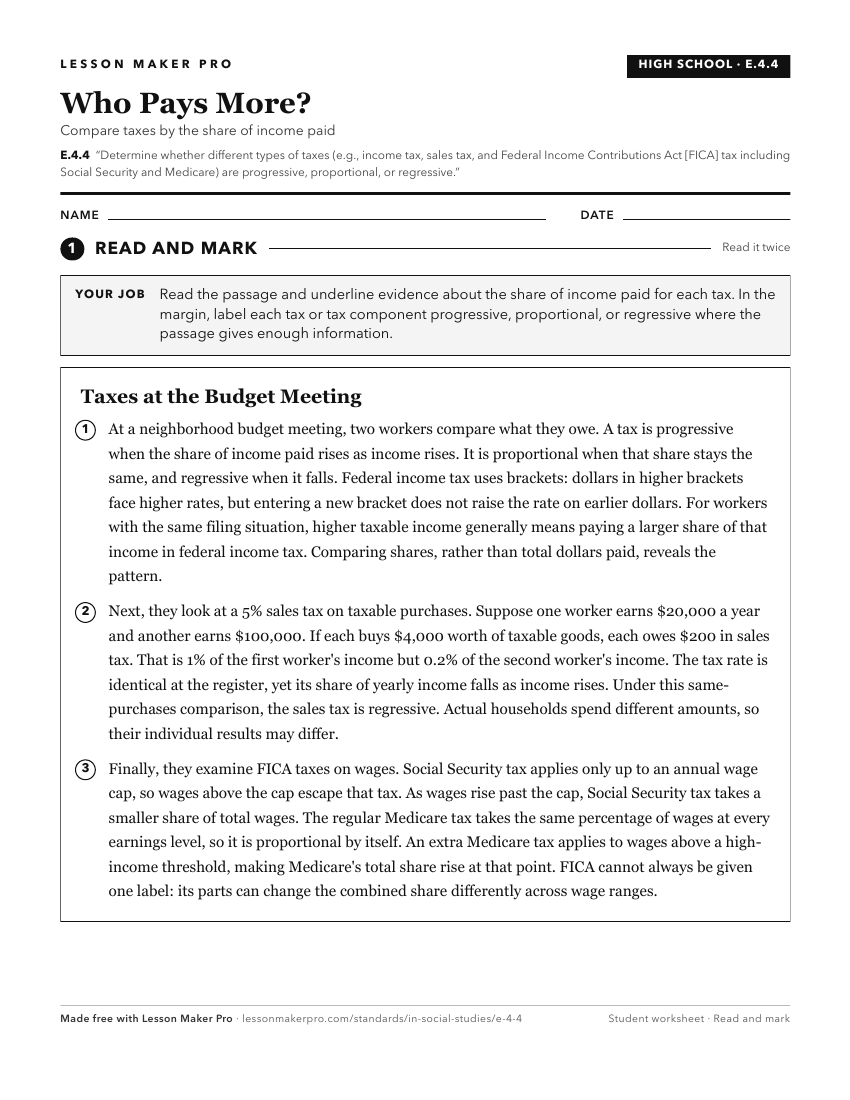
A ready-to-print activity worksheet aligned to E.4.4, with an answer key for the teacher on its own page. No account needed.
PDF, US Letter, prints cleanly in black and white.
Download the worksheetKeep exploring
Related Standards
- 3.E.8
Identify different ways people save their income, and explain advantages and disadvantages of each.
- GE.2.6
Explain and evaluate how and why government control influences businesses and individuals through laws and taxes.
- GE.2.5
Describe fiscal policy, including how taxes are used within different economic systems.
- GE.5.9
Analyze and discuss the structure of, the purpose for, and the effects of government taxation.
Turn this exact standard into a lesson
Grade, subject, topic, and the complete standard are prefilled. Create one free, no account needed.
Also for this standard:Make a WorksheetMake a QuizMake a Sub Lesson