Indiana Social Studies E.3.2
The Standard
Compare and contrast the basic characteristics of the four market structures: monopoly, oligopoly, monopolistic competition, and pure competition.
2026 Indiana Academic Standards: K-12 Social Studies · Students explain that because resources are limited, people must make choices, understanding the role that supply, demand, prices, and profits play in a market economy. Key elements of the course include study of scarcity and economic reasoning, supply and demand, market structures, the role of government, national economic performance, the role of financial institutions, economic stabilization, and trade.
Teacher's field guide
What This Standard Means
What Students Need to Do
- Students sort markets by the number of sellers, product differences, and barriers to entry. They compare how much control sellers have over prices in each market.
What Mastery Looks Like
- Given a short market scenario, students name the market structure and cite clues that support their choice. They can explain why a wheat farmer has less control over price than a sole seller of a patented drug.
Common Misconceptions
- Students often call a popular brand a monopoly even when customers have other choices. They may confuse monopolistic competition with monopoly or assume every seller can set prices freely.
How to Assess It
- Give students four cases: one city water provider, four airlines serving an airport, dozens of burger shops with different menus, and hundreds of farms selling identical wheat. Ask them to name each market structure and give one clue for each choice.
Lesson moves
Ways to Teach It
Give pairs four market cards showing a water provider, airlines, burger shops, and wheat farms; have them sort by seller count and product differences.
Ask students to write: Why can a sole seller of a patented drug influence price more than a wheat farmer selling identical grain?
Read clues such as 'three airlines, costly to start'; students race to hold up the matching market structure card.
Compare a city water bill with a map of local coffee shops; list how many sellers customers can choose in each market.
Free download
Printable E.3.2 Worksheet
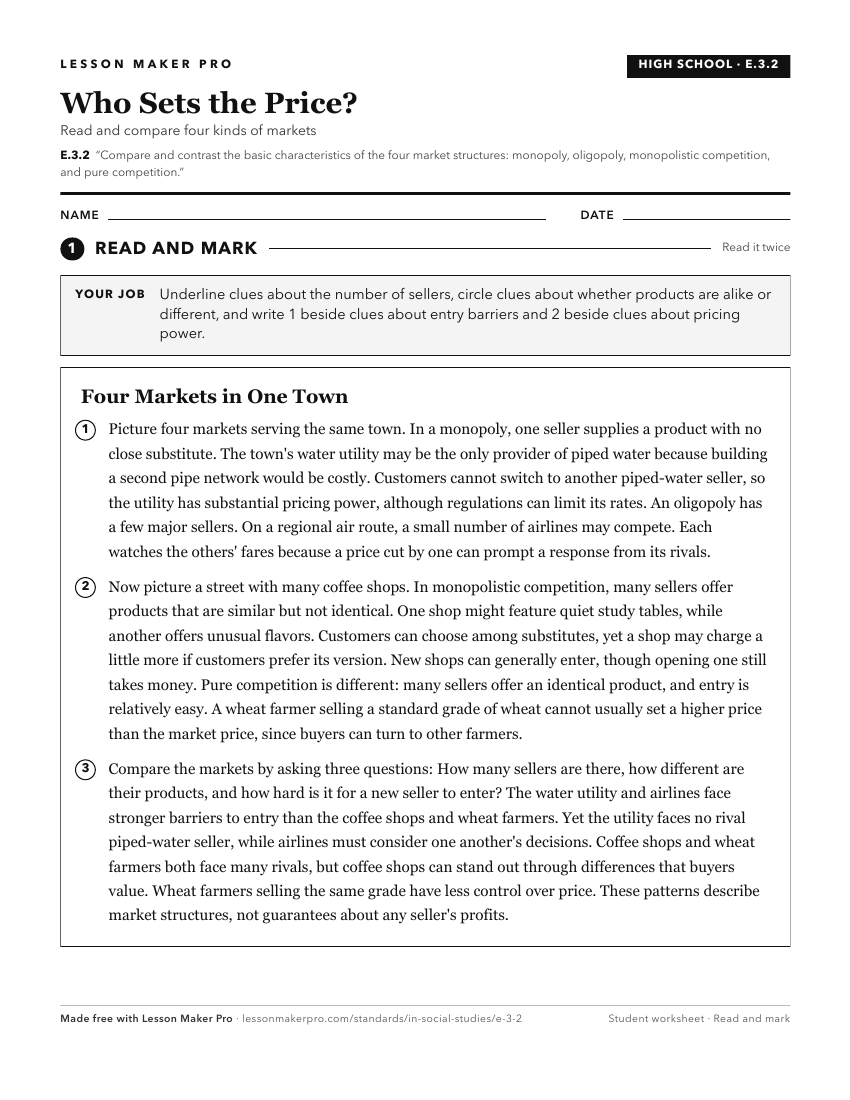
A ready-to-print activity worksheet aligned to E.3.2, with an answer key for the teacher on its own page. No account needed.
PDF, US Letter, prints cleanly in black and white.
Download the worksheetKeep exploring
Related Standards
- E.1.6
Describe and compare the various economic systems (i.e., traditional, market, command, mixed, feudal, mercantile) and explain their strengths and weaknesses.
- WG.4.10
Describe and locate on maps the worldwide occurrence of the three major economic systems (traditional, command, and market) and describe the characteristics of ...
- GE.3.3
Describe different types of competitive structures in economic systems.
- GE.3.5
Assess the influence of monopolies and oligopolies on marketplaces.
Turn this exact standard into a lesson
Grade, subject, topic, and the complete standard are prefilled. Create one free, no account needed.
Also for this standard:Make a WorksheetMake a QuizMake a Sub Lesson