Indiana Social Studies 8.H.5
The Standard
Analyze the causes and effects of the Revolutionary War (1775–1783), including the ideas from the Declaration of Independence, the enactment of the Articles of Confederation, and the Treaty of Paris (1761-1783).
2026 Indiana Academic Standards: K-12 Social Studies
Teacher's field guide
What This Standard Means
What Students Need to Do
- Students explain how British taxes, limits on colonial self-rule, and armed clashes led to war. They connect the Declaration’s case for independence to the new government under the Articles and the peace treaty that ended the war.
What Mastery Looks Like
- A student can link a colonial complaint to the Declaration’s idea that government needs the people’s consent. They can explain that the Articles gave Congress limited power and that the 1783 treaty recognized U.S. independence.
Common Misconceptions
- Students may think the Declaration started the war, but fighting began in 1775. They may also confuse the Declaration with the Articles, which set up the first national government.
How to Assess It
- Ask students to write four labeled lines: a cause of the war, an idea from the Declaration, a feature of the Articles, and a result of the treaty.
Lesson moves
Ways to Teach It
Give pairs cards for the Stamp Act, Lexington, the Declaration, the Articles, and the treaty; have them order the cards and draw cause-and-effect arrows.
Ask students to answer in two sentences, “Why did colonists say British taxes were unfair?” Require the word consent.
Have teams sort fact cards under four headings: war causes, Declaration ideas, Articles provisions, and treaty terms; check each choice together.
Compare a 1783 boundary map with a current U.S. map; students mark three present-day states outside the 1783 borders.
Free download
Printable 8.H.5 Worksheet
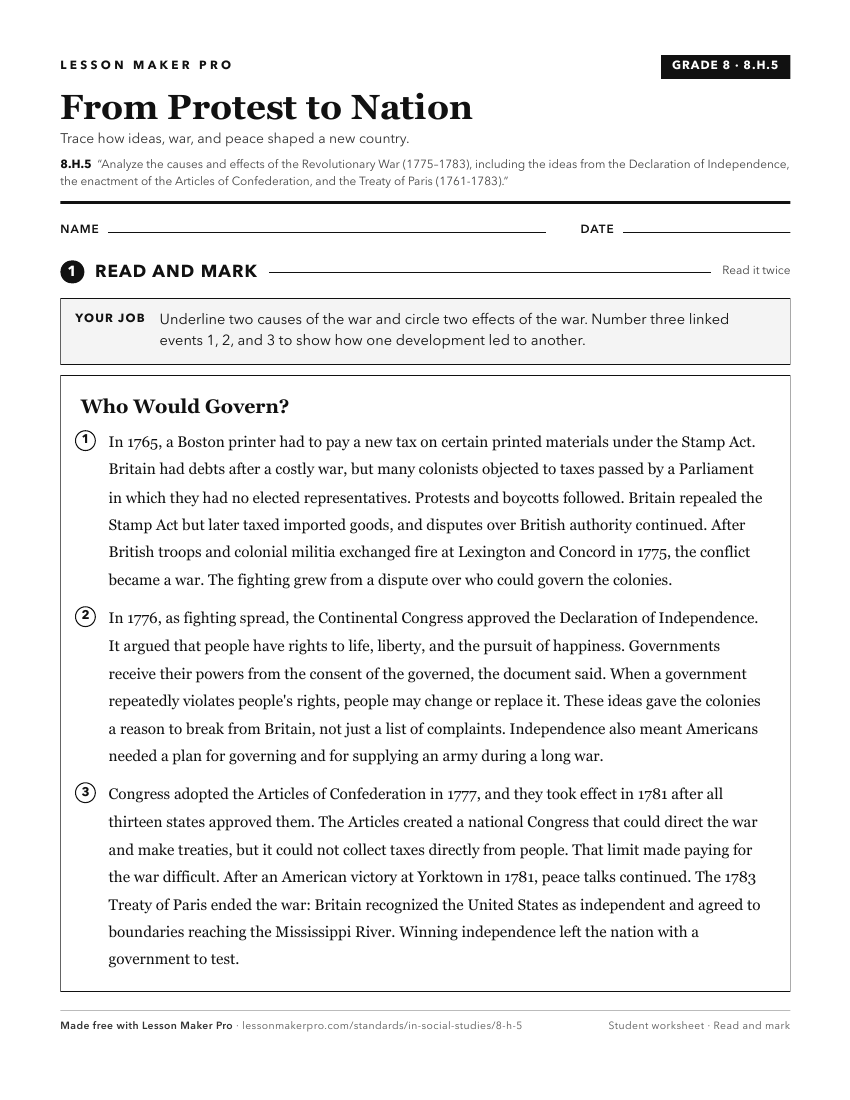
A ready-to-print activity worksheet aligned to 8.H.5, with an answer key for the teacher on its own page. No account needed.
PDF, US Letter, prints cleanly in black and white.
Download the worksheetKeep exploring
Related Standards
- USG.2.1
Analyze how colonial, revolutionary, and Founding Era events helped to inform the Framers on the design, ratification, and implementation of the United States C...
- 5.H.13
Explain consequences of the American Revolution, including the strengths and weaknesses of the Articles of Confederation, changes in trade relationships, and th...
- 8.H.4
Identify and explain the reasons and actions for the resistance and rebellion against British imperial rule by the 13 colonies in North America (1761–1775).
- 5.H.9
Analyze the causes of the American Revolution as outlined in the Declaration of Independence.
Turn this exact standard into a lesson
Grade, subject, topic, and the complete standard are prefilled. Create one free, no account needed.
Also for this standard:Make a WorksheetMake a QuizMake a Sub Lesson