Indiana Social Studies 8.H.3
The Standard
Explain the conditions, causes, consequences, and significance of Britain’s struggle to maintain control of colonies during the French and Indian War (1754–1763).
2026 Indiana Academic Standards: K-12 Social Studies
Teacher's field guide
What This Standard Means
What Students Need to Do
- Students explain why Britain and France fought over the Ohio Valley. They describe how French alliances with some Indigenous nations made British control harder. They connect Britain's victory to war debt, new settlement limits, and disputes with colonists.
What Mastery Looks Like
- A student can use 1754 and 1763 maps to show what Britain gained. They can explain why paying for the war and limiting western settlement strained Britain's ties with its colonies.
Common Misconceptions
- Students may think every Indigenous nation fought for France. They may also assume Britain's victory ended conflict on the frontier or that colonists became independent right after the war.
How to Assess It
- Give students a 1754 and 1763 map. Ask them to name one cause of the war, one challenge Britain faced, and one effect of its victory on colonists.
Lesson moves
Ways to Teach It
Have pairs color British and French claims on 1754 and 1763 maps, then mark the Ohio Valley and the 1763 settlement line.
Ask students to write three sentences answering: Why did winning the war make it harder for Britain to govern its colonies?
Deal cards labeled French forts, frontier raids, war debt, and settlement limits; have groups sort them into causes, wartime challenges, and consequences.
Find Fort Ouiatenon near Lafayette on a modern Indiana map and trace the Wabash River to discuss why that trade route mattered.
Free download
Printable 8.H.3 Worksheet
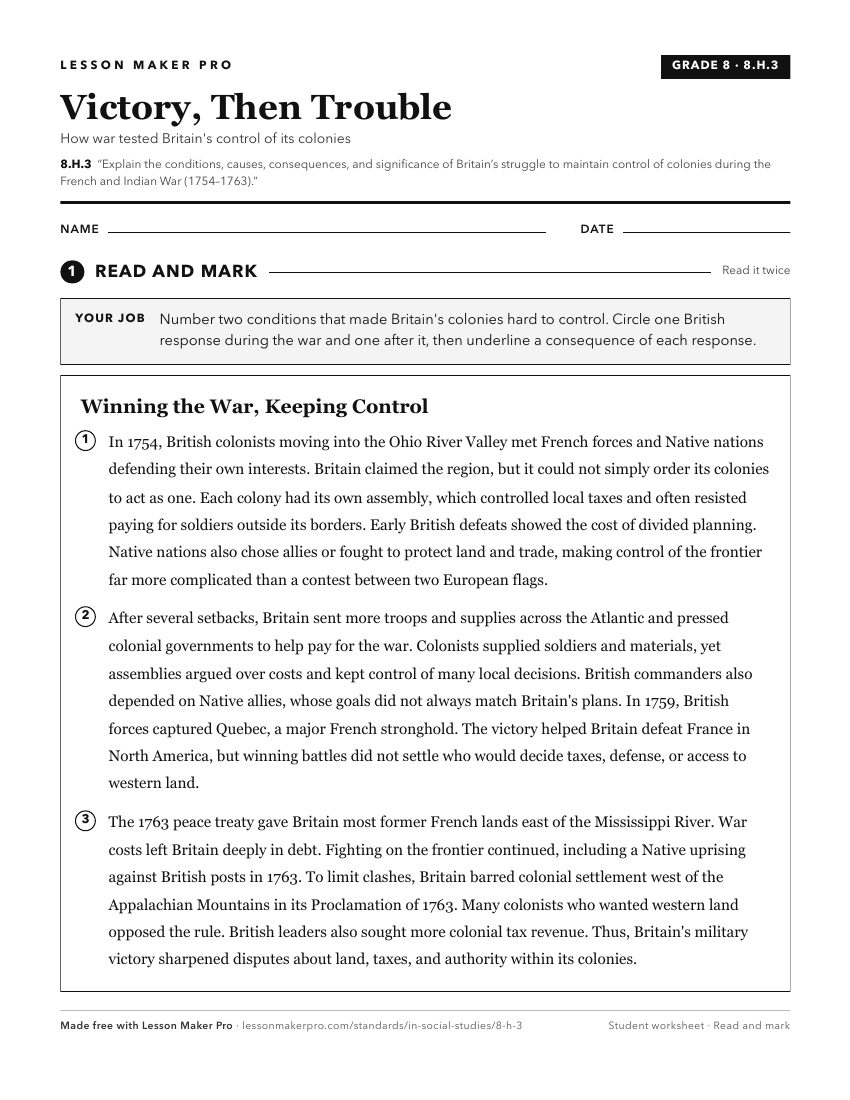
A ready-to-print activity worksheet aligned to 8.H.3, with an answer key for the teacher on its own page. No account needed.
PDF, US Letter, prints cleanly in black and white.
Download the worksheetKeep exploring
Related Standards
- 8.H.4
Identify and explain the reasons and actions for the resistance and rebellion against British imperial rule by the 13 colonies in North America (1761–1775).
- 8.H.2
Compare and contrast reasons for British, French, Spanish, and Dutch colonization in the New World.
- 8.H.5
Analyze the causes and effects of the Revolutionary War (1775–1783), including the ideas from the Declaration of Independence, the enactment of the Articles of ...
- 5.H.6
Identify and explain instances of both cooperation and conflict that existed between Native Americans and colonists.
Turn this exact standard into a lesson
Grade, subject, topic, and the complete standard are prefilled. Create one free, no account needed.
Also for this standard:Make a WorksheetMake a QuizMake a Sub Lesson