Indiana Social Studies 6.C.6
The Standard
Discuss the impact of major forms of government in Europe and the Americas on civil and human rights.
2026 Indiana Academic Standards: K-12 Social Studies
Teacher's field guide
What This Standard Means
What Students Need to Do
- Students compare how governments in Europe and the Americas have treated civil and human rights. They use examples to explain who could vote, speak openly, or receive a fair trial.
What Mastery Looks Like
- A student can explain that Britain’s constitutional monarchy has legal protections for speech, while Brazil’s military government censored newspapers. They can also explain why a country with elections might still deny rights to some people.
Common Misconceptions
- Students may think every monarch rules alone or that every democracy gives everyone equal rights. They may assume a right written in law is always protected in practice.
How to Assess It
- Exit ticket: Compare press freedom in Britain under its constitutional monarchy with press freedom under Brazil’s military government from 1964 to 1985. Name one government action that supports your answer.
Lesson moves
Ways to Teach It
Give pairs case cards stating Britain elects lawmakers and Brazil’s military censored newspapers; sort speech and voting cards under protected, restricted, or unclear.
Ask: Why did women lack the vote in the United States before 1920 despite its democratic government?
Play rights detective with scenarios about a banned newspaper, a rigged vote, a barred voter, and a jailed protester; teams name the right affected.
Open Freedom House country pages for Canada and Cuba; students compare reports on elections and free media, then link one difference to government rules.
Free download
Printable 6.C.6 Worksheet
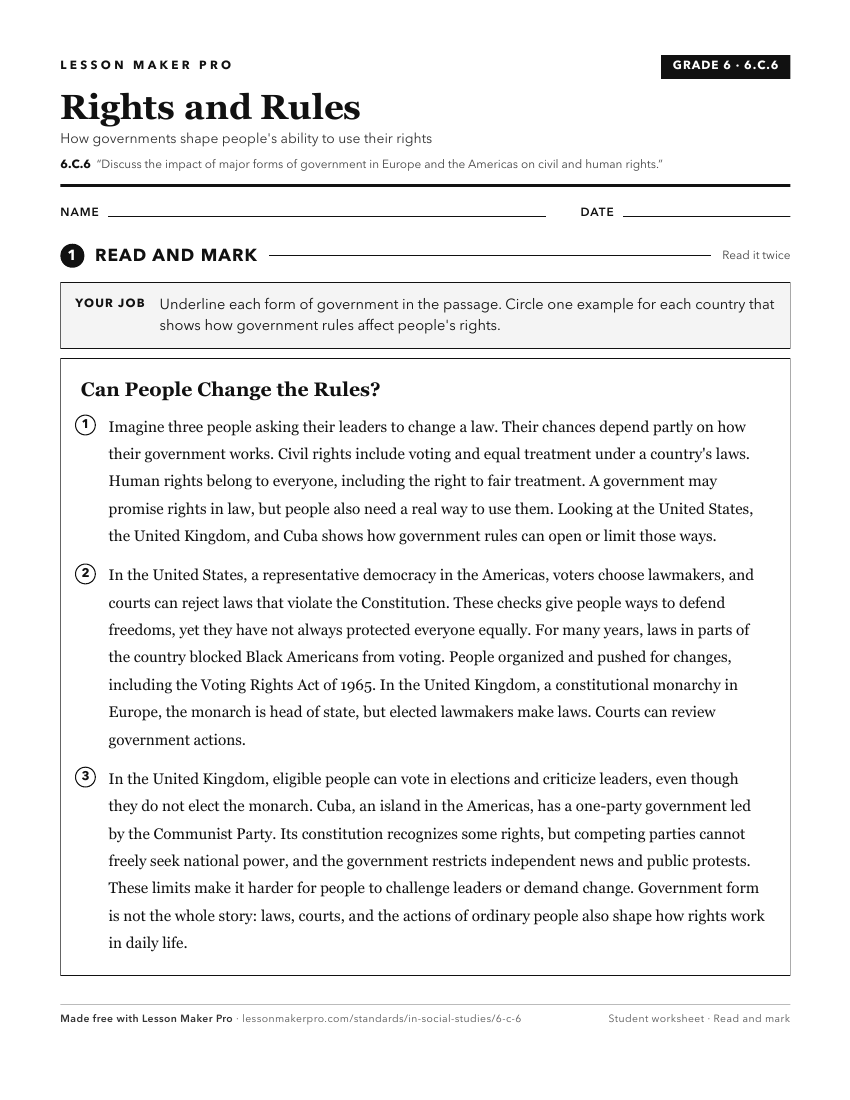
A ready-to-print activity worksheet aligned to 6.C.6, with an answer key for the teacher on its own page. No account needed.
PDF, US Letter, prints cleanly in black and white.
Download the worksheetKeep exploring
Related Standards
- 6.H.3
Identify and explain the development and organization of political, cultural, social, and economic systems in Europe and the Americas.
- 6.C.1
Compare and contrast major forms of governments in Europe and the Americas throughout history.
- 6.C.7
Define and compare the citizen’s role and methods of participation in civil society in civilizations of Europe and the Americas.
- 7.C.3
Describe how major forms of governments of Japan, North Korea, India, South Africa, and China currently protect or violate the human rights of their citizens.
Turn this exact standard into a lesson
Grade, subject, topic, and the complete standard are prefilled. Create one free, no account needed.
Also for this standard:Make a WorksheetMake a QuizMake a Sub Lesson