Indiana Social Studies 6.C.5
The Standard
Define the term nation-state and describe the rise of nation-states headed by monarchs in Europe from 1500 to 1700.
2026 Indiana Academic Standards: K-12 Social Studies
Teacher's field guide
What This Standard Means
What Students Need to Do
- Students explain what makes a nation-state: a defined territory, a central government, and people who share a sense of belonging. They describe how European monarchs gained more control over taxes, officials, and armies from 1500 to 1700.
What Mastery Looks Like
- A student can use Louis XIV's France to show how royal officials and a standing army strengthened the king's rule. They can explain why a kingdom with a monarch was not automatically a nation-state.
Common Misconceptions
- Students may call every kingdom a nation-state, even when its people did not share a national identity. They may think monarchs always controlled taxes and armies directly, rather than taking power from local nobles.
How to Assess It
- Exit ticket: Define nation-state. Then explain how either royal officials or a standing army helped Louis XIV strengthen his control over France.
Lesson moves
Ways to Teach It
On a map of France, pairs place tokens for royal tax collectors, judges, and soldiers, then explain how each helped the king.
Ask: Is every kingdom a nation-state? Have students write two sentences using France under Louis XIV as evidence.
Play a card sort with royal tax collector, standing army, royal judge, and independent local lord; pairs pick three that strengthened the monarch.
Show a modern passport cover beside a labeled portrait of Louis XIV; ask who represents the state in each image.
Free download
Printable 6.C.5 Worksheet
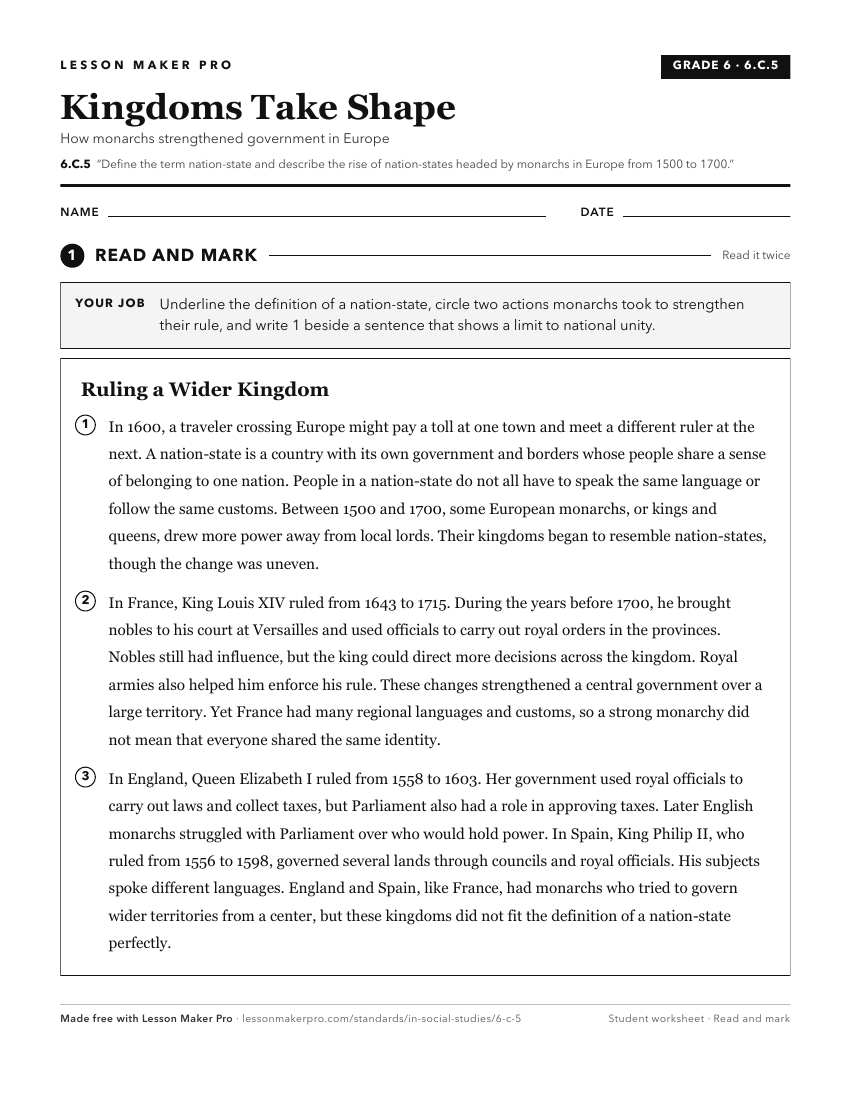
A ready-to-print activity worksheet aligned to 6.C.5, with an answer key for the teacher on its own page. No account needed.
PDF, US Letter, prints cleanly in black and white.
Download the worksheetKeep exploring
Related Standards
- WH.4.3
Discuss the emergence of nation-states as well as the increased impact of the citizen as a result of the decline of the European medieval period.
- WH.3.4
Explain the cultural, political, economic, and religious causes of the Crusades and their consequences for Europe and Southwest Asia, including the growth in po...
- GHW.10.1
Differentiate between a state (country) and a nation, specifically focusing on the concepts of territorial control and self-determination of internal and foreig...
- 8.H.15
Define nationalism and explain how it affected domestic policy, foreign policy, and the development of an industrial economy during this period.
Turn this exact standard into a lesson
Grade, subject, topic, and the complete standard are prefilled. Create one free, no account needed.
Also for this standard:Make a WorksheetMake a QuizMake a Sub Lesson