Indiana Social Studies 4.H.1
The Standard
Identify and compare the major early cultures that lived in the region of Indiana before the arrival of the Europeans and before Indiana became a state.
2026 Indiana Academic Standards: K-12 Social Studies
Teacher's field guide
What This Standard Means
What Students Need to Do
- Students use timelines, maps, and artifact pictures to study Native communities in the Indiana area. They learn the broad order of the Paleoindian, Archaic, Woodland, and Mississippian periods. They describe changes in tools, food, and settlements.
What Mastery Looks Like
- A student puts the four periods in broad order and gives an accurate clue for each. They compare two periods using evidence, such as early stone points and later corn farming.
Common Misconceptions
- Students may think everyone in the Indiana area lived the same way or farmed corn. They may mistake the four periods for the names of four tribes. Some assume Native peoples disappeared when Europeans arrived.
How to Assess It
- On an exit ticket, ask students to put the four periods in order. Then have them compare two periods using one tool, food, or settlement clue.
Lesson moves
Ways to Teach It
Give pairs dated period cards and pictures of a fluted point, grinding stone, pottery, and corn; have them build a floor timeline.
Show an early stone point and an Angel Mounds town diagram; ask, “What changed in how people lived, and what evidence supports that?”
Play a four-corner clue game: read “corn farming and a large town,” then have students choose a period and explain their choice.
Locate Angel Mounds near Evansville on an Indiana map, then use a site diagram to find the plaza and houses.
Free download
Printable 4.H.1 Worksheet
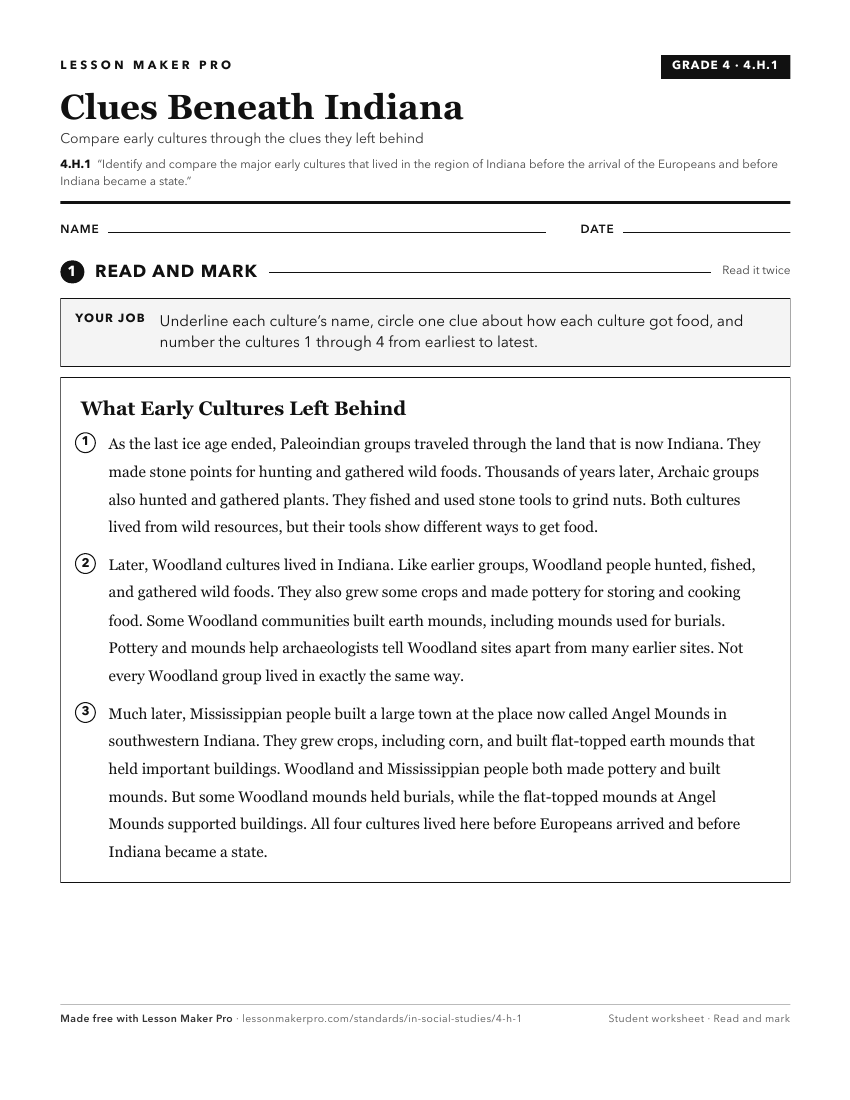
A ready-to-print activity worksheet aligned to 4.H.1, with an answer key for the teacher on its own page. No account needed.
PDF, US Letter, prints cleanly in black and white.
Download the worksheetKeep exploring
Related Standards
- 4.H.2
Identify and describe historic Native American groups that lived in Indiana at the time of early European exploration, including ways these groups adapted to an...
- IS.1.1
Identify two or more Native American groups that existed and describe their contributions to what is now the state of Indiana.
- IS.5.1
Describe the development of Hoosier culture after the pioneer era settled the land.
- 5.H.1
Identify and describe early cultures and settlements that existed in North America prior to contact with Europeans.
Turn this exact standard into a lesson
Grade, subject, topic, and the complete standard are prefilled. Create one free, no account needed.
Also for this standard:Make a WorksheetMake a QuizMake a Sub Lesson