Indiana Social Studies 4.C.4
The Standard
Identify major state offices, the duties and powers associated with them, and how they are chosen, such as by election or appointment.
2026 Indiana Academic Standards: K-12 Social Studies
Teacher's field guide
What This Standard Means
What Students Need to Do
- Students name major Indiana offices, such as governor, attorney general, and secretary of education. They match each office to a job and tell whether voters elect the person or the governor appoints them.
What Mastery Looks Like
- A student can explain that voters elect the governor, who signs or vetoes bills, and the attorney general, who represents Indiana in court. They can also explain that the governor appoints the secretary of education to lead the state education department.
Common Misconceptions
- Students may think the governor makes laws alone or that the attorney general is a judge. They may assume every state official wins an election, including the appointed secretary of education.
How to Assess It
- Ask on an exit ticket: “Who chooses Indiana’s governor and secretary of education? Write one job each person does.”
Lesson moves
Ways to Teach It
Give pairs office, duty, and selection cards for governor, attorney general, and secretary of education; have them build three correct sets.
Ask, “Why might voters elect a governor but let the governor appoint a secretary of education?” Have students write two sentences.
Play “Who am I?” Read “I represent Indiana in court”; students hold up an attorney general card and say how the office is filled.
Show a past Indiana ballot listing the governor and the education department page naming its secretary; students label each office elected or appointed.
Free download
Printable 4.C.4 Worksheet
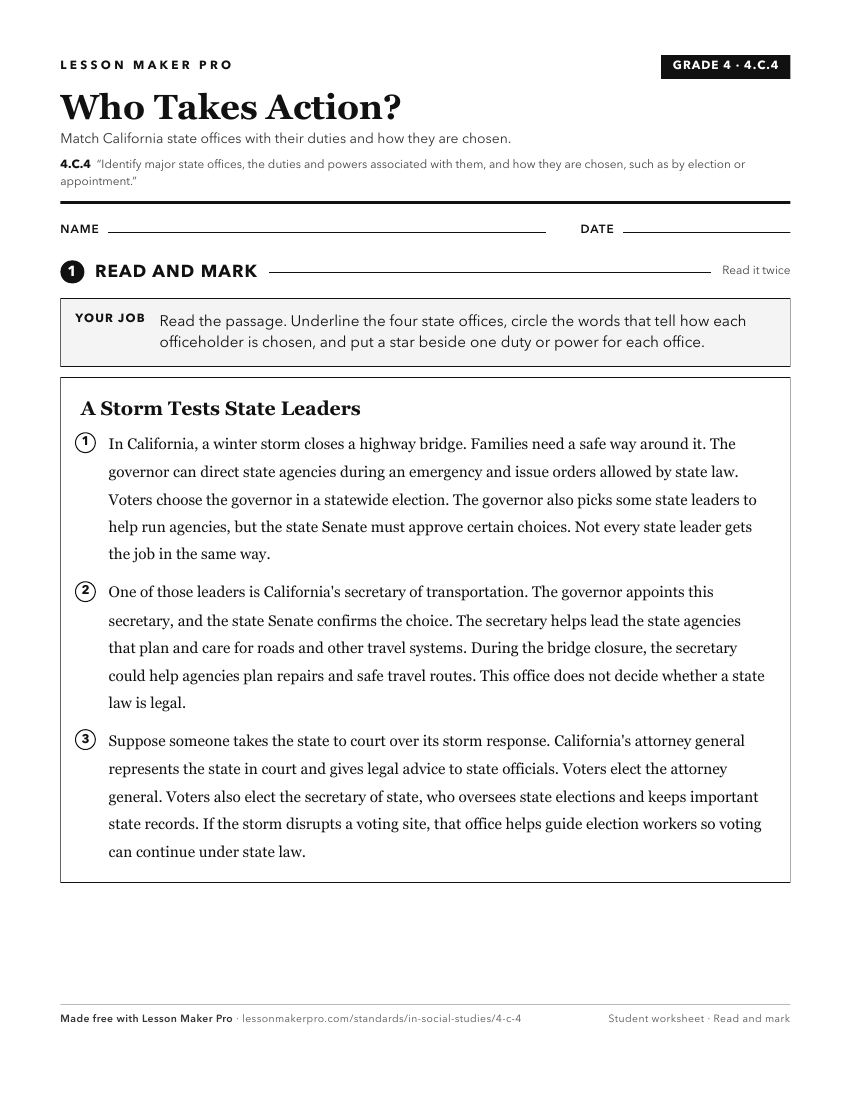
A ready-to-print activity worksheet aligned to 4.C.4, with an answer key for the teacher on its own page. No account needed.
PDF, US Letter, prints cleanly in black and white.
Download the worksheetKeep exploring
Related Standards
- 4.C.3
Identify and explain the major responsibilities of the legislative (Article 4), executive (Article 5), and judicial branches (Article 7) of state government as ...
- 3.C.2
Identify and explain the duties of and selection process for local and state government officials who make, implement, and enforce laws.
- 5.C.4
Describe the primary and general election processes for local, state, and federal offices, including those used to select congressional and presidential office ...
- IS.2.4
Give examples of how citizens can participate in their state government and explain their rights and responsibilities, including civic engagement and voting.
Turn this exact standard into a lesson
Grade, subject, topic, and the complete standard are prefilled. Create one free, no account needed.
Also for this standard:Make a WorksheetMake a QuizMake a Sub Lesson