Indiana Social Studies 1.C.2
The Standard
Define and give examples of rules and laws in the school and the community, and explain the benefits of these rules and laws.
2026 Indiana Academic Standards: K-12 Social Studies
Teacher's field guide
What This Standard Means
What Students Need to Do
- Students tell the difference between a school rule and a community law. They give an example of each and explain how it helps people.
What Mastery Looks Like
- A student identifies walking in the hall as a school rule and stopping at a red light as a law. They explain that one prevents bumps and the other prevents crashes.
Common Misconceptions
- Students may think every rule is a law, or that laws are only for adults. They may think rules exist just to get people in trouble.
How to Assess It
- Ask on an exit slip: “Is walking in the hall a school rule or a law? Is stopping at a red light a school rule or a law? How does each help?”
Lesson moves
Ways to Teach It
Have pairs sort picture cards showing walking in halls, raising a hand, stopping at red lights, and wearing seat belts in cars.
Ask, “What might happen if drivers ignored red lights? How does stopping help people crossing the street?”
Play a matching game with cards: pair “walk in the hall” with “fewer bumps” and “stop at a red light” with “fewer crashes.”
Show a photo of a nearby stop sign; ask what drivers must do and who that helps.
Free download
Printable 1.C.2 Worksheet
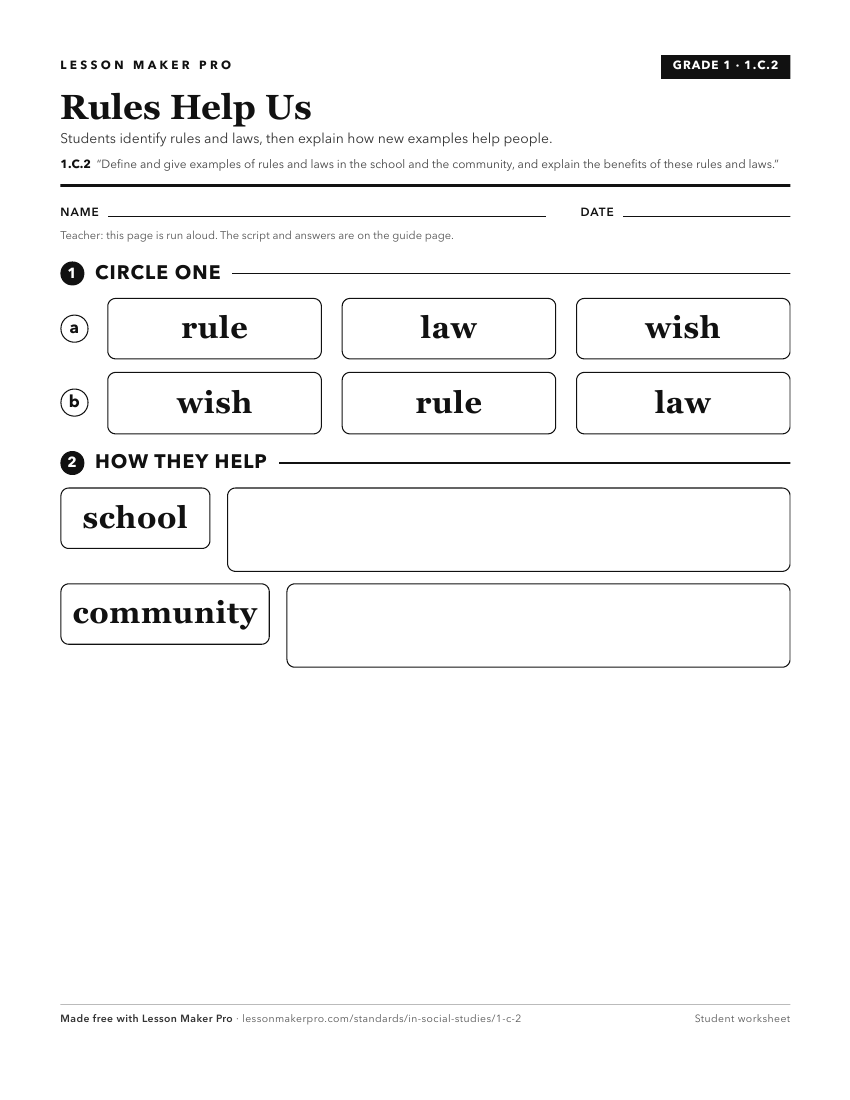
A ready-to-print activity worksheet aligned to 1.C.2, with an answer key for the teacher on its own page. No account needed.
PDF, US Letter, prints cleanly in black and white.
Download the worksheetKeep exploring
Related Standards
- K.C.1
Give examples of classroom and school rules, and explain the importance of following these rules to ensure order and safety.
- USG.1.6
Define and provide historical and contemporary examples of constitutionalism, rule of law, limited government, and popular sovereignty in the United States Cons...
- 3.C.5
Explain the role citizens have in making decisions and rules within the community, state, and nation, such as participating in local and regional activities, vo...
- 1.C.3
Describe ways that individual actions can contribute to the common good of the classroom or community.
Turn this exact standard into a lesson
Grade, subject, topic, and the complete standard are prefilled. Create one free, no account needed.
Also for this standard:Make a WorksheetMake a QuizMake a Sub Lesson