Indiana Science HS-PSII-2.3
The Standard
Cite evidence from everyday life to describe the transfer of thermal energy by conduction, convection, and radiation.
Indiana Academic Standards for Science (2023) · Temperature and Thermal Energy Transfer
Teacher's field guide
What This Standard Means
What Students Need to Do
- Students explain how thermal energy moves through direct contact, moving liquids or gases, and radiation. They use everyday observations as evidence and identify what gains energy.
What Mastery Looks Like
- A student can explain why a spoon handle warms in soup, colored water rises in a heated beaker, and a sunlit bench gets warmer than one in shade. They identify the transfer method and cite an observation for each.
Common Misconceptions
- Some students say a metal spoon makes heat instead of conducting energy from the soup. Others call rising warm water conduction or think radiation needs air to carry it.
How to Assess It
- Exit ticket: A spoon handle warms in soup, colored water rises in a heated beaker, and a sunlit bench is warmer than a shaded one. Name each transfer method and give one observed clue for each.
Lesson moves
Ways to Teach It
Place metal and wooden spoons in warm water for two minutes, feel their handles, and explain which conducted energy faster.
Show a video of food coloring rising from the bottom of a heated beaker; ask what moves upward and what the color reveals.
Sort picture cards of a hot pan handle, boiling soup, and a sunlit bench by transfer method, then give a clue for each choice.
Study a photo of an oven mitt gripping a hot pan, then explain how the mitt slows energy transfer to the cook's hand.
Free download
Printable HS-PSII-2.3 Worksheet
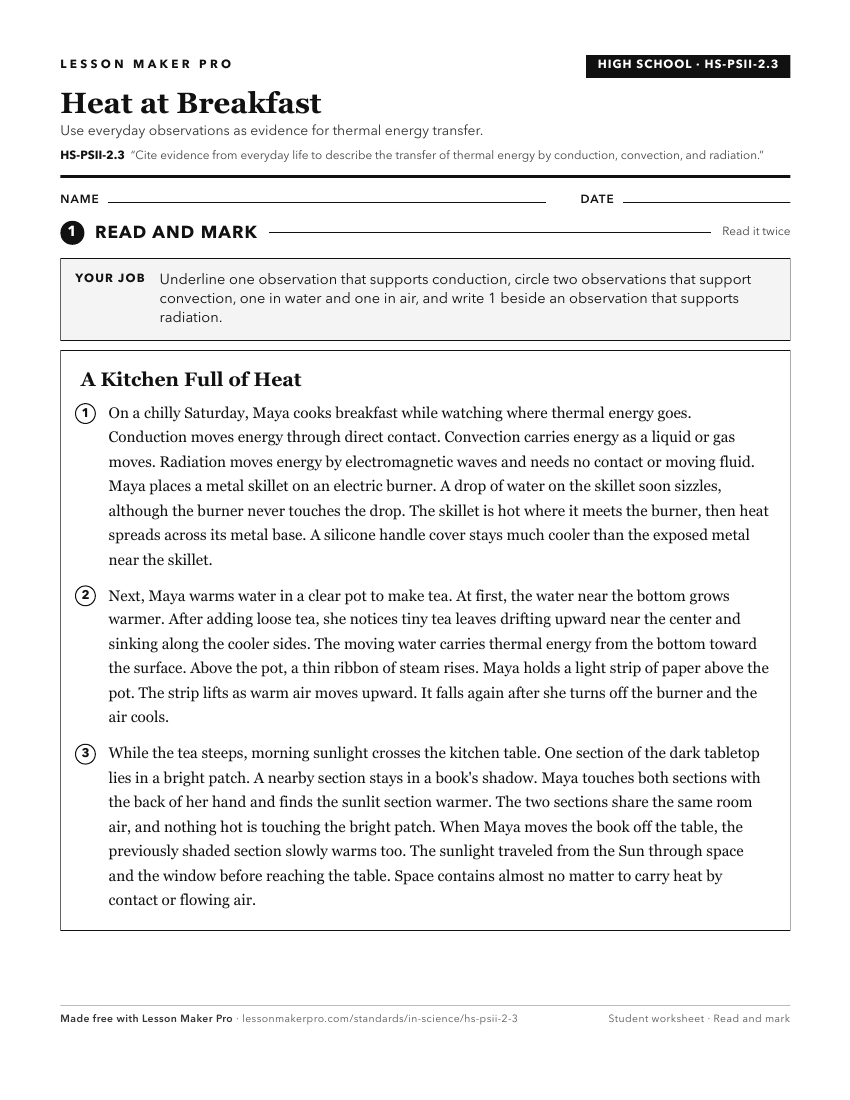
A ready-to-print activity worksheet aligned to HS-PSII-2.3, with an answer key for the teacher on its own page. No account needed.
PDF, US Letter, prints cleanly in black and white.
Download the worksheetKeep exploring
Related Standards
Turn this exact standard into a lesson
Grade, subject, topic, and the complete standard are prefilled. Create one free, no account needed.
Also for this standard:Make a WorksheetMake a QuizMake a Sub Lesson