Indiana Science HS-ENV1-4
The Standard
Analyze data regarding differences between systems in equilibrium and systems in disequilibrium. Use corresponding data to support how steady state is achieved through negative and positive feedback loops.
Indiana Academic Standards for Science (2023) · Environmental Systems
Teacher's field guide
What This Standard Means
What Students Need to Do
- Students read data collected over time to tell a steady system from one that is changing. They use numbers to explain how one feedback loop speeds change while another slows it.
What Mastery Looks Like
- A student can recognize a steady pattern even when readings vary slightly. They can cite population, birth, and food data to explain why growth speeds up, then levels off.
Common Misconceptions
- Students may call any small fluctuation disequilibrium or assume a flat graph means nothing enters or leaves. They may think positive feedback stabilizes a system or that negative feedback is harmful. Positive feedback amplifies change, while negative feedback counters it.
How to Assess It
- Exit ticket: Pond snails by week are 20, 30, 45, 50, 51; births are 5, 9, 14, 5, 4; food units are 90, 80, 55, 30, 28. Mark when counts begin to level off, then use birth and food numbers to explain both feedback loops.
Lesson moves
Ways to Teach It
Use 10 snail counters and 20 food counters; each round, add one snail per five, spend one food per snail, remove unfed snails, replenish ten.
Ask: Why do snails rise from 20 to 45, then level near 51 as food drops from 90 to 28?
Have teams sort count cards (10, 11, 10, 9; 10, 15, 22, 31) into steady or changing, then justify one choice.
Show before-and-after Arctic sea ice maps; ask how exposed dark water absorbs more sunlight and speeds further melting.
Free download
Printable HS-ENV1-4 Worksheet
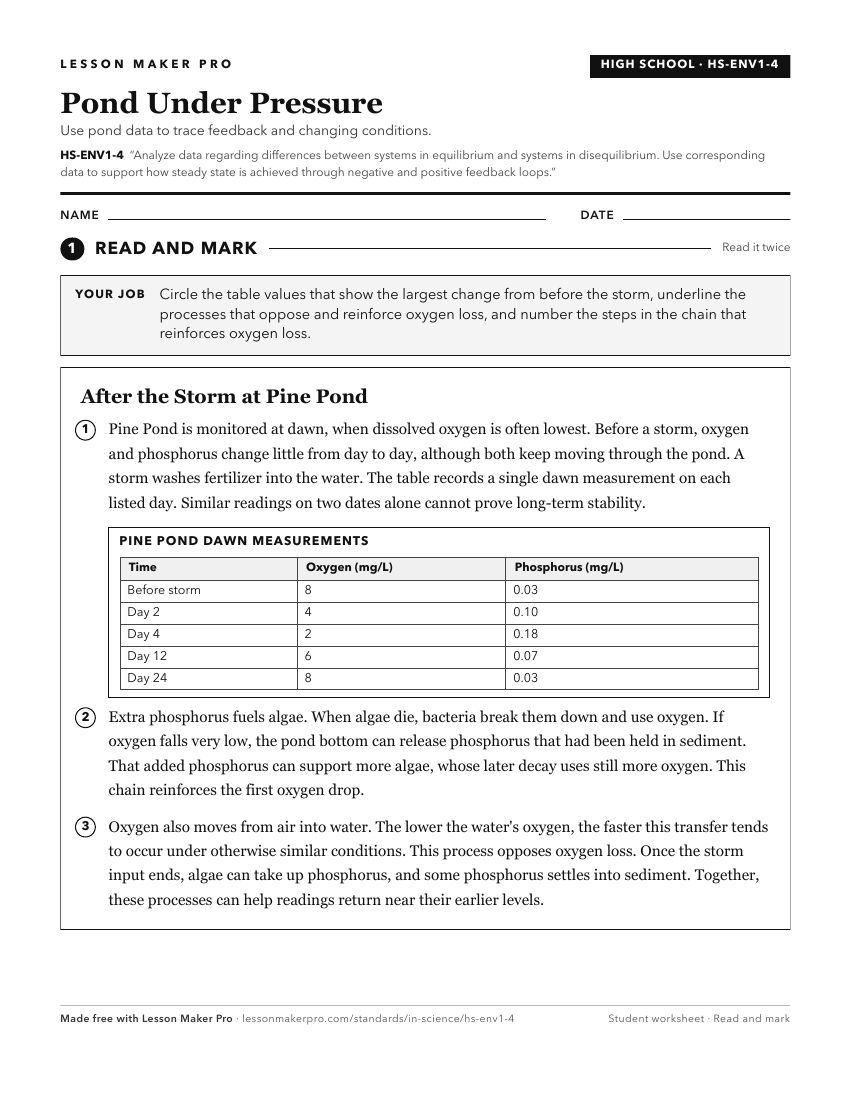
A ready-to-print activity worksheet aligned to HS-ENV1-4, with an answer key for the teacher on its own page. No account needed.
PDF, US Letter, prints cleanly in black and white.
Download the worksheetKeep exploring
Related Standards
- HS-AP8-7
Design an experiment to illustrate how the cardiovascular system maintains homeostasis.
- HS-AP1-1
Plan and conduct and investigation to provide evidence that feedback mechanisms maintain homeostasis in humans.
- HS-ICP3-1
Quantitatively analyze various scenarios to describe how the change of energy in one component in a system responds to the change in energy of the other compone...
Turn this exact standard into a lesson
Grade, subject, topic, and the complete standard are prefilled. Create one free, no account needed.
Also for this standard:Make a WorksheetMake a QuizMake a Sub Lesson