Indiana Science HS-AP8-5
The Standard
Use a diagram and/or a model of the heart to illustrate the external and internal structures, the vessels entering and exiting, unidirectional blood flow and how the heart supports pulmonary and cardiac circulation.
Indiana Academic Standards for Science (2023) · Transport, Blood and the Cardiovascular System
Teacher's field guide
What This Standard Means
What Students Need to Do
- Students identify the chambers, valves, septum, and major vessels on a heart diagram or model. They trace one-way blood flow through the heart, lungs, and body. They also show how blood reaches the heart muscle.
What Mastery Looks Like
- Students can label where blood enters and leaves each side of the heart and draw arrows through the correct valves. They can trace blood from the aorta through the coronary arteries to the heart muscle and back to the right atrium.
Common Misconceptions
- Students may think every artery carries oxygen-rich blood, so they label the pulmonary artery incorrectly. They may reverse left and right on a heart diagram. Some think blood inside the chambers directly supplies the heart muscle.
How to Assess It
- Hand out an unlabeled heart diagram. Ask students to label the chambers, valves, vena cavae, pulmonary vessels, aorta, and coronary arteries, then draw arrows showing flow to the lungs, body, and heart muscle.
Lesson moves
Ways to Teach It
Place red and blue yarn on a printed heart diagram to trace blood through the chambers, valves, lungs, and aorta.
Ask, "Why does the pulmonary artery carry oxygen-poor blood?" Have students answer using the direction blood travels.
Give pairs shuffled chamber, valve, and vessel cards, then have them arrange the cards in blood-flow order.
Show a diagram of a blocked coronary artery and ask which part of the heart muscle loses its blood supply.
Free download
Printable HS-AP8-5 Worksheet
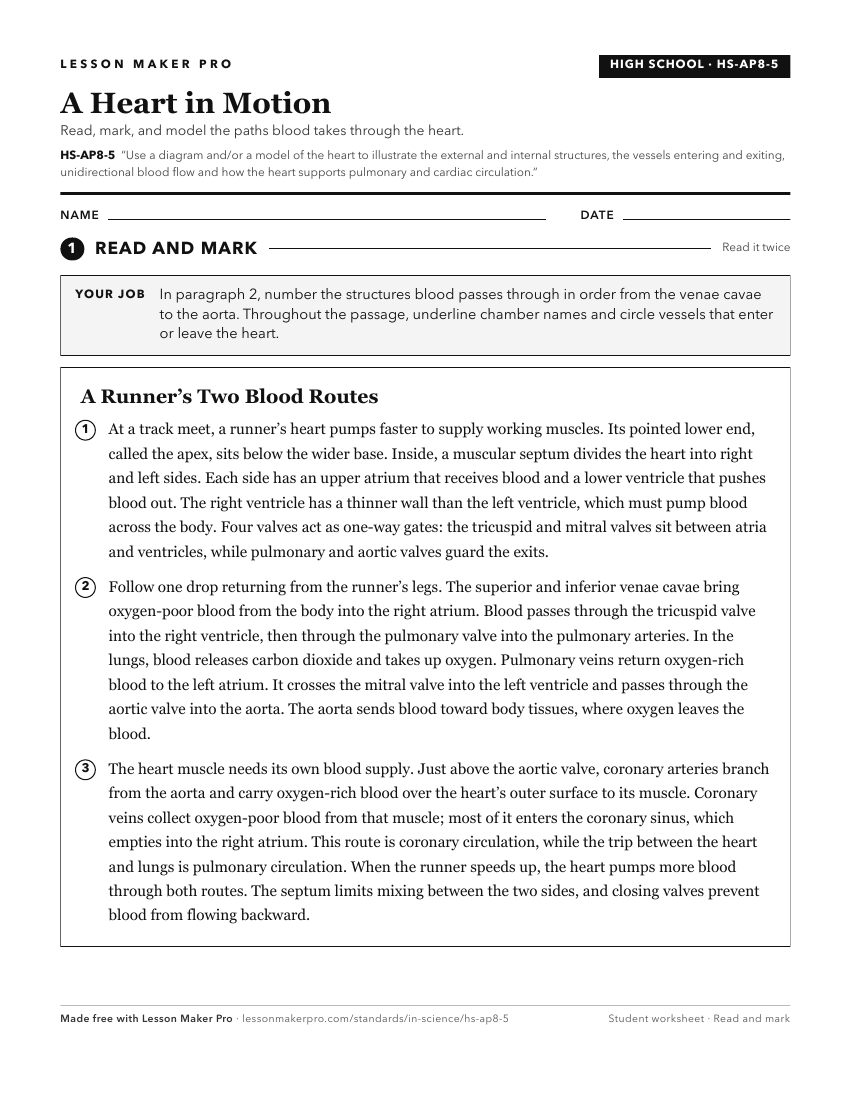
A ready-to-print activity worksheet aligned to HS-AP8-5, with an answer key for the teacher on its own page. No account needed.
PDF, US Letter, prints cleanly in black and white.
Download the worksheetKeep exploring
Related Standards
- HS-AP8-4
Create a model of vasoconstriction and vasodilation to demonstrate the structural and functional difference between arteries and veins.
- HS-AP8-3
Investigate the primary structures of the cardiovascular system and explore their functional importance to maintaining homeostasis.
- HS-AP8-7
Design an experiment to illustrate how the cardiovascular system maintains homeostasis.
- HS-AP1-2
Develop and use a model to illustrate the hierarchical organization of structural body systems that provide specific functions within the Human Body.
Turn this exact standard into a lesson
Grade, subject, topic, and the complete standard are prefilled. Create one free, no account needed.
Also for this standard:Make a WorksheetMake a QuizMake a Sub Lesson