Indiana Science HS-AP4-5
The Standard
Use a diagram, model, or dissection to identify major muscle groups.
Indiana Academic Standards for Science (2023) · Movement and Support, the Muscular System
Teacher's field guide
What This Standard Means
What Students Need to Do
- Students use body landmarks, such as shoulders, upper arms, and thighs, to find and name muscle groups. They check front and back views so they do not miss groups shown from only one side.
What Mastery Looks Like
- A student labels major groups on front and back body diagrams, including the deltoids, pectorals, biceps, triceps, gluteals, quadriceps, hamstrings, and calves. They can find the same groups on a model or dissection photo.
Common Misconceptions
- Students often put biceps and triceps on the same side of the upper arm, or swap quadriceps and hamstrings. They may assume every muscle appears in a front view and leave the gluteals or hamstrings unlabeled.
How to Assess It
- Give students an unlabeled front-and-back body outline. Ask them to label the biceps, triceps, gluteals, quadriceps, hamstrings, and calves.
Lesson moves
Ways to Teach It
Give pairs a paper body outline and colored sticky notes; have them place and label six muscle groups on the correct view.
Show front and back arm diagrams; ask students to write where the biceps and triceps sit and how they tell them apart.
Give groups muscle-name cards and an unlabeled body poster; have them place each card, then check their work against an anatomy diagram.
Have students watch someone do a squat, then mark the quadriceps, hamstrings, and gluteals on a leg diagram.
Free download
Printable HS-AP4-5 Worksheet
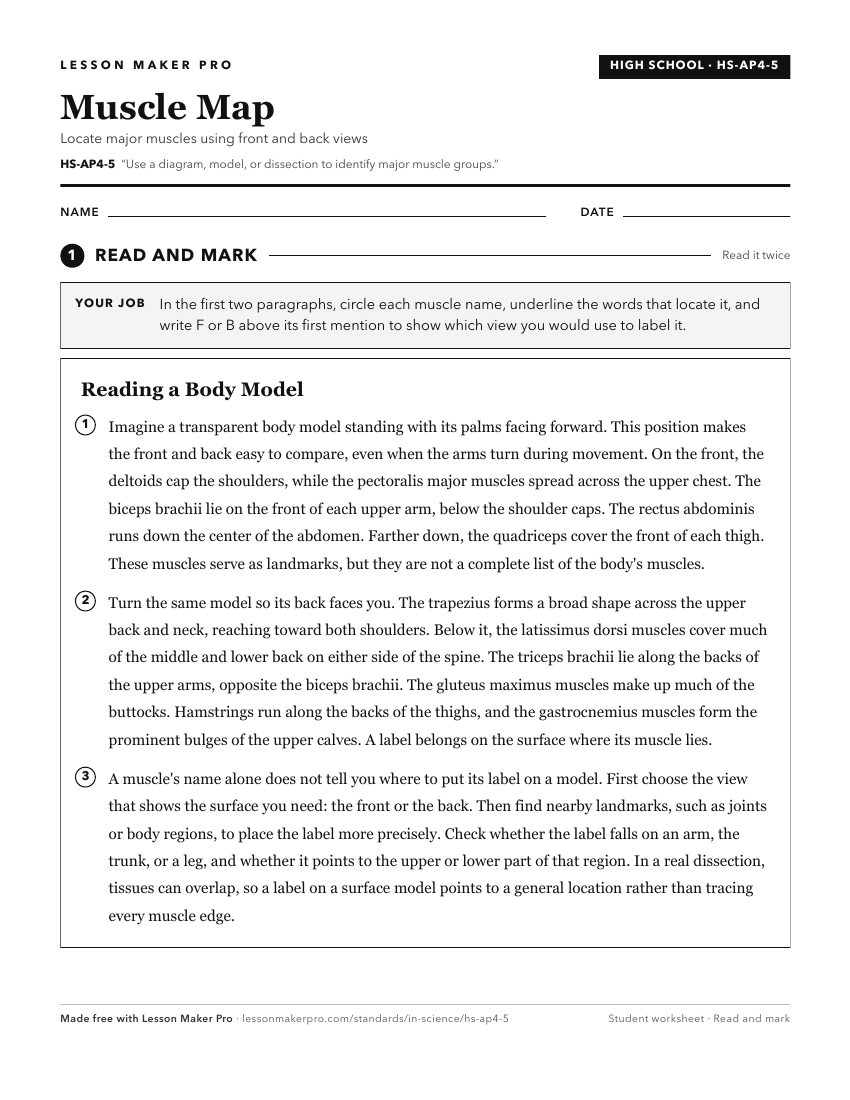
A ready-to-print activity worksheet aligned to HS-AP4-5, with an answer key for the teacher on its own page. No account needed.
PDF, US Letter, prints cleanly in black and white.
Download the worksheetKeep exploring
Related Standards
- HS-AP10-1
Identify and locate major and accessory organs of the digestive system and investigate their physiological functions.
- HS-AP1-2
Develop and use a model to illustrate the hierarchical organization of structural body systems that provide specific functions within the Human Body.
- HS-AP1-6
Identify anatomical terms (including anatomical orientation, regions, planes) on a diagram, model, or through dissection.
- HS-AP4-2
Develop a model to illustrate the components of a muscle fiber and how they interact in contraction and relaxation.
Turn this exact standard into a lesson
Grade, subject, topic, and the complete standard are prefilled. Create one free, no account needed.
Also for this standard:Make a WorksheetMake a QuizMake a Sub Lesson