Indiana ELA 9-10.CC
Standard Cluster
Students actively engage in listening, discussing, and presenting ideas justified by sound reasoning and textual evidence while also evaluating and identifying fallacious reasoning or distorted evidence.
Indiana Academic Standards for English/Language Arts (2023)
Cluster contents
Standards in This Cluster
9-10.CC is a cluster heading. These are the individual standards under it.
- 9-10.CC.1
Initiate and participate effectively in a range of collaborative discussions on grade-appropriate topics, texts, and issues, building on others' ideas and expre...
- 9-10.CC.2
Examine, analyze, and reflect on ideas under discussion by providing textual evidence to support or refute those ideas. (E)
- 9-10.CC.5
Analyze multiple sources of information presented in diverse media and formats while evaluating the credibility and accuracy of each source.
- 9-10.CC.6
Evaluate a speaker's perspective, reasoning, and use of evidence and rhetoric, identifying any fallacious reasoning or distorted evidence.
- 9-10.CC.7
Present information, findings, and supporting evidence logically so that listeners can follow the line of reasoning, ensuring organization and development are a...
- 9-10.CC.8
Analyze bias in media through the inclusion or exclusion of information and reliability of the source from visual and verbal messages to achieve a desired resul...
- 9-10.CC.1aInitiate and/or participate appropriately in a discussion with others on an instructional-level topic, text, and/or issue. (E)
- 9-10.CC.2aProvide textual evidence to support or refute one or more ideas under discussion. (E)
- 9-10.CC.3aPose or respond to questions that relate the current discussion to broader themes and larger ideas.
- 9-10.CC.4aRespond appropriately to two or more perspectives; identify at least one point of agreement and disagreement, and, when warranted, justify personal views and understandings or make new connections in reference to the evidence and reasoning presented. (E)
- 9-10.CC.5aAnalyze three or more sources of information presented in diverse media and determine the credibility of each source.
- 9-10.CC.6aEvaluate the evidence and rhetoric a speaker uses to develop their perspective and reasoning; identify any false evidence or distorted reasoning.
- 9-10.CC.7aPresent on a topic using a logical sequence of ideas, appropriate facts, and relevant, descriptive details to support the main ideas.
- 9-10.CC.8aAnalyze bias in media through visual or verbal messaging. (E)
Teacher's field guide
What This Cluster Means
What Students Need to Do
- Students listen to a classmate's claim and respond to the point made. They present their own claim with a relevant line from a text and explain how it supports their thinking. They also spot quotes taken out of context and conclusions that go beyond the evidence.
What Mastery Looks Like
- A student quotes a source accurately and explains how it supports a claim. In discussion, they restate a peer's point before agreeing or challenging it. They can explain why one example does not prove a claim about everyone.
Common Misconceptions
- Students may think any quote proves their claim, even when the surrounding lines change its meaning. They may treat one person's experience as proof about a whole group. Some call an argument flawed simply because they disagree with its conclusion.
How to Assess It
- Give pairs this claim: 'Two students missed a quiz while texting, so phones make everyone fail.' Ask each student to explain the weak reasoning, then restate their partner's explanation.
Lesson moves
Ways to Teach It
Give groups a short article and a misleading quote from it; have them highlight the omitted lines that change the quote's meaning.
Have pairs read a short school lunch editorial; ask, 'Which line supports its claim?' Partners must restate each other's answers before responding.
Make cards with claims and evidence, including one sweeping claim from a single example; teams sort them into supported, weak, or distorted.
Post the week's lunch menu beside 'The cafeteria never serves vegetables'; students check the claim against the menu and write a reply.
Free download
Printable 9-10.CC Worksheet
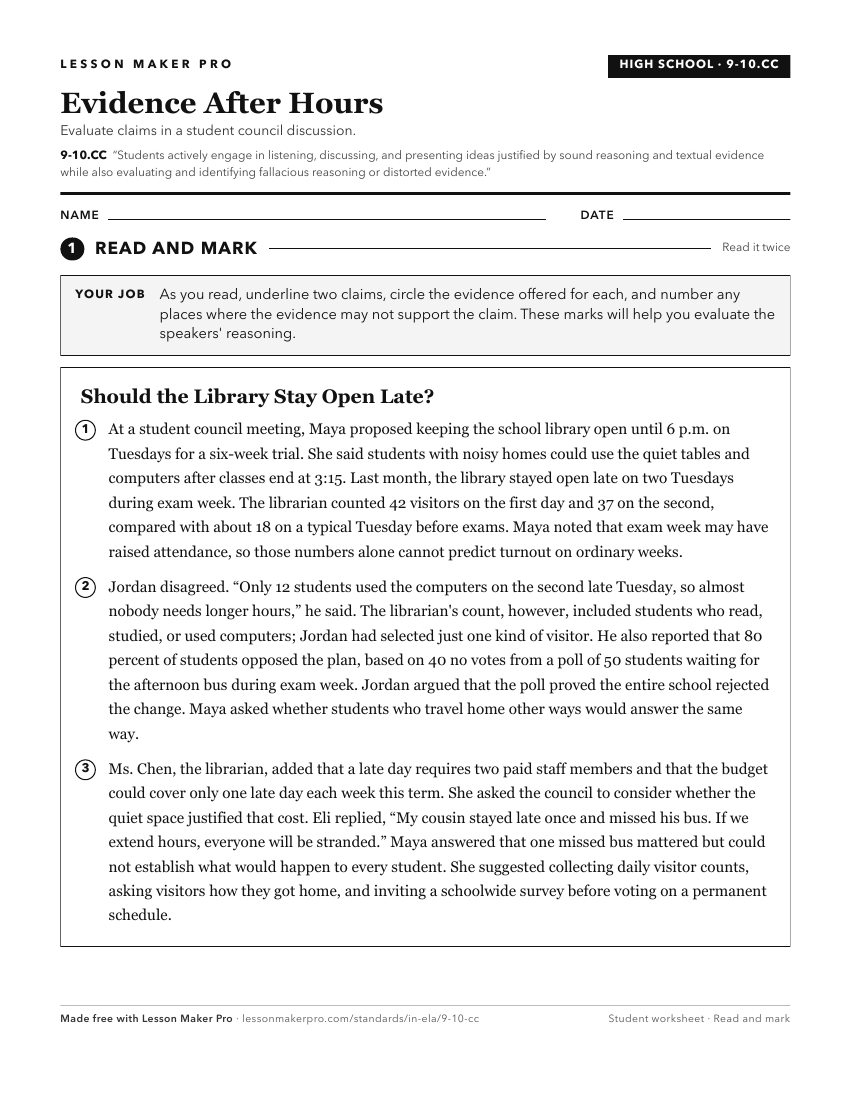
A ready-to-print activity worksheet aligned to 9-10.CC, with an answer key for the teacher on its own page. No account needed.
PDF, US Letter, prints cleanly in black and white.
Download the worksheetKeep exploring
Related Standards
- 8.CC
Students actively engage in listening, discussing, and presenting ideas justified by sound reasoning and textual evidence.
- 6.CC
Students actively engage in listening, discussing, and presenting ideas using text and other sources of evidence to drive and demonstrate their thoughts.
- 7.CC
Students actively engage in listening, discussing, and presenting ideas using text and other sources of evidence to drive and demonstrate their thoughts.
- 11-12.CC
Students discuss and debate ideas based on research and specific evidence, allowing for all perspectives to be heard, and assessing and analyzing a speaker's st...
Turn this cluster into a lesson
Grade, subject, topic, and the complete cluster are prefilled. Create one free, no account needed.
Also for this cluster:Make a WorksheetMake a QuizMake a Sub Lesson