Indiana ELA 11-12.CC
Standard Cluster
Students discuss and debate ideas based on research and specific evidence, allowing for all perspectives to be heard, and assessing and analyzing a speaker's stylistic choices.
Indiana Academic Standards for English/Language Arts (2023)
Cluster contents
Standards in This Cluster
11-12.CC is a cluster heading. These are the individual standards under it.
- 11-12.CC.1
Initiate and engage in a range of collaborative discussions on grade-appropriate topics, texts, and issues, building on others' ideas and expressing personal id...
- 11-12.CC.2
Engage in a thoughtful, well-reasoned exchange of ideas by referring to specific evidence. (E)
- 11-12.CC.4
Conduct, debate, and discuss to allow all views to be presented; allow for a dissenting view, in addition to group compromise; and determine what additional inf...
- 11-12.CC.5
Evaluate a speaker's perspective, reasoning, and use of evidence and rhetoric, as well as assessing stylistic choices such as word choice, points of emphasis, a...
- 11-12.CC.6
Using a range of informal and formal tasks, present information, findings, and supporting evidence, conveying a clear and distinct perspective, such that listen...
- 11-12.CC.7
Develop engaging presentations that make strategic and creative use of digital media (e.g., textual, graphical, audio, visual, and interactive elements) to add ...
- 11-12.CC.8
Analyze the impact of the media on the public, including identifying and analyzing rhetorical and logical fallacies. (E)
- 11-12.CC.1aInitiate and/or participate appropriately in more than one discussion with others on an instructional-level topic, text, and/or issue. (E)
- 11-12.CC.2aEngage in an exchange of ideas by referring to specific evidence. (E)
- 11-12.CC.3aPose or respond to multiple questions that probe for reasoning or evidence, and that actively seek the ideas and opinions of others in one or more discussions.
- 11-12.CC.4aEngage appropriately in debates or discussions with others who have diverse or divergent perspectives. (E)
- 11-12.CC.5aEvaluate a speaker’s perspective, reasoning, and use of evidence and/or rhetoric by identifying stylistic choices, such as word choice, tone, and/or points of emphasis. (E)
- 11-12.CC.6aUsing a range of informal and formal tasks, report on a topic using a logical sequence of ideas, appropriate facts, and relevant examples to support the main ideas and/or address opposing perspectives.
- 11-12.CC.7aCreate presentations that include digital media (e.g., textual, graphical, audio, visual, and interactive elements) to add interest and enhance audience understanding. (E)
- 11-12.CC.8aAnalyze how the media impacts the views of the public, including identifying the use of rhetorical and logical fallacies. (E)
Teacher's field guide
What This Cluster Means
What Students Need to Do
- Students use research to make and defend a claim in a discussion or debate. They listen to different views and respond to counterclaims. They explain how a speaker's word choice, tone, or repetition affects the message.
What Mastery Looks Like
- A student cites a source, answers a counterclaim fairly, and invites a classmate who has not spoken to weigh in. They point to a speaker's specific words and explain their effect on listeners.
Common Misconceptions
- Students may treat a strong opinion as evidence or repeat a number without checking its source. Some think hearing a view means agreeing with it. Others call a speaker persuasive without pointing to a word choice or delivery choice.
How to Assess It
- Give students a short speech excerpt and two source cards on later school start times. Ask them to write a claim with cited evidence, state a fair opposing view, and explain the effect of one phrase in the speech.
Lesson moves
Ways to Teach It
Give pairs two short source excerpts on later school start times; have them sort claims, data, and counterclaims into labeled piles.
Hold a four-person debate on later school start times; require each student to cite evidence, invite dissent, and identify one speaker's wording choice.
Play a response round: read a short speech aloud, then draw cards labeled evidence, counterclaim, tone, or repetition and respond.
Watch two minutes of a local school board meeting; list each speaker's claim, cited evidence, and tone, then note whose concern went unanswered.
Free download
Printable 11-12.CC Worksheet
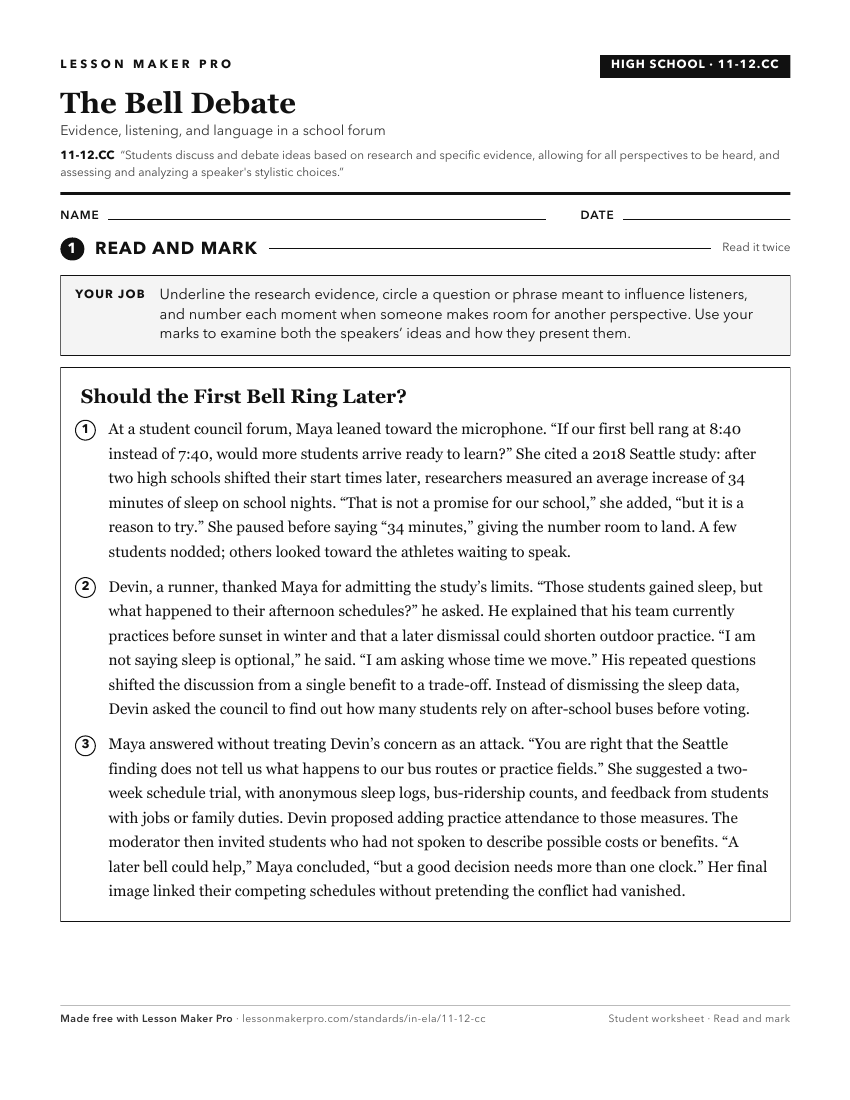
A ready-to-print activity worksheet aligned to 11-12.CC, with an answer key for the teacher on its own page. No account needed.
PDF, US Letter, prints cleanly in black and white.
Download the worksheetKeep exploring
Related Standards
- 9-10.CC
Students actively engage in listening, discussing, and presenting ideas justified by sound reasoning and textual evidence while also evaluating and identifying ...
- 8.CC
Students actively engage in listening, discussing, and presenting ideas justified by sound reasoning and textual evidence.
- 7.CC
Students actively engage in listening, discussing, and presenting ideas using text and other sources of evidence to drive and demonstrate their thoughts.
Turn this cluster into a lesson
Grade, subject, topic, and the complete cluster are prefilled. Create one free, no account needed.
Also for this cluster:Make a WorksheetMake a QuizMake a Sub Lesson