Indiana ELA 7.CC
Standard Cluster
Students actively engage in listening, discussing, and presenting ideas using text and other sources of evidence to drive and demonstrate their thoughts.
Indiana Academic Standards for English/Language Arts (2023)
Cluster contents
Standards in This Cluster
7.CC is a cluster heading. These are the individual standards under it.
- 7.CC.1
Engage effectively in a range of collaborative discussions (e.g., one-on-one, in groups, and teacher-led) on grade-appropriate topics, texts, and issues, buildi...
- 7.CC.3
Acknowledge new information expressed by others, and consider it in relation to one's own views. (E)
- 7.CC.7
Develop engaging presentations that include multimedia components and visual displays to clarify claims and findings and emphasize salient points.
- 7.CC.8
Analyze the ways that the media use words and images to attract the public's attention. (E)
- 7.CC.1aParticipate in at least three collaborative discussions (one-on-one, in groups, and/or teacher-led) by making at least two comments on instructional-level topics. (E)
- 7.CC.2aAsk more than one question that prompts others to elaborate, and provide relevant responses to questions or comments from others in order to keep the discussion on topic. (E)
- 7.CC.3aAcknowledge new information expressed by others, and consider whether or not it relates to or mirrors one's own view(s). (E)
- 7.CC.4aDemonstrate an understanding of information presented in three different forms of media and/or formats (e.g., visually, quantitatively, orally) by explaining how the ideas clarify a topic, text, or issue under study.
- 7.CC.5aIdentify a speaker's argument and specific claims, and evaluate the soundness of reasoning, relevance, and sufficiency of the supporting evidence.
- 7.CC.6aPresent on a claim and findings in a focused manner using at least three pertinent descriptions, facts, details, and examples, emphasizing key points.
- 7.CC.7aDevelop presentations that include more than two multimedia components (e.g., graphics, images, music, sound) and/or visual displays to clarify information and emphasize key points.
- 7.CC.8aIdentify words and images the media uses in ads or videos to attract the public's attention. (E)
Teacher's field guide
What This Cluster Means
What Students Need to Do
- Students listen to a classmate's idea before responding. They use details from a text and another source, such as a chart, to explain their own ideas aloud.
What Mastery Looks Like
- A student can summarize a partner's point accurately, then add a related idea. They can point to a sentence or chart value that supports what they say.
Common Misconceptions
- Students may repeat a claim without giving evidence. Some treat a chart value as proof of a cause, or respond to what they expected a partner to say rather than what they heard.
How to Assess It
- Give pairs a short paragraph and bar chart about lunch waste. Ask each student to summarize their partner's idea, then give a 30-second response using one detail from either source.
Lesson moves
Ways to Teach It
Give pairs sticky notes to label claims and supporting details on a lunch waste article and chart, then sort the notes together.
Ask, “Which change would cut lunch waste most?” Have partners cite the article or chart and restate each other's answer before replying.
Play evidence match: read a claim aloud, then have teams find a supporting sentence or chart value and explain their choice.
Use the school's lunch menu and a cafeteria waste count to plan one change, then present the case to another group.
Free download
Printable 7.CC Worksheet
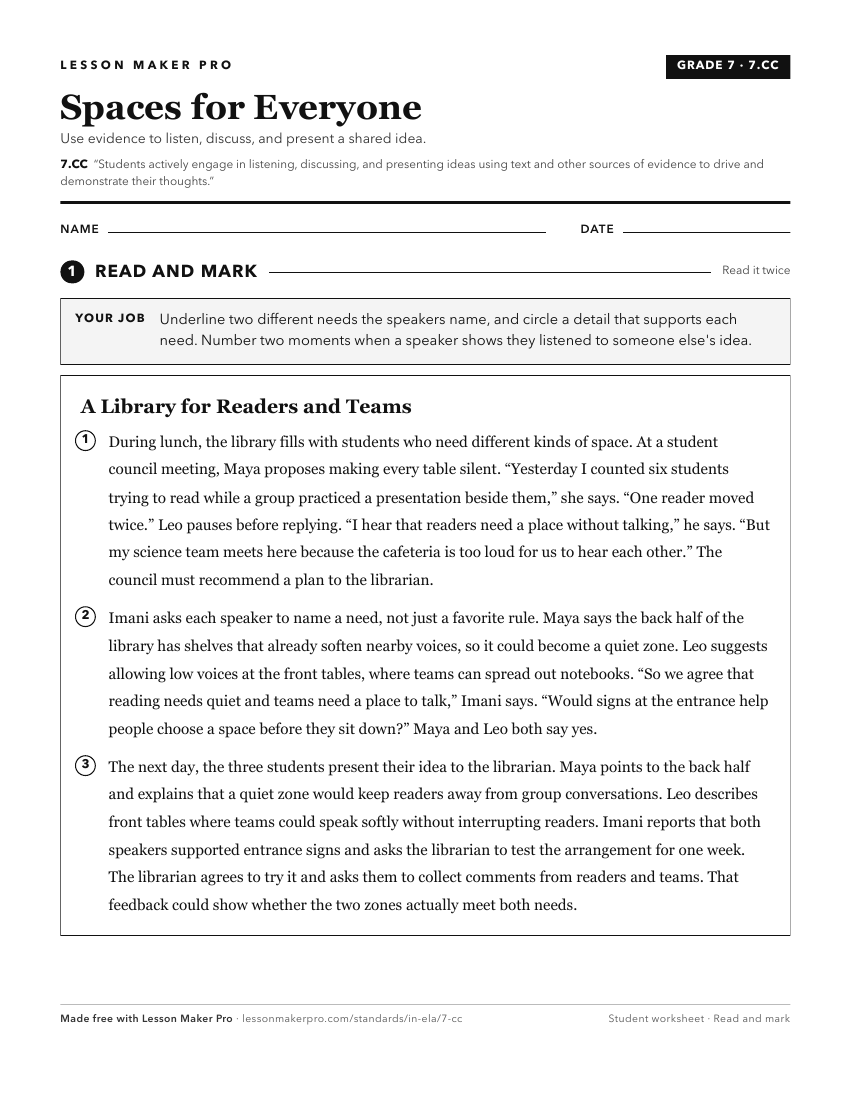
A ready-to-print activity worksheet aligned to 7.CC, with an answer key for the teacher on its own page. No account needed.
PDF, US Letter, prints cleanly in black and white.
Download the worksheetKeep exploring
Related Standards
- 6.CC
The 6th Grade version of this standard.
- 8.CC
Students actively engage in listening, discussing, and presenting ideas justified by sound reasoning and textual evidence.
- 9-10.CC
Students actively engage in listening, discussing, and presenting ideas justified by sound reasoning and textual evidence while also evaluating and identifying ...
- 1.CC
Students actively listen and participate in discussions using details and answering questions.
Turn this cluster into a lesson
Grade, subject, topic, and the complete cluster are prefilled. Create one free, no account needed.
Also for this cluster:Make a WorksheetMake a QuizMake a Sub Lesson