Indiana ELA 2.W.4.b
The Standard
- 2.W
- Students produce writing for a variety of purposes, applying their knowledge of language and sentence structure.
- 2.W.4
- Write narratives that: a. Include a beginning; b. Use temporal words to signal event order (e.g., first of all); c. Provide details to describe actions, thoughts, and feelings; and d. Provide a middle and an ending. (E)
Use temporal words to signal event order (e.g., first of all)
Indiana Academic Standards for English/Language Arts (2023)
Teacher's field guide
What This Standard Means
What Students Need to Do
- Students tell a story in the order things happened. They use words like first, next, and finally to help the reader follow the events.
What Mastery Looks Like
- A student writes events in a clear order and puts time words where they fit. A reader can tell what happened before and after each event.
Common Misconceptions
- Students may put finally before the last event or use and for every change. Some add time words but leave the events out of order.
How to Assess It
- A child drops a mitten, looks for it, and finds it under a bench. Have students write three sentences telling the story, using first, next, and finally.
Lesson moves
Ways to Teach It
Give students slips reading 'pack a bag,' 'ride the bus,' and 'see a lion'; have them arrange and label the slips first, next, finally.
Read 'First, I saw a lion. Next, I packed my bag. Finally, I rode the bus.' Ask students what sounds wrong and why.
Play a story relay: pass a toy puppy around and have each student add a sentence using a time word that fits.
Ask students to write three sentences about arriving at school today, using first, then, and finally to show what they did.
Free download
Printable 2.W.4.b Worksheet
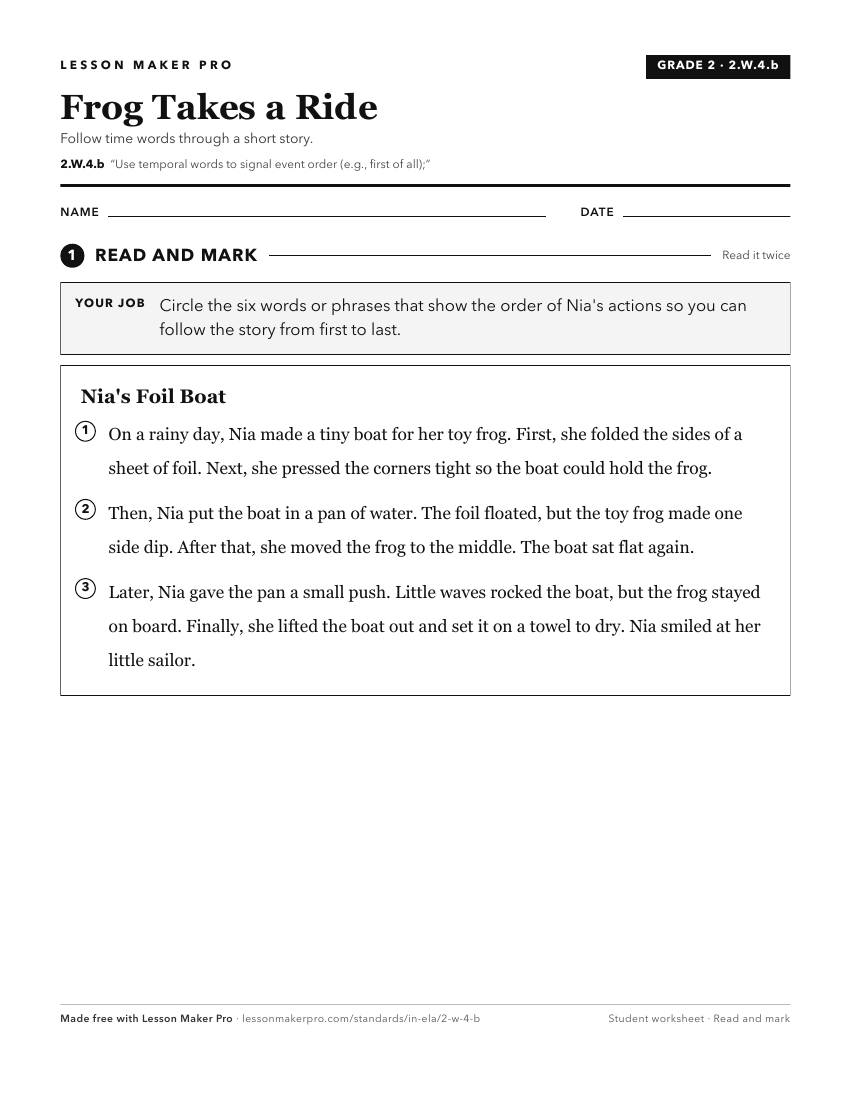
A ready-to-print activity worksheet aligned to 2.W.4.b, with an answer key for the teacher on its own page. No account needed.
PDF, US Letter, prints cleanly in black and white.
Download the worksheetKeep exploring
Related Standards
- 7.W.3.b
Organize an event sequence (e.g., conflict, climax, resolution) that unfolds naturally and logically, using a variety of transition words, phrases, and clauses ...
- 8.W.3.b
Organize an event sequence (e.g., conflict, climax, resolution) that unfolds naturally and logically, using a variety of transition words, phrases, and clauses ...
- 6.W.3.b
Organize an event sequence (e.g., conflict, climax, resolution) that unfolds naturally and logically, using a variety of transition words, phrases, and clauses ...
Turn this exact standard into a lesson
Grade, subject, topic, and the complete standard are prefilled. Create one free, no account needed.
Also for this standard:Make a WorksheetMake a QuizMake a Sub Lesson