Idaho Social Studies 9-12.WC.31
The Standard
Explain humanism and describe how Thomas Aquinas’s writings influenced humanistic thought and fostered a balance between reason and faith.
Idaho Content Standards: K-12 Social Studies · The Renaissance and Reformation (c. 1450 AD – 1600 AD)
Teacher's field guide
What This Standard Means
What Students Need to Do
- Students explain why Renaissance humanists studied Greek and Roman works and valued human learning. They connect Aquinas's earlier writings about reason and faith to later Christian humanist thought.
What Mastery Looks Like
- A student can describe humanism without saying it rejected religion. They can place Aquinas before the Renaissance and explain how his view that reason and faith can work together appealed to Christian humanists.
Common Misconceptions
- Students may think all humanists rejected Christianity or that Aquinas was a Renaissance writer. They may also think he argued that reason should replace faith.
How to Assess It
- Ask students to write three sentences: What did humanists value? What did Aquinas say about reason and faith? How might his view appeal to a Christian humanist?
Lesson moves
Ways to Teach It
Give pairs cards reading 'faith teaches truth,' 'reason finds truth,' and 'read Greek and Roman texts'; sort them under Aquinas, humanists, or both.
Ask students to write: 'If reason and faith can agree, why might a Christian scholar read ancient Greek authors?'
Run a partner quiz: one student explains humanism, the other explains Aquinas's view of reason and faith, then they switch.
Show biology and theology course descriptions from a university catalog; ask how Aquinas might view studying both.
Free download
Printable 9-12.WC.31 Worksheet
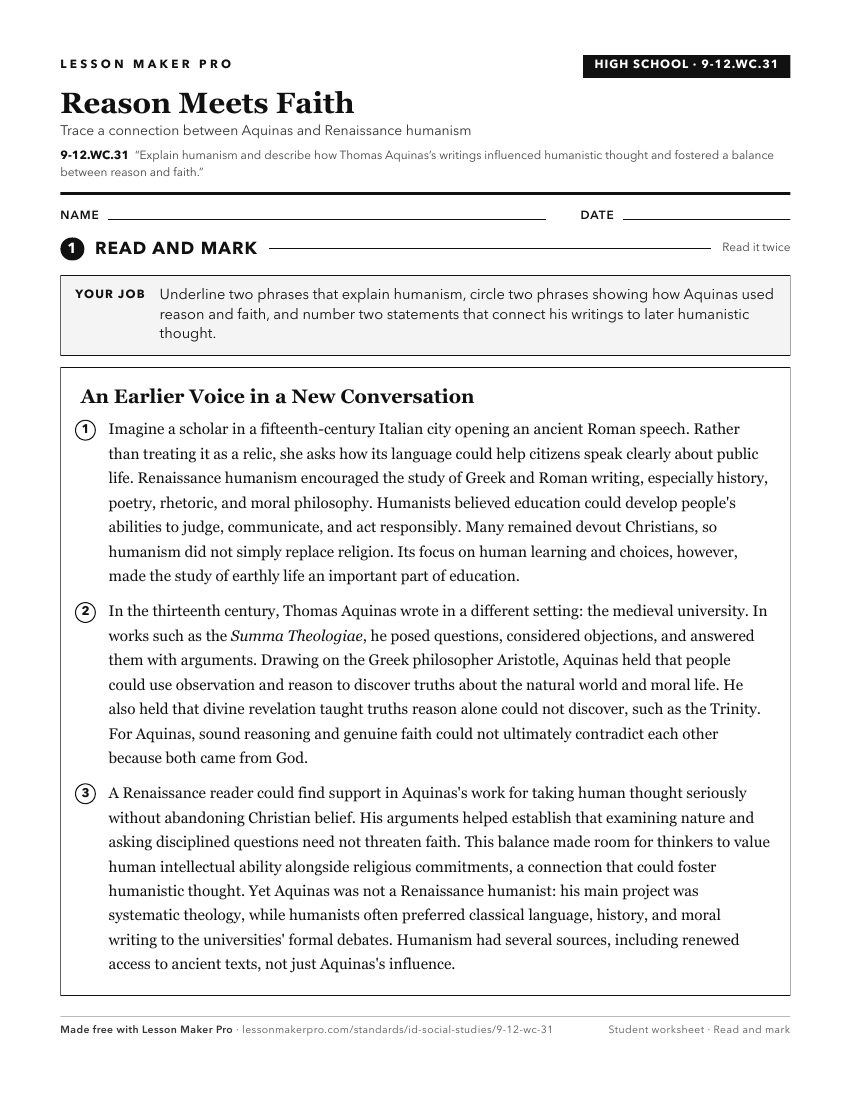
A ready-to-print activity worksheet aligned to 9-12.WC.31, with an answer key for the teacher on its own page. No account needed.
PDF, US Letter, prints cleanly in black and white.
Download the worksheetKeep exploring
Related Standards
- 9-12.WC.23
Identify key figures, artistic and intellectual achievements of the medieval period in Western Europe, (e.g. Thomas Aquinas, Hildegard von Bingen, Dante, Gothic...
- 9-12.GOV.1
Examine the influences of leading European thinkers such as Locke and Montesquieu, as well as the influence of historical institutions such as Greek democracy, ...
- 9-12.WC.25
Explain the reintroduction of Classical thought from the Islamic World into Christendom.
- 9-12.WC.32
Analyze the ideas of Renaissance and Northern humanism.
Turn this exact standard into a lesson
Grade, subject, topic, and the complete standard are prefilled. Create one free, no account needed.
Also for this standard:Make a WorksheetMake a QuizMake a Sub Lesson