Idaho Social Studies 9-12.US2.17
The Standard
Describe the strategies, events, and turning points that shaped the outcomes of World War Two.
Idaho Content Standards: K-12 Social Studies · World War II 1939-1945
Teacher's field guide
What This Standard Means
What Students Need to Do
- Students put major battles in order and locate them in Europe and the Pacific. They explain how military strategies and key battles changed which side had the advantage.
What Mastery Looks Like
- A student can explain why Midway weakened Japan's navy and Stalingrad stopped Germany's advance in the east. They can show how D-Day added pressure on Germany without claiming it ended the war.
Common Misconceptions
- Students may think D-Day ended the war in Europe, though fighting continued for eleven more months. They may mix up Midway and Stalingrad or assume both theaters followed the same strategy.
How to Assess It
- Exit ticket: Choose Midway or Stalingrad. Name where it happened, explain what changed afterward, and connect that change to the war's outcome.
Lesson moves
Ways to Teach It
Give pairs a blank timeline and two theater maps; have them place Midway, Stalingrad, and D-Day cards and mark changes in momentum.
Ask: Why did Midway matter in the Pacific while Stalingrad mattered in Europe? Use one fact about each battle.
Play a card sort matching blitzkrieg, island hopping, and strategic bombing to campaigns; have students explain each match.
Compare a June 1944 D-Day newspaper front page with a May 1945 victory front page; list what changed between them.
Free download
Printable 9-12.US2.17 Worksheet
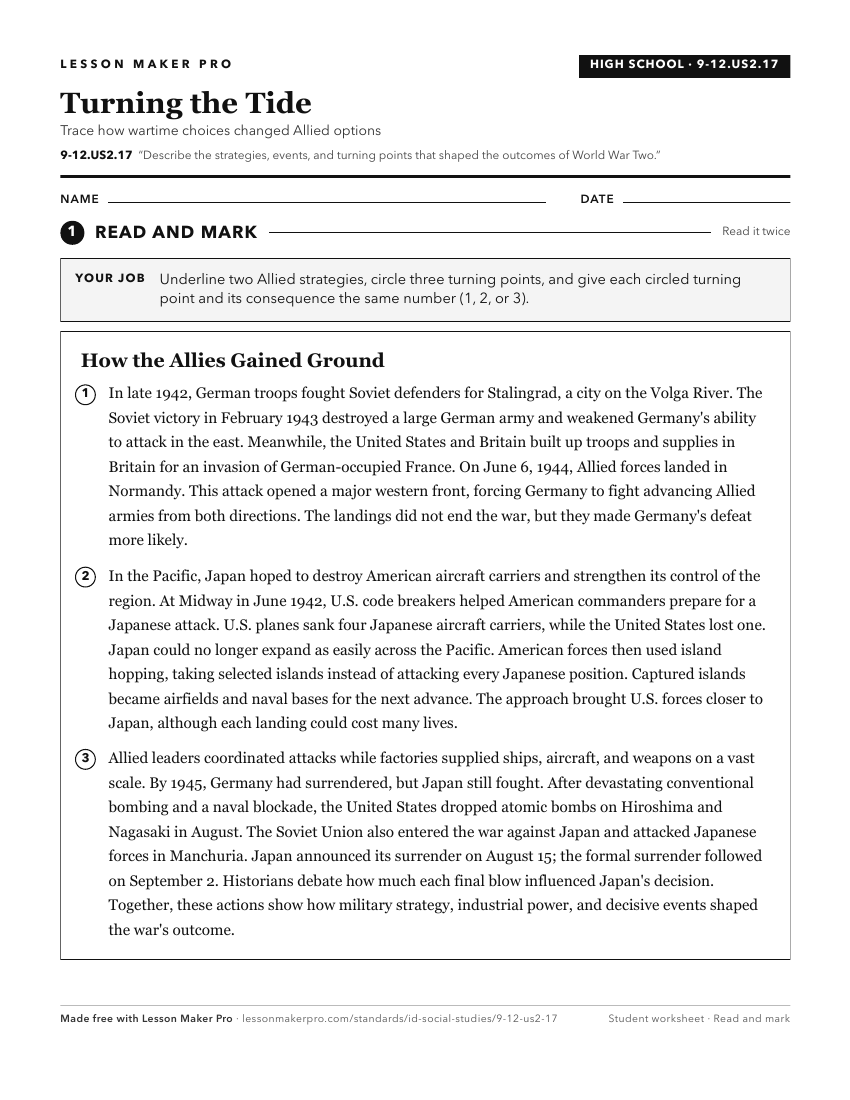
A ready-to-print activity worksheet aligned to 9-12.US2.17, with an answer key for the teacher on its own page. No account needed.
PDF, US Letter, prints cleanly in black and white.
Download the worksheetKeep exploring
Related Standards
- 9-12.US2.18
Compare and contrast the experience of Americans on the Pacific and European battle fronts during World War Two.
- 9-12.US2.7
Explain how new technologies influenced strategies, military tactics, and battle conditions on the Western Front during World War One.
- 9-12.US2.20
Analyze the impact of events and policies on the Homefront during World War Two.
- 9-12.US2.15
Explain the events and actions that led to World War Two, including the rise of fascism and totalitarianism, appeasement, and European and Japanese Imperialism.
Turn this exact standard into a lesson
Grade, subject, topic, and the complete standard are prefilled. Create one free, no account needed.
Also for this standard:Make a WorksheetMake a QuizMake a Sub Lesson