Idaho Social Studies 9-12.GOV.35
The Standard
Analyze Article II of the Constitution as it relates to the executive branch, including appointments, oath of office, Commander-in-chief of the military, powers of the president, eligibility for office, succession (25th Amendment), executive orders, treaties, length of term (20th and 22nd Amendments).
Idaho Content Standards: K-12 Social Studies · Function And Structure of the U.S. Political System
Teacher's field guide
What This Standard Means
What Students Need to Do
- Students read Article II and later amendments to work out who can serve as president, when a term starts, and what happens if a president cannot serve. They explain the president’s powers over appointments, treaties, the military, and executive orders, along with limits on those powers.
What Mastery Looks Like
- Students can check a candidate’s eligibility and explain the oath, four-year term, January 20 start, and two-election limit. They can tell when a vice president becomes president rather than acting president. They can explain why a Cabinet nominee needs Senate confirmation, a treaty needs a two-thirds Senate vote, and an executive order cannot override a law.
Common Misconceptions
- Students may think the commander in chief can declare war or that an executive order can create a law. They may confuse Senate confirmation of appointees with approval of treaties. Some think the vice president becomes president during a temporary disability, rather than acting president.
How to Assess It
- Exit ticket: A president temporarily cannot serve, so the vice president takes over. Does the vice president become president or acting president? Can an executive order override a law passed by Congress?
Lesson moves
Ways to Teach It
Give pairs printed excerpts and cards marked “Cabinet appointment,” “January 20,” and “temporary disability” to match to the right passage.
Ask: “Can a president command troops and also declare war?” Have students cite Article II and Congress’s war power in their answer.
Run a card sort with two headings: Senate confirmation and Senate two-thirds vote. Use cards for a Cabinet secretary, an ambassador, and a treaty.
Print a Federal Register executive order on federal hiring; students underline its cited legal authority and name one limit on the order.
Free download
Printable 9-12.GOV.35 Worksheet
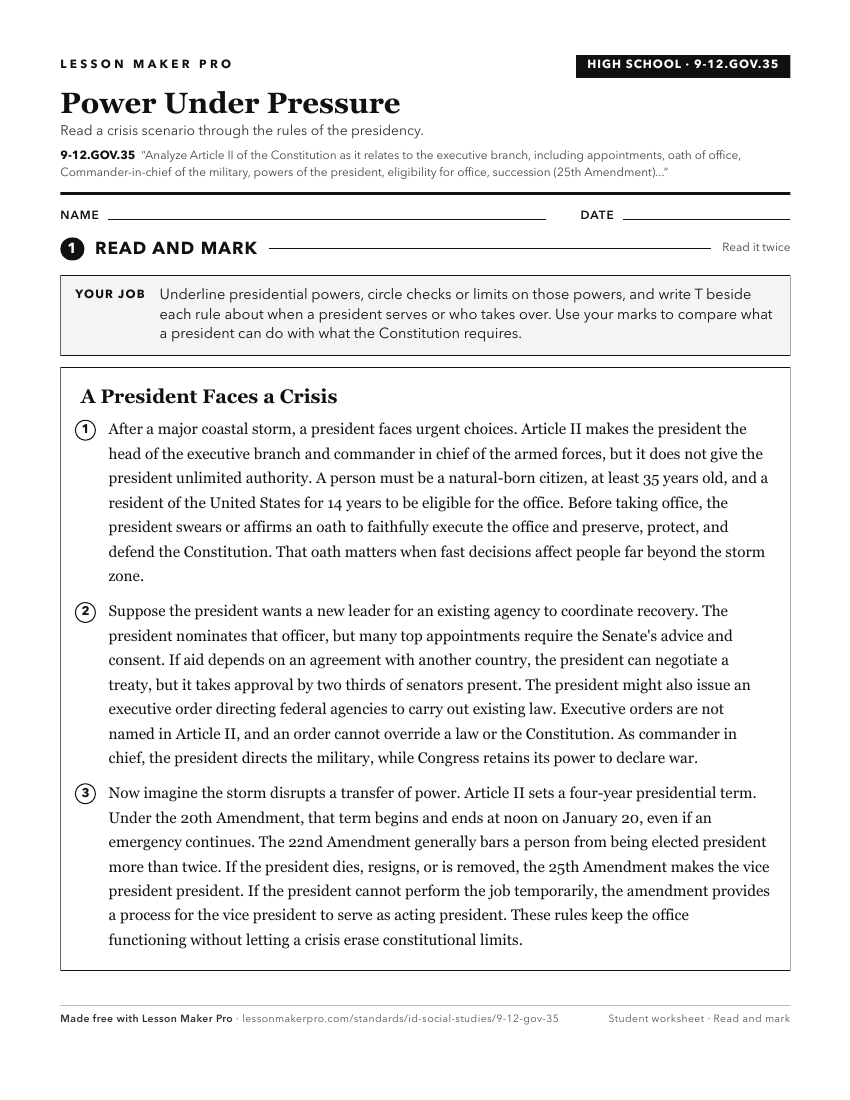
A ready-to-print activity worksheet aligned to 9-12.GOV.35, with an answer key for the teacher on its own page. No account needed.
PDF, US Letter, prints cleanly in black and white.
Download the worksheetKeep exploring
Related Standards
- 9-12.GOV.36
Identify major departments of the executive branch, including cabinet and non-cabinet level departments and agencies, along with the development and growth of f...
- 9-12.GOV.30
Analyze Article I and the 17th Amendment of the Constitution as they relate to the legislative branch, including eligibility for office, roles, duties, casework...
- 9-12.GOV.38
Analyze Article III of the Constitution as it relates to judicial power, including the length of terms and the jurisdiction of the U.S. Supreme Court.
- 6-12.US1.16
Analyze the original Constitution by comparing the powers of government branches, assessing its response to Revolutionary causes and alignment with Declaration ...
Turn this exact standard into a lesson
Grade, subject, topic, and the complete standard are prefilled. Create one free, no account needed.
Also for this standard:Make a WorksheetMake a QuizMake a Sub Lesson