Idaho Social Studies 9-12.EC.16
The Standard
Evaluate types of investments to determine how they meet the objectives of a personal financial plan including compound interest over time.
Idaho Content Standards: K-12 Social Studies · Personal Finance
Teacher's field guide
What This Standard Means
What Students Need to Do
- Students compare investments by potential growth, risk, fees, and when they can get their money. They calculate how interest earns more interest over time, then choose options that fit short- and long-term goals.
What Mastery Looks Like
- A student calculates a CD balance using each year's new total. They can explain why a two-year CD may fit a car purchase in two years, while a stock fund may fit retirement better despite its risk of loss.
Common Misconceptions
- Students may assume stocks earn a fixed interest rate or that higher returns come without risk. Some calculate interest only on the original deposit, even after interest has been added.
How to Assess It
- Exit ticket: A $1,000 CD earns 5% interest compounded yearly. Find its balance after two years, then explain whether that CD or a stock fund better fits a car purchase in two years and retirement in 30 years.
Lesson moves
Ways to Teach It
Hand pairs $1,000 in play money and risk-and-return cards for a CD and stock fund; have them fund a two-year car purchase and retirement.
Ask: Why might a two-year CD fit a car purchase better than a stock fund, even if the fund could earn more?
Run a rate race: teams calculate a $1,000 CD at 5% for three years, then check each other's balances.
Use a local bank's savings and CD rates and a stock fund's fee page to build a plan for rent and retirement.
Free download
Printable 9-12.EC.16 Worksheet
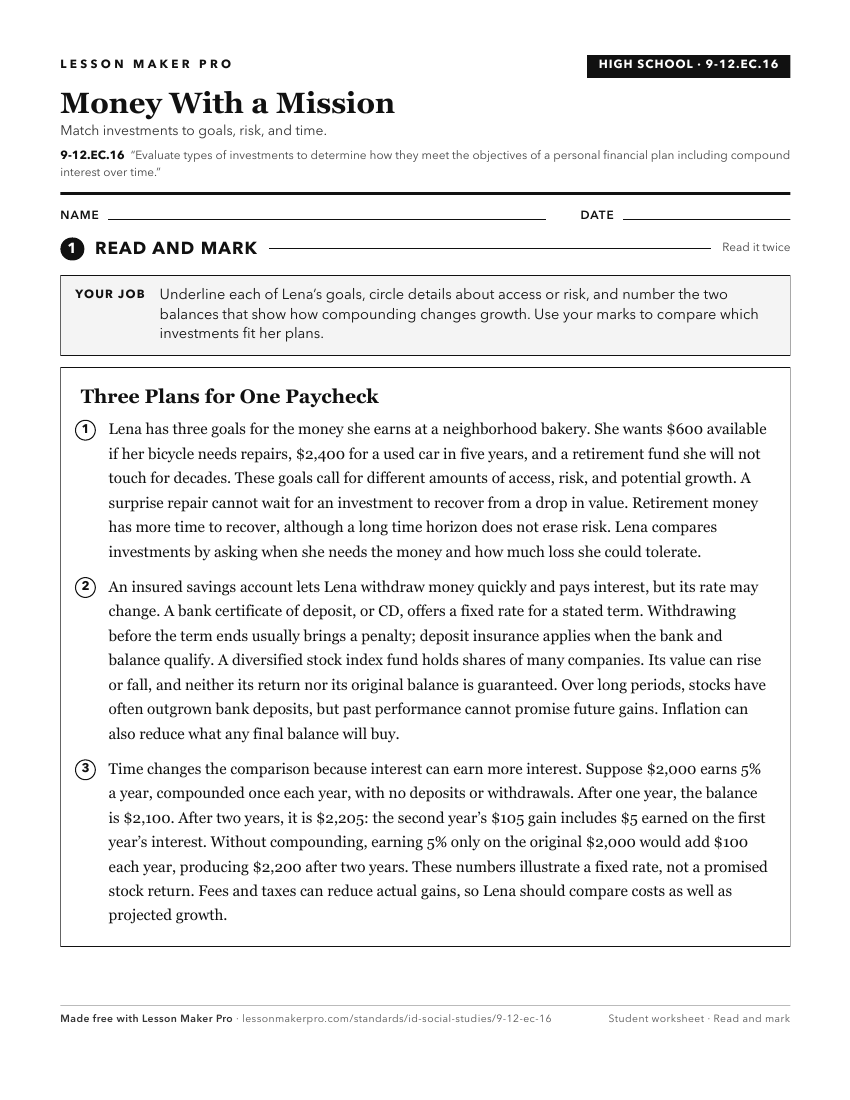
A ready-to-print activity worksheet aligned to 9-12.EC.16, with an answer key for the teacher on its own page. No account needed.
PDF, US Letter, prints cleanly in black and white.
Download the worksheetKeep exploring
Related Standards
- 9-12.EC.18
Demonstrate how to use comparison shopping skills to make purchasing decisions, including major purchases and college education.
- 9-12.EC.14
Demonstrate how to set financial goals and analyze the costs and benefits of spending decisions.
- 1.SS.3.3
Identify ways to save money for future needs and wants
- 3.SS.3.4
Identify different examples of making an economic choice, including consumption of goods and services, using a bank, investing, and budgeting.
Turn this exact standard into a lesson
Grade, subject, topic, and the complete standard are prefilled. Create one free, no account needed.
Also for this standard:Make a WorksheetMake a QuizMake a Sub Lesson