Idaho Social Studies 9-12.EC.18
The Standard
Demonstrate how to use comparison shopping skills to make purchasing decisions, including major purchases and college education.
Idaho Content Standards: K-12 Social Studies · Personal Finance
Teacher's field guide
What This Standard Means
What Students Need to Do
- Students compare the full cost of purchases, not just the listed price. They account for fees, loan interest, and other costs. For college, they also subtract grants and compare housing costs.
What Mastery Looks Like
- A student can calculate the total cost of two car offers and explain which fits a budget. They can compare two college offers using grants, housing costs, and likely borrowing, then justify a choice.
Common Misconceptions
- Students may treat the lowest listed price as the cheapest choice and overlook fees, repairs, or interest. They may count a student loan as a grant or assume a larger scholarship always means a lower college bill.
How to Assess It
- Exit ticket: Car A costs $15,000 plus $800 in fees and $2,400 in loan interest. Car B costs $16,000 plus $300 in fees and $1,200 in interest. Which costs less overall, and what else would you check before buying?
Lesson moves
Ways to Teach It
Give pairs two printed used-car listings and loan offers; have them calculate price, fees, interest, and expected repairs on a comparison sheet.
Show two sample college aid letters and housing costs; ask students to write which offer leaves less to borrow and why.
Deal pairs phone-plan cards with monthly rates, activation fees, and device payments; race to find the lowest two-year cost.
Use two local college cost pages to estimate one-year tuition, housing, and fees, then list one missing cost to verify.
Free download
Printable 9-12.EC.18 Worksheet
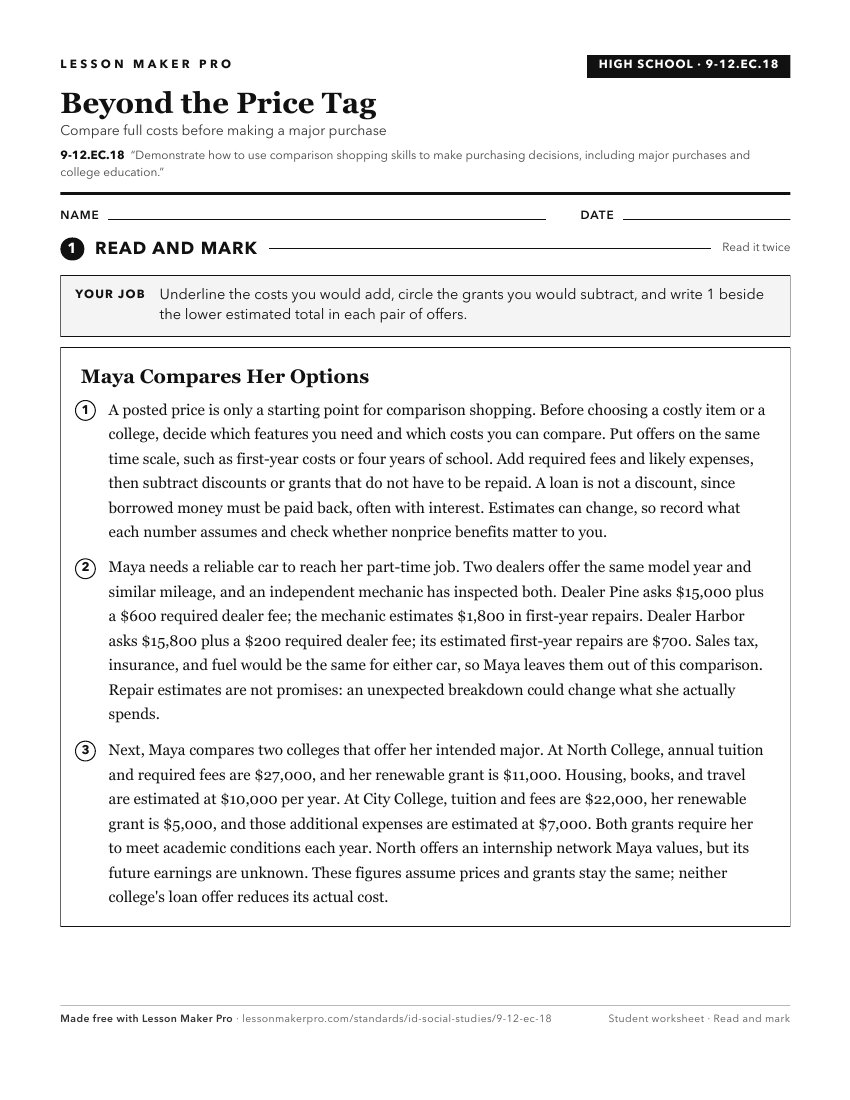
A ready-to-print activity worksheet aligned to 9-12.EC.18, with an answer key for the teacher on its own page. No account needed.
PDF, US Letter, prints cleanly in black and white.
Download the worksheetKeep exploring
Related Standards
- 9-12.EC.14
Demonstrate how to set financial goals and analyze the costs and benefits of spending decisions.
- 1.SS.3.3
Identify ways to save money for future needs and wants
- 3.SS.3.4
Identify different examples of making an economic choice, including consumption of goods and services, using a bank, investing, and budgeting.
- 9-12.EC.24
Identify and evaluate modern consumer skills, tools, and practices.
Turn this exact standard into a lesson
Grade, subject, topic, and the complete standard are prefilled. Create one free, no account needed.
Also for this standard:Make a WorksheetMake a QuizMake a Sub Lesson