Idaho Social Studies 6-9.WH.4.3
The Standard
Analyze and evaluate the global expansion of liberty and democracy through revolution and reform movements.
Idaho Content Standards: K-12 Social Studies
Teacher's field guide
What This Standard Means
What Students Need to Do
- Students compare revolutions and reform movements in different countries. They use events and records to explain who gained freedom or voting rights, who was left out, and how much changed.
What Mastery Looks Like
- A student can explain that Haiti's revolution ended slavery and brought independence, while South Africa's anti-apartheid movement led to an election open to voters of all races in 1994. They use a fact about each movement to judge its results and name a limit, such as the power held by Haiti's early rulers.
Common Misconceptions
- Students may assume that independence gave everyone the vote at once. They may call every protest a revolution or think one election ended racial inequality overnight.
How to Assess It
- Ask: How did Haiti's independence in 1804 and South Africa's election in 1994 expand people's rights? Give one fact about each and name one limit of either change.
Lesson moves
Ways to Teach It
Give pairs cards for Haiti's 1804 independence and South Africa's 1994 election. Have them place each on a timeline and label the rights gained.
Ask: Can a movement win freedom without giving everyone a vote? Use Haiti and South Africa to explain.
Play claim check: teams use event cards to challenge claims such as 'independence always brings voting rights' and 'one election ends inequality.'
Show your state's voter eligibility page. Have students compare its rules with who could vote in South Africa in 1994.
Free download
Printable 6-9.WH.4.3 Worksheet
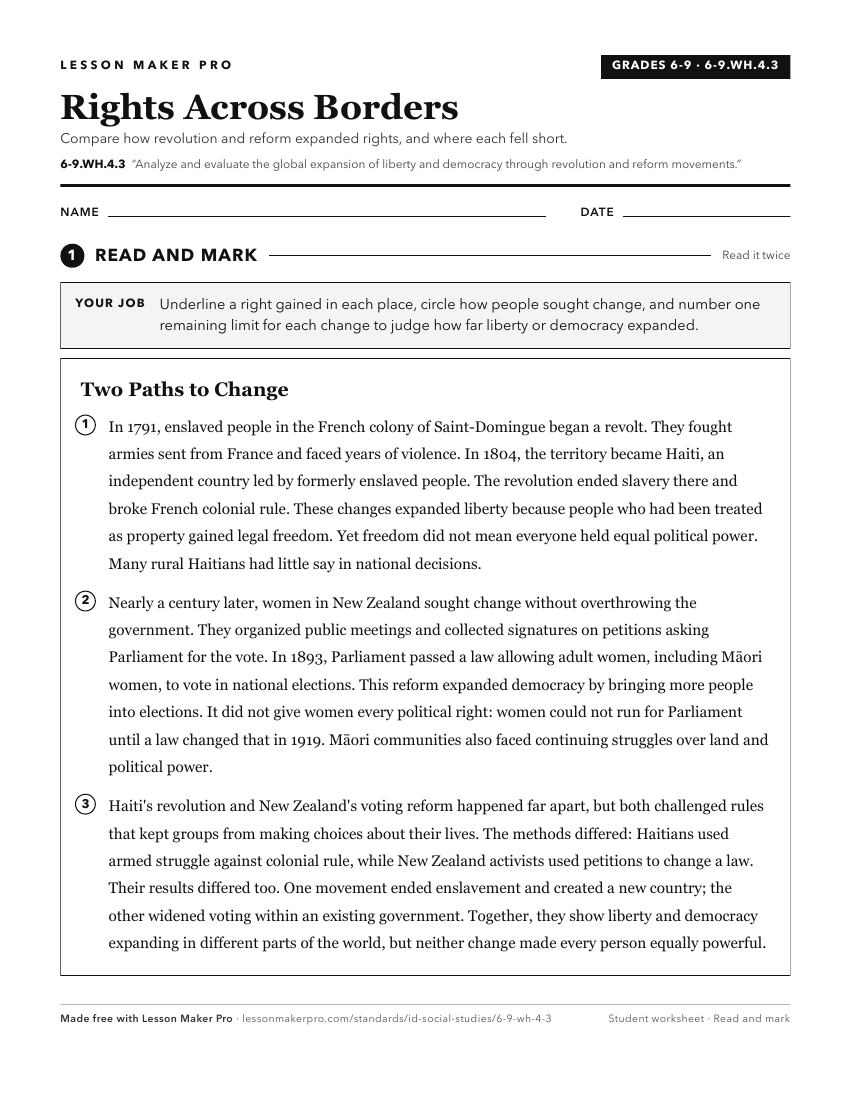
A ready-to-print activity worksheet aligned to 6-9.WH.4.3, with an answer key for the teacher on its own page. No account needed.
PDF, US Letter, prints cleanly in black and white.
Download the worksheetKeep exploring
Related Standards
- 6-9.WH.5.2
Identify and compare major modern world conflicts and explain their global consequences and impacts including European colonialism, World War I, World War II, t...
- 6-9.WH.4.2
Analyze the various political systems that shaped civilizations throughout the world, including the City-State, Monarchy, Republic, Nation-State, or Democracy.
- 9-12.GOV.59
Evaluate the changing role of the United States in supporting democratic principles and institutions in the international system.
- 9-12.US2.38
Analyze the rise of the New Right and the Reagan Revolution including the social, cultural, and economic policies it advocated for.
Turn this exact standard into a lesson
Grade, subject, topic, and the complete standard are prefilled. Create one free, no account needed.
Also for this standard:Make a WorksheetMake a QuizMake a Sub Lesson