Idaho Social Studies 6-9.WG.5.4
The Standard
Discuss present conflicts between cultural groups and nation-states in regions throughout the world.
Idaho Content Standards: K-12 Social Studies
Teacher's field guide
What This Standard Means
What Students Need to Do
- Students examine current disputes between cultural groups and governments in two regions. They explain what people are asking for, how governments respond, and what is at stake.
What Mastery Looks Like
- A student can name a government decision and explain its effect on a cultural group using a recent source. They can compare two disputes without suggesting everyone in a group holds the same view.
Common Misconceptions
- Students may confuse a government’s position with the views of everyone in that country. They may also assume all members of a cultural group agree, or treat a past dispute as current.
How to Assess It
- Give students two short, recent news excerpts, one on Sámi grazing land in Norway and one on Guarani Kaiowá land claims in Brazil. Ask them to name each group’s claim, one government action, and one difference between the disputes.
Lesson moves
Ways to Teach It
Give pairs maps of Norway and Brazil; use two news excerpts to mark the disputed areas and label the governments involved.
Ask students: Why might a government and a cultural group disagree over land use? Compare one detail from each excerpt.
Run a card sort matching four claims and government actions to the Sámi or Guarani Kaiowá dispute, then check against the excerpts.
Bring a local zoning notice; have students list whose land use it affects and compare who makes the decision in Norway or Brazil.
Free download
Printable 6-9.WG.5.4 Worksheet
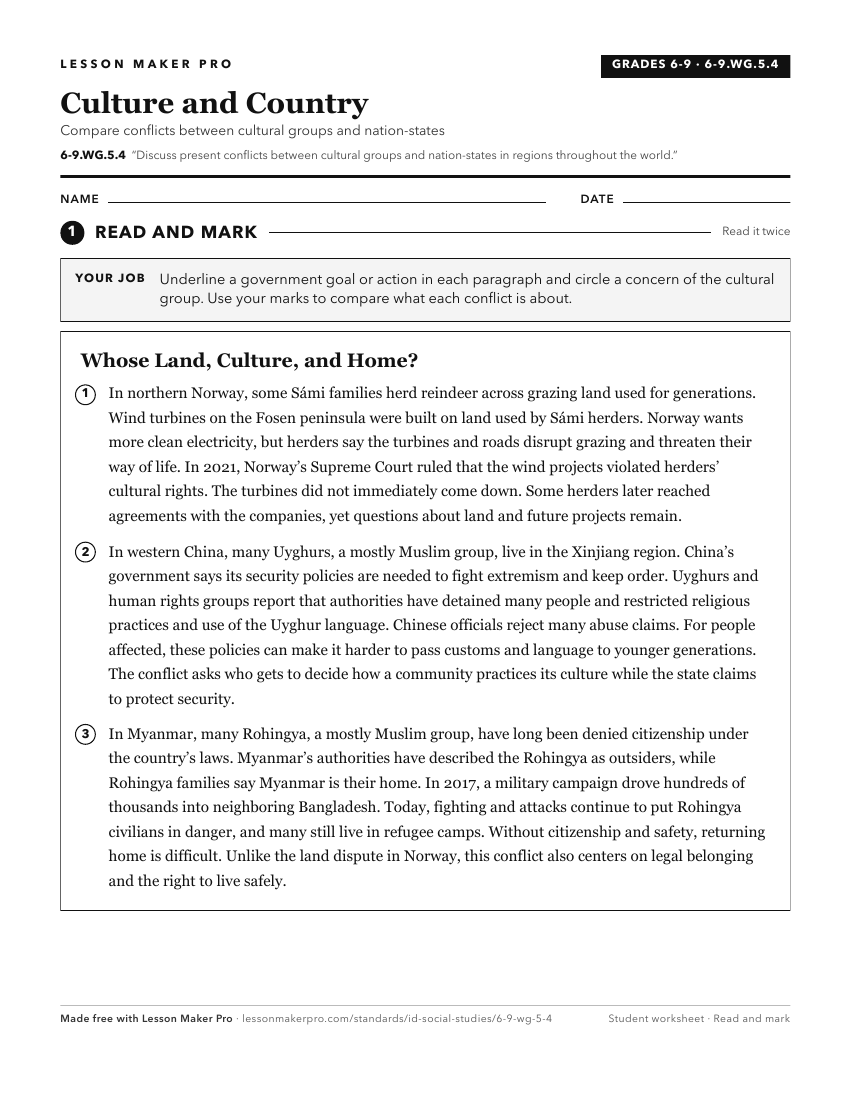
A ready-to-print activity worksheet aligned to 6-9.WG.5.4, with an answer key for the teacher on its own page. No account needed.
PDF, US Letter, prints cleanly in black and white.
Download the worksheetKeep exploring
Related Standards
- 6-9.WH.5.1
Explain the political, economic, religious, or cultural causes of conflicts in various civilizations and their consequences.
- 6-9.WH.1.12
Examine why the diversity of religion and belief systems across cultural, social, political, and economic institutions have been sources of conflict.
- 6-9.WG.5.3
Analyze how miscommunication or misunderstandings of different cultures can lead to conflict.
- 6-9.WG.2.10
Compare and contrast cultural patterns in regions throughout the world, such as language, religion, and ethnicity.
Turn this exact standard into a lesson
Grade, subject, topic, and the complete standard are prefilled. Create one free, no account needed.
Also for this standard:Make a WorksheetMake a QuizMake a Sub Lesson