Idaho Social Studies 6-9.WG.2.10
The Standard
Compare and contrast cultural patterns in regions throughout the world, such as language, religion, and ethnicity.
Idaho Content Standards: K-12 Social Studies
Teacher's field guide
What This Standard Means
What Students Need to Do
- Students use maps and country profiles to compare languages, religions, and ethnic groups in two world regions. They name patterns and exceptions without treating a region as one uniform culture.
What Mastery Looks Like
- Students use examples from at least two countries in each region to support a similarity and a difference. They keep language, religion, and ethnicity separate and point out an exception to a broad claim.
Common Misconceptions
- Students may assume everyone in North Africa speaks Arabic or everyone in Southeast Asia is Buddhist. They may treat a shared language as proof of shared ethnicity or confuse ethnicity with citizenship.
How to Assess It
- Exit ticket: Using profile cards for Morocco, Egypt, Indonesia, and Thailand, write one similarity and one difference between the two regions. Give country examples and explain why neither region fits a single cultural label.
Lesson moves
Ways to Teach It
Give pairs profile cards for Morocco, Egypt, Indonesia, and Thailand; have them place language, religion, and ethnic group facts on two region maps.
Ask students to revise the claim "Everyone in Southeast Asia is Buddhist" using facts from Indonesia and Thailand.
Play a card match with the four country names and language, religion, or ethnic group facts; require partners to justify two matches.
Open the Morocco and Thailand tourism websites; students list page languages and explain why those options may reflect visitors more than residents.
Free download
Printable 6-9.WG.2.10 Worksheet
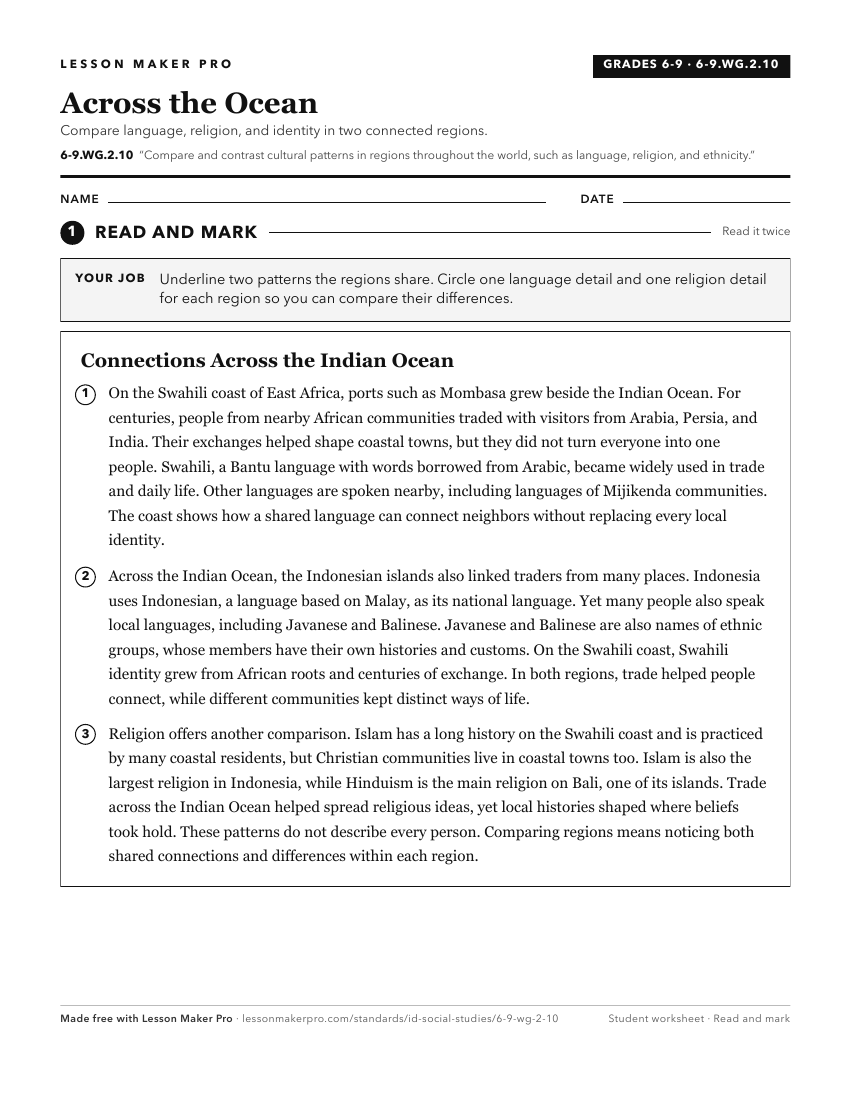
A ready-to-print activity worksheet aligned to 6-9.WG.2.10, with an answer key for the teacher on its own page. No account needed.
PDF, US Letter, prints cleanly in black and white.
Download the worksheetKeep exploring
Related Standards
- 6-9.WG.5.2
Give examples of how language, literature, and the arts shape the development and transmission of culture in regions throughout the world.
- 6-9.WG.5.1
Discuss how social institutions, including the family, religion, and education, influence behavior in different societies in regions throughout the world.
- 2.SS.5.2
Compare traditions in your community with those practiced in other parts of the world.
- 6-9.WG.1.1
Describe major aspects of the civilizations in regions throughout the world prior to European contact including government, religion/belief systems, arts/archit...
Turn this exact standard into a lesson
Grade, subject, topic, and the complete standard are prefilled. Create one free, no account needed.
Also for this standard:Make a WorksheetMake a QuizMake a Sub Lesson