Idaho Social Studies 6-9.WG.1.3
The Standard
Describe and compare various motivations of European colonization in regions throughout the world.
Idaho Content Standards: K-12 Social Studies
Teacher's field guide
What This Standard Means
What Students Need to Do
- Students identify why European powers took control of places overseas, including trade, resources, land, religious conversion, and political power. They compare motives in two places and support each claim with a historical detail.
What Mastery Looks Like
- Given short accounts of Spanish rule in the Philippines and British rule in India, a student can identify missionary work and trade as motives. They can explain that a colony could serve more than one goal.
Common Misconceptions
- Students may assume every European power colonized places for gold. They may treat an entire region as having one motive, or confuse a colonizer's goals with the effects on local people.
How to Assess It
- On an exit ticket, ask: "How did Spanish missionary goals in the Philippines differ from British trade goals in India? Give one detail for each place."
Lesson moves
Ways to Teach It
Give pairs a blank map and fact cards on Potosí silver, Philippine missions, Indian cotton, and Algerian farmland; mark each place and motive.
Ask students to write: "How did the motives in the Philippine mission card and Indian cotton card differ?"
Read claims about the four fact cards aloud; teams vote supported or unsupported and point to the card that proves their answer.
Show a cinnamon jar and an Indian Ocean map; ask why controlling spice routes could bring wealth to a European empire.
Free download
Printable 6-9.WG.1.3 Worksheet
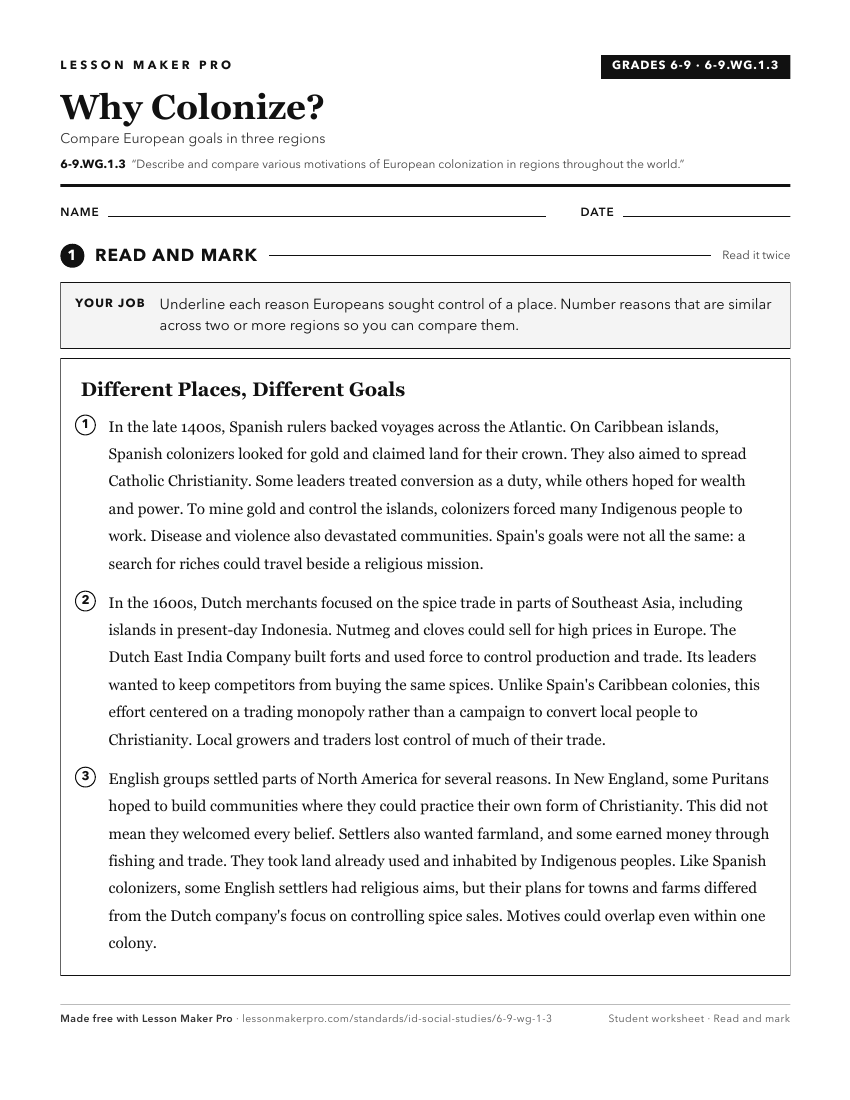
A ready-to-print activity worksheet aligned to 6-9.WG.1.3, with an answer key for the teacher on its own page. No account needed.
PDF, US Letter, prints cleanly in black and white.
Download the worksheetKeep exploring
Related Standards
- 9-12.WC.39
Analyze the causes and consequences of the Age of Discovery and the rise of European Empires.
- 6-9.WH.5.2
Identify and compare major modern world conflicts and explain their global consequences and impacts including European colonialism, World War I, World War II, t...
- 6-9.WG.1.2
Examine the impact of Europeans and native cultures on one another in regions throughout the world.
- 5.SS.1.9
Analyze or distinguish the geographic, economic, and religious motivations that influenced the movement of people.
Turn this exact standard into a lesson
Grade, subject, topic, and the complete standard are prefilled. Create one free, no account needed.
Also for this standard:Make a WorksheetMake a QuizMake a Sub Lesson