Idaho Social Studies 6-12.US1.32
The Standard
Analyze the communication, industrial and agricultural changes and their impact on the social and economic lives of people in the North, South, and West.
Idaho Content Standards: K-12 Social Studies · Geographic Expansion and Political and Social Changes 1820-1860
Teacher's field guide
What This Standard Means
What Students Need to Do
- Students explain how telegraphs, factories, and changes in cotton and wheat farming changed work and trade from 1820 to 1860. They compare the effects on people in the North, South, and West.
What Mastery Looks Like
- Students can explain how northern mills drew wage workers, southern cotton production expanded forced labor, and reapers increased western harvests. They can distinguish messages sent by telegraph from goods moved by rail.
Common Misconceptions
- Students may think telegraphs carried goods or that machines removed the need for workers. They may also assume cotton profits improved life for enslaved people, rather than increasing the demand for their labor.
How to Assess It
- Exit ticket: How did faster messages, factory production, or farm machines change work or trade in the North, South, and West? Give one specific effect and name an affected group in each region.
Lesson moves
Ways to Teach It
Give pairs a blank U.S. map, yarn, and telegraph, railroad, cotton, and wheat cards to trace a message and a shipment.
Read a Lowell mill worker account and Solomon Northup's account of cotton picking, then ask whose labor made cheap cloth possible.
Play a card sort matching telegraph, textile mill, cotton gin, and reaper cards to regional work and trade effects.
Show a sample package tracking page, then compare modern delivery updates with an 1850 order sent by telegraph and goods shipped by rail.
Free download
Printable 6-12.US1.32 Worksheet
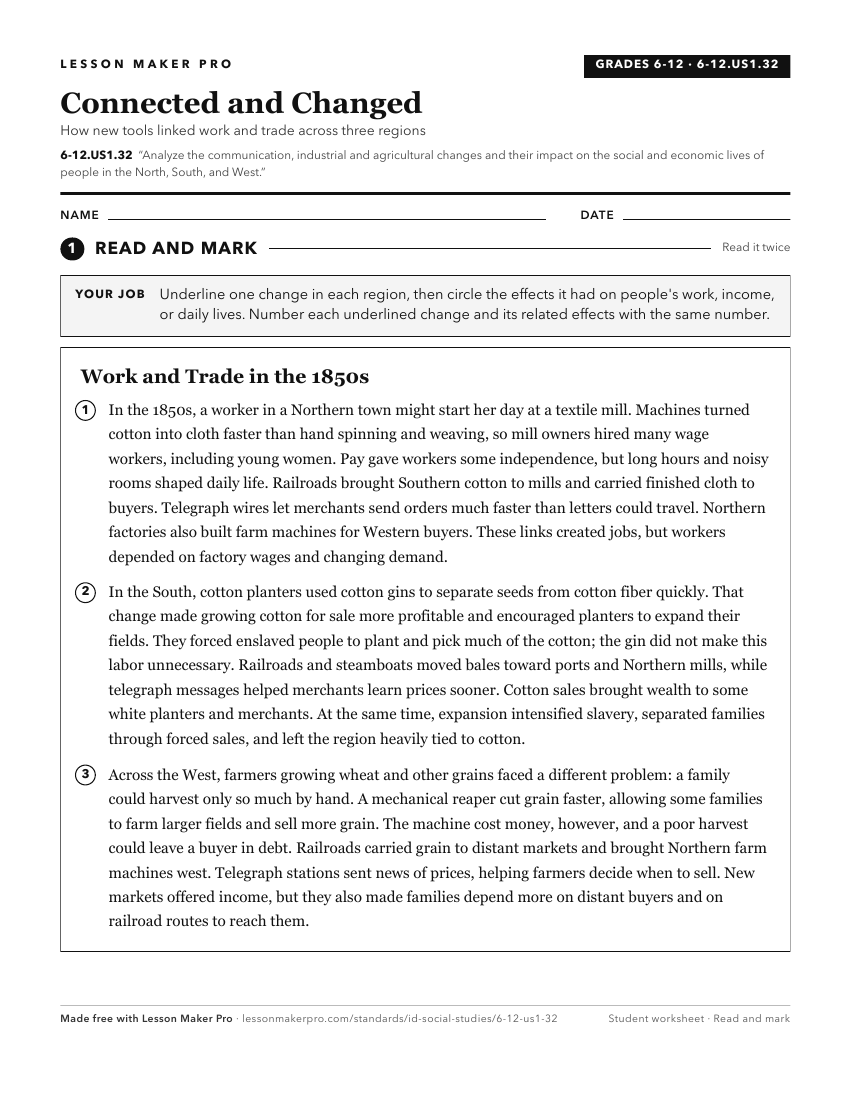
A ready-to-print activity worksheet aligned to 6-12.US1.32, with an answer key for the teacher on its own page. No account needed.
PDF, US Letter, prints cleanly in black and white.
Download the worksheetKeep exploring
Related Standards
- 6-12.US1.29
Analyze the political and individual motivations and the social, political, economic, environmental impacts of individuals who moved West.
- 9-12.WC.44
Analyze the causes and consequences of the Second Agricultural Revolution and the early Industrial Revolution.
- 9-12.US2.12
Analyze the impact of the Great Depression and the Dust Bowl on farmers, businesses, workers, and racial and ethnic minorities.
- 6-12.US1.2
Analyze the impact of the Columbian exchange on Europe, Africa, and the Americas, including, but not limited to agriculture, technology, politics, and religion.
Turn this exact standard into a lesson
Grade, subject, topic, and the complete standard are prefilled. Create one free, no account needed.
Also for this standard:Make a WorksheetMake a QuizMake a Sub Lesson