Idaho Social Studies 5.SS.4.11
The Standard
Explain how the United States is a republic.
Idaho Content Standards: K-12 Social Studies
Teacher's field guide
What This Standard Means
What Students Need to Do
- Students explain that eligible voters choose people to make national laws on their behalf. They identify Congress as elected lawmakers and describe how the Constitution limits government power.
What Mastery Looks Like
- A student can trace a decision from voters electing members of Congress to those members voting on a bill. They can explain why the president cannot make laws alone.
Common Misconceptions
- Some students think everyone votes on each federal law. Others think the president makes laws alone, or that a republic cannot also be a democracy.
How to Assess It
- Ask: “Congress is voting on a bill. Who chose its members, and why do those members vote instead of every voter?”
Lesson moves
Ways to Teach It
Give groups paper ballots to elect one delegate each, then have the delegates vote on two proposed class rules.
Ask students to write two sentences explaining why voters elect members of Congress instead of voting on every bill.
Sort cards labeled “voters elect Congress,” “everyone votes on each bill,” and “one ruler decides” into three ways to make decisions.
Use house.gov to find your district’s U.S. House member, then write whom that member represents.
Free download
Printable 5.SS.4.11 Worksheet
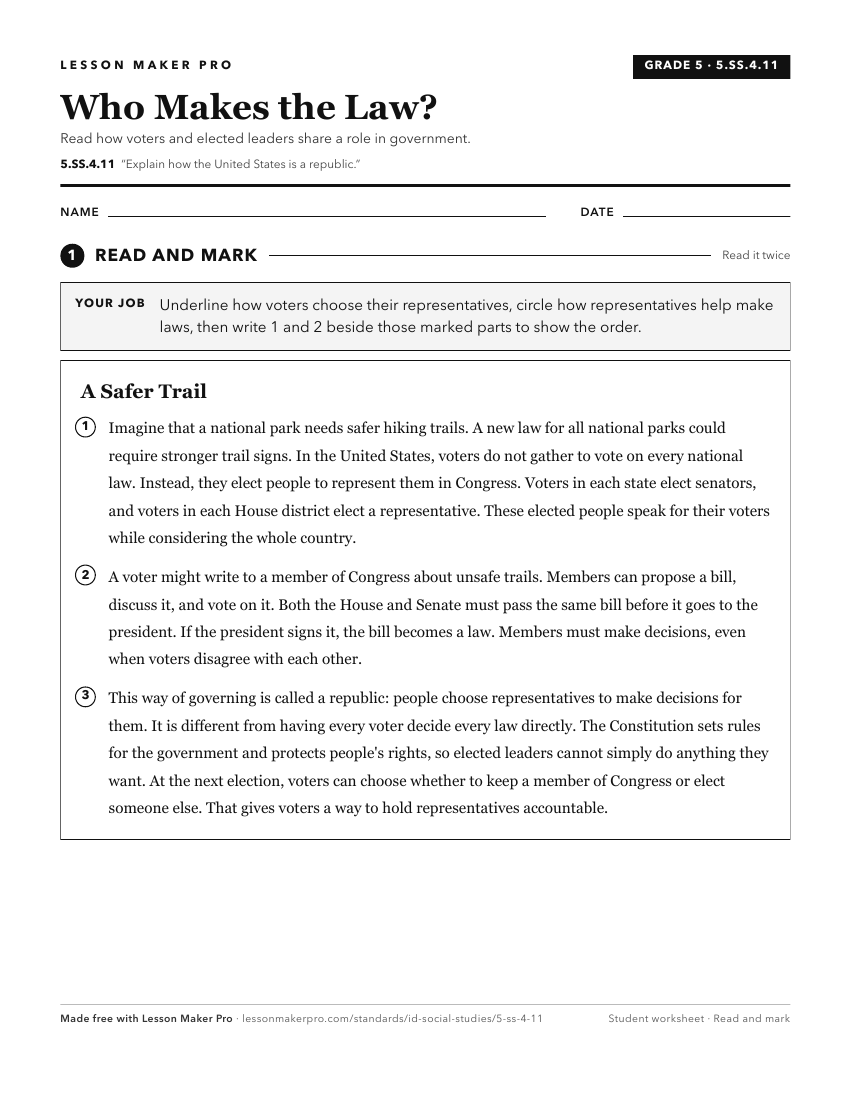
A ready-to-print activity worksheet aligned to 5.SS.4.11, with an answer key for the teacher on its own page. No account needed.
PDF, US Letter, prints cleanly in black and white.
Download the worksheetKeep exploring
Related Standards
- 5.SS.4.12
State the difference between direct democracy and the constitutional republic of today’s United States.
- 9-12.WC.49
Explain how the American republic emerged from the traditions of the West.
- 9-12.GOV.10
Define the concepts of democracy and republic and examine the relationship between the two.
- 9-12.WC.8
Describe the government of the Roman Republic and its contribution to the development of modern democratic principles including, but not limited to separation o...
Turn this exact standard into a lesson
Grade, subject, topic, and the complete standard are prefilled. Create one free, no account needed.
Also for this standard:Make a WorksheetMake a QuizMake a Sub Lesson