Georgia SS5H6.b
The Standard
- SS5H6
- Describe the importance of key people, events, and developments between 1950-1975.
Explain the key events and people of the Civil Rights movement: Brown v. Board of Education (1954), Montgomery Bus Boycott, the March on Washington, Civil Rights Act, Voting Rights Act, and civil rights activities of Thurgood Marshall, Lyndon B. Johnson, Cesar Chavez, Rosa Parks, and Martin Luther King, Jr.
Georgia Standards of Excellence for Social Studies · Describe the importance of key people, events, and developments between 1950-1975.
Teacher's field guide
What This Standard Means
What Students Need to Do
- Students place major civil rights events from 1954 to 1965 in order. They explain what each person did and connect protests, court rulings, and federal laws through cause and effect. They also recognize Cesar Chavez’s work for farmworker rights as part of the broader struggle for equality.
What Mastery Looks Like
- A student can build an accurate timeline and match Marshall, Parks, King, Johnson, and Chavez to specific actions. The student can explain how legal challenges and public protests built pressure for new federal laws. The explanation distinguishes ending legal segregation from protecting voting access.
Common Misconceptions
- Students may think Brown immediately integrated every school, or that Rosa Parks acted without planning or support from local organizers. They often confuse the Civil Rights Act with the Voting Rights Act. Some credit only King, overlooking Marshall’s legal work, Johnson’s support for federal laws, and Chavez’s farmworker campaigns.
How to Assess It
- Exit ticket: Choose two major events or laws from the lesson. For each, write its place in the timeline, one connected person, and one effect.
Lesson moves
Ways to Teach It
Give pairs event, person, and law cards to arrange on a desk timeline, then connect causes and effects with labeled yarn.
Write: Which had greater immediate power, a court ruling, a protest, or a federal law, and what evidence supports your choice?
Play a matching relay where teams pair each leader with an action, then earn the point only after explaining the connection.
Examine a current voter registration form and identify which listed requirements are ordinary procedures and which would be unfair barriers.
Free download
Printable SS5H6.b Worksheet
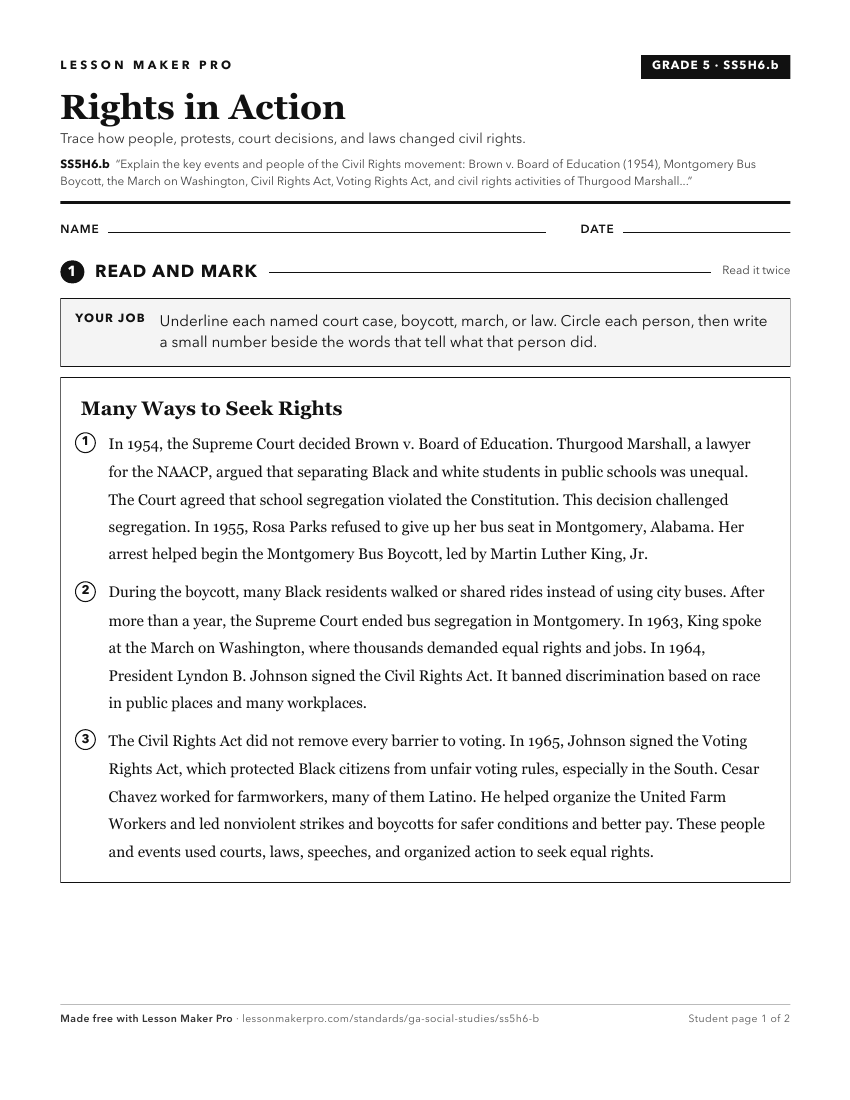
A ready-to-print activity worksheet aligned to SS5H6.b, with an answer key for the teacher on its own page. No account needed.
PDF, US Letter, prints cleanly in black and white.
Download the worksheetKeep exploring
Related Standards
- SS8H11.c
Explain the resistance to the 1964 Civil Rights Act, emphasizing the role of Lester Maddox.
- SS8H5.a
Explain the importance of key issues and events that led to the Civil War; include slavery, states' rights, nullification, Compromise of 1850 and the Georgia Pl...
- SS8H11.b
Describe the role of individuals (Martin Luther King, Jr. and John Lewis), groups (SNCC and SCLC) and events (Albany Movement and March on Washington) in the Ci...
- SS8H7.b
Analyze how rights were denied to African Americans or Blacks through Jim Crow laws, Plessy v. Ferguson, disenfranchisement, and racial violence, including the ...
Turn this exact standard into a lesson
Grade, subject, topic, and the complete standard are prefilled. Create one free, no account needed.
Also for this standard:Make a WorksheetMake a QuizMake a Sub Lesson